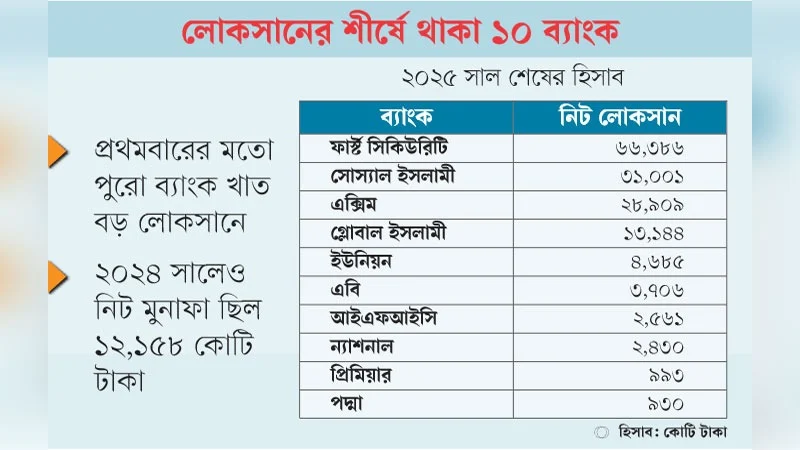
The financial distress in Bangladesh’s banking sector has spread to all major indicators, and even the strong profits posted by a few banks failed to hold up the wider picture. For the first time, the sector as a whole booked a large loss. In 2025, the net loss across the banking sector reached 1 lakh 36,666 crore taka. A year earlier, in 2024, net profit stood at 12,158 crore taka, and the sector had recorded a profit every year before that. The picture emerged in Bangladesh Bank’s annual financial stability report for 2025.
According to Bangladesh Bank data, net interest income in the banking sector was negative 12,537 crore taka in 2025. That means the amount earned from interest fell short of the interest paid out to depositors. A year earlier, net interest income was a positive 29,391 crore taka. Non-interest income, however, rose from 63,861 crore taka in 2024 to 83,171 crore taka. Operating expenses, including salaries and allowances, came to 51,663 crore taka last year, up from 48,993 crore taka the year before. In all, the banking sector’s pre-tax loss was 1 lakh 24,284 crore taka, and the net loss stood at 1 lakh 36,666 crore taka.
The financial stability report did not give bank-by-bank profit and loss figures. But the government’s “Activities and Data of Banks and Financial Institutions” booklet, published alongside the national budget, provided all indicators for each bank. By that account, the 10 banks with the largest net losses lost 1 lakh 54,745 crore taka. The merged banks were at the top of that list.
Last year, First Security Islami Bank recorded a net loss of 66,386 crore taka. Social Islami Bank lost 31,000 crore taka, EXIM Bank 28,909 crore, Global Islami Bank 13,144 crore and Union Bank 4,685 crore taka. The next-largest losses were at AB Bank with 3,706 crore taka, IFIC with 2,561 crore, National with 2,430 crore, Premier with 993 crore and Padma Bank with 930 crore taka.
Even amid the severe distress, a few banks posted record profits. BRAC Bank topped that list, with a net profit of 1,581 crore taka last year. City Bank made 1,306 crore taka, Pubali Bank 1,079 crore, Eastern Bank 910 crore and Prime Bank 890 crore taka in profit. Of the 36 banks listed on the stock market, 16 were able to pay dividends last year.
Arif Hossain Khan, spokesman and executive director of Bangladesh Bank, said several measures had been taken to ease the distress in the banking sector. A 60,000 crore taka stimulus package was provided to revive the economy, including restarting closed factories. If the loans are disbursed properly, recovery will improve and the banking sector’s situation will turn around quickly, he said. People familiar with the matter said loans were routinely shown in good standing through various means during the Awami League government. After the interim government took charge in August 2024 and began bringing the true scale of defaulted loans to light, the picture of the entire sector emerged. Defaulted loans rose to 35.73 percent at the end of September last year. Because of special rescheduling, they fell by 87,298 crore taka over the last three months to 5 lakh 57,217 crore taka in December, or 30.60 percent of total loans. The deterioration in the wider sector surfaced largely as hidden defaulted loans came to light and distressed loans rose sharply. More than 1 lakh 70,000 crore taka in loans were rescheduled last year, a record. Even so, distressed loans in the banking sector rose to 10 lakh 87,590 crore taka, or 59.73 percent of total loans. A year earlier, distressed loans stood at 7 lakh 56,553 crore taka.
According to the report, the sharp rise in defaulted loans pushed the banking sector’s overall capital adequacy into negative territory for the first time. Banks are required to hold capital equal to 12.5 percent of their total risk-weighted loans. By the end of last year, that had fallen to negative 2.64 percent. At the end of the previous year, capital was also far below requirement but stood at a positive 3.08 percent. The shortfall was driven mainly by a 2 lakh 78,000 crore taka deficit at 20 banks, which created the situation across the sector.
To strengthen the financial base of the distressed banking sector, Bangladesh Bank has tightened the rules on declaring dividends. Under last year’s directive, no bank with defaulted loans of 10 percent or more was allowed to pay a dividend for 2025. Banks running a shortfall in capital or provisioning were also barred from paying dividends regardless of their profit. Under that rule, only 16 of the 36 listed banks were able to pay dividends this time. For 2026, two new conditions have been added alongside those directives. This time, banks with paid-up capital below 2,000 crore taka will not be allowed to pay a cash dividend for 2026.
বাংলায় মূল প্রতিবেদন পড়ুন · Read the original Bengali report