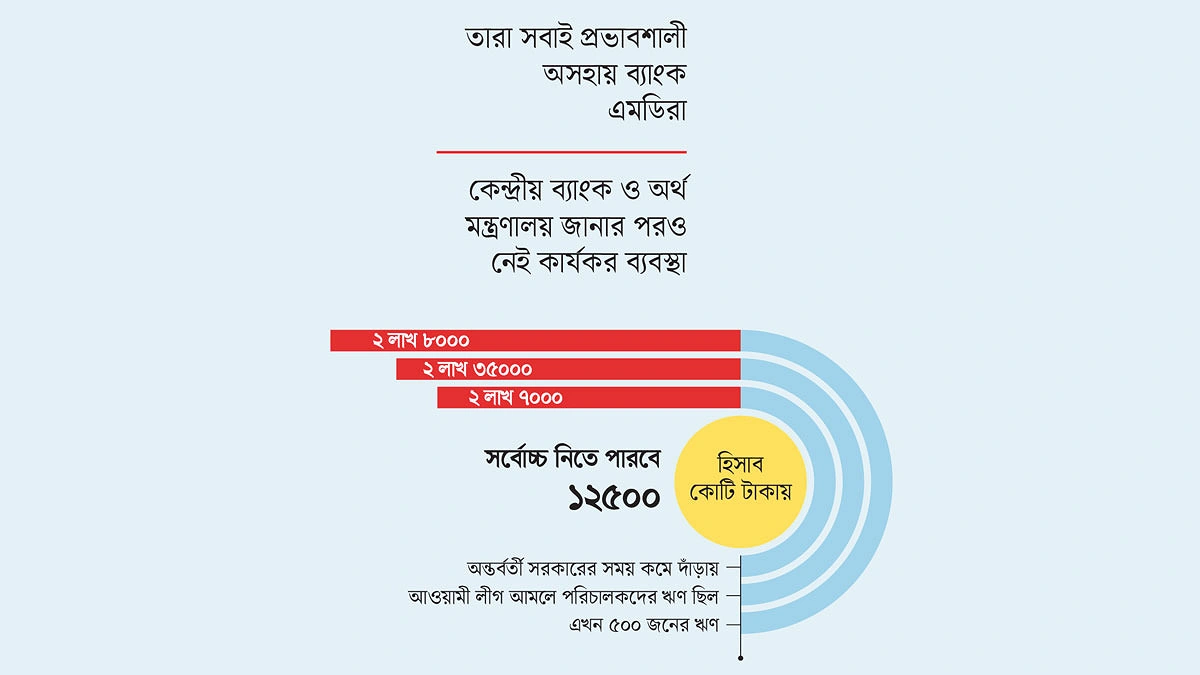
They are all directors of private banks. Quite influential. Roughly 500 of them. They pay little heed to regulations. Using their influence, they have collectively taken out loans worth 2.08 trillion taka. Some make occasional installment payments; many make none at all. Exploiting various loopholes in the law, they pay in token amounts just often enough to avoid being formally classified as defaulters, then borrow again, pushing the total higher still. Their influence has persisted under every government. It eased somewhat during the interim government’s tenure, but has since run unchecked again. Bank managing directors say they are powerless to stop it. Even the central bank and the finance ministry are aware of the situation, yet no effective action has been taken. What’s more, published government reports no longer include this loan data at all. These striking findings emerged from interviews with Bangladesh Bank officials and an analysis of directors’ loan records.
According to central bank rules, a director may hold between 2% and 10% of a bank’s shares. With most banks’ paid-up capital currently around 5 billion taka, that would cap a director’s shareholding at 500 million taka. The limit on loans a director can take from any bank is 50% of their own shareholding — meaning no director should be able to borrow more than 250 million taka. If the 500 directors across 42 private banks had borrowed at that legal maximum, the total would come to no more than 125 billion taka. Yet directors’ loans currently stand at 2.08 trillion taka — a figure experts describe as entirely illegal.
Experts say a significant number of directors have strategically taken large loans not only from their own bank but from other banks as well. The highest levels on record came during the Awami League era, when directors’ loans stood at 2.35 trillion taka as of June 2024. Under the interim government, that figure fell to 2.07 trillion taka by December 2025. But the trend reversed starting in June 2025, and by this past June, under the current government, directors’ loans at just 42 banks had climbed back to 2.08 trillion taka.
At least a dozen commercial bank managing directors gave broadly similar accounts, saying banks are unable to ensure accountability over how loans to directors are disbursed and used. These directors are businessmen who are themselves the banks’ sponsors. They borrow freely, default, then find ways to borrow again — a pattern that has become something of a “permanent culture,” persisting year after year despite being illegal. This is deeply damaging to the banking sector and the broader economy. The central bank is not adequately monitoring directors’ loans and defaults; despite the law, directors are not repaying, and executives, feeling they have no choice, keep approving directors’ loan requests. It suggests bank directors now wield more power than the country’s own laws. With so much credit concentrated in their hands, others are being crowded out of access to loans. The only real solution, they say, is political will.
Asked about the matter, Dr Saleuddin Ahmed, a former finance adviser to the interim government and former Bangladesh Bank governor, said: “Bank directors naturally carry influence. A lot of loans are tied up with them. The bank itself bears the primary responsibility for recovering this enormous volume of loans. Being a director doesn’t mean everything gets forgiven. A bank’s chief executive should not claim helplessness, but instead take it up with the bank’s chairman. If no solution is found there, they should seek recourse from Bangladesh Bank, which can find a way if it wants to — and then results will follow. Directors cannot simply exercise unchecked power in every situation.”
An examination of directors’ loans found that the banking sector’s troubles began in 2013, when at least nine banks received approval on political grounds. Most directors of these banks began exerting illegitimate influence over their institutions after the Awami League government took office in 2014. However, figures including S Alam, Salman F Rahman, Nazrul Islam Mazumder and Zainul Haque Sikder had already gained notoriety in the banking sector well before that. The 2017 forcible takeover of Islami Bank by S Alam raised fears of wholesale looting of the banking sector, after which bank directors more broadly grew increasingly reckless. One set of figures shows that directors’ loans stood at just 900 billion taka in 2016 — a figure that had climbed to 2.08 trillion taka a decade later, as of this past June.
According to the data, banks that have lent significant sums to their own directors include Pubali, United Commercial, Bank Asia, Shahjalal Islami, Dutch-Bangla, Prime, Dhaka Bank, Southeast, BRAC, City Bank, Eastern Bank, AB Bank, Standard Bank, Premier, and South Bangla Agriculture and Commerce (SBAC).
Banks that have lent to directors of other banks include Pubali, United Commercial, Shahjalal Islami, Dutch-Bangla, Prime, Dhaka Bank, Bank Asia, Southeast, BRAC, City Bank, Eastern Bank, and South Bangla Agriculture and Commerce.
Leaders of the Bangladesh Association of Banks (BAB), an organization of bank owners, recently met with Bangladesh Bank Governor Md Mostakur Rahman. During the meeting, the governor urged swift action on recovering defaulted loans and raised the issue of directors’ borrowing, instructing that banking governance rules be properly followed.
Asked about this, BAB chairman and Dhaka Bank Chairman Abdul Hai Sarkar said: “Bank management has changed now. Directors are doing what they can to help develop the banking sector. Loan management follows the rules. Loans are disbursed only after proper vetting under established procedures. There should be no issue with directors receiving loans in that context — there’s nothing wrong with getting a loan. That’s explicitly provided for under the Bank Company Act.”
Dr Mostafa K Mujeri, a former chief economist at Bangladesh Bank, said: “Bank directors can take loans when needed. Like any ordinary customer, they should take loans against proper terms and collateral. Banks should adhere to lending standards and should not grant any special favors. If loans continue to be disbursed through special collusion or backroom deals rather than following the rules, the same kind of crisis as before will emerge — and in fact, it still persists. Public trust in banks has eroded. It’s time to move away from this kind of malpractice, because certain identified groups have siphoned money out of banks and remain bank owners themselves. It’s the regulator’s responsibility to act on whatever bank inspections reveal.”
Bangladesh Bank spokesperson and Executive Director Arif Hossain Khan said: “Bank directors can take loans when necessary, but there’s no scope to exceed the limit. How did such enormous sums end up with these owners? It should be examined whether they’re even allowed to hold this much money under the rules. And defaulters aren’t supposed to remain directors in the first place. Why aren’t banks taking action? How long can this go on? This needs to be resolved.”
Nazma Mobarek, secretary of the Finance Ministry’s Financial Institutions Division (FID), said: “Bangladesh Bank is essentially the regulator for all banks — meaning bank governance, oversight and directors’ loans all fall under its purview. We don’t oversee private bank directors’ loans; that data doesn’t come to us. But if Bangladesh Bank wants, we would direct that action be taken in accordance with the law.”
বাংলায় মূল প্রতিবেদন পড়ুন · Read the original Bengali report