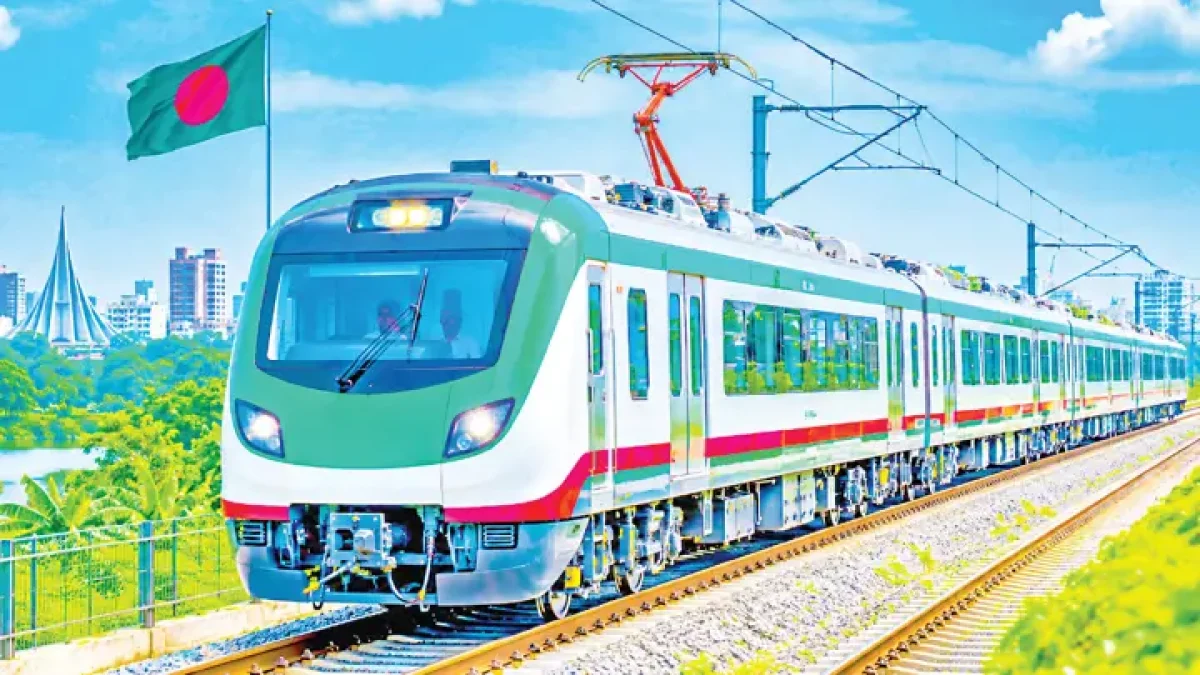
Rail transport has evolved worldwide for more than a century and a half, from steam to diesel and then electricity. Bangladesh is now joining that shift with its first electric train initiative on the Dhaka, Narayanganj and Joydebpur route. The Executive Committee of the National Economic Council approved the project on Sept. 16.
Most Bangladesh Railway trains currently use diesel locomotives. The move to electric traction aims to reduce diesel dependence, increase capacity, lower fuel and maintenance costs and reduce pollution. The government estimates that electric trains on the Narayanganj-Dhaka-Joydebpur corridor could cut fuel costs by about 40% and raise average speeds by 18% to 20%. The corridor links densely populated and industrial areas in Dhaka, Narayanganj and Gazipur and carries large numbers of passengers. Greater rail capacity could also ease pressure on roads.
Electric lines will use special overhead wires. A roof-mounted pantograph will collect electricity from the wires to power the train’s motors and other systems. Electric multiple-unit trains, or EMUs, can place motors and equipment across several coaches instead of relying on a separate heavy locomotive, allowing faster acceleration and efficient operation on urban and suburban routes with frequent stops.
Electric passenger and freight trains operate widely in Switzerland, France, Germany, Italy, Spain, the United Kingdom and other European countries. China, India, Japan and South Korea also have extensive electric rail systems, including Japan’s Shinkansen and China’s high-speed network.
The first phase in Bangladesh will electrify 52.32 kilometers of track between Narayanganj, Dhaka and Joydebpur. It will include overhead wires, power supply systems, EMU trains and maintenance facilities. Bangladesh Railway has also studied possible future electrification on additional routes involving Narayanganj, Dhaka, Chattogram, Tongi and Joydebpur.
Electric motors accelerate quickly, making EMUs effective on routes with frequent station stops. Project data indicate average train speeds could rise by 18% to 20% while fuel costs could fall by about 40%.
Electric trains do not directly emit diesel smoke or exhaust while operating, although their overall environmental benefit depends on how the electricity is generated. The project aims to reduce diesel use, air pollution and greenhouse gas emissions while improving rail energy efficiency.
Electrification requires more than buying trains. It needs reliable power, substations, overhead wires, coordinated signaling and safety systems, and skilled personnel to maintain EMUs. The project therefore represents a major technological change in Bangladesh’s rail infrastructure and operations.
Electric rail began with a demonstration in Berlin in 1879 and is now established across China, India, Japan and Europe. Bangladesh’s formal transition will begin on the Narayanganj-Dhaka-Joydebpur corridor. Its success will depend on power supply, infrastructure, skilled workers, maintenance and long-term planning, but ECNEC approval has opened the door to a shift from diesel to electric rail.
বাংলায় মূল প্রতিবেদন পড়ুন · Read the original Bengali report