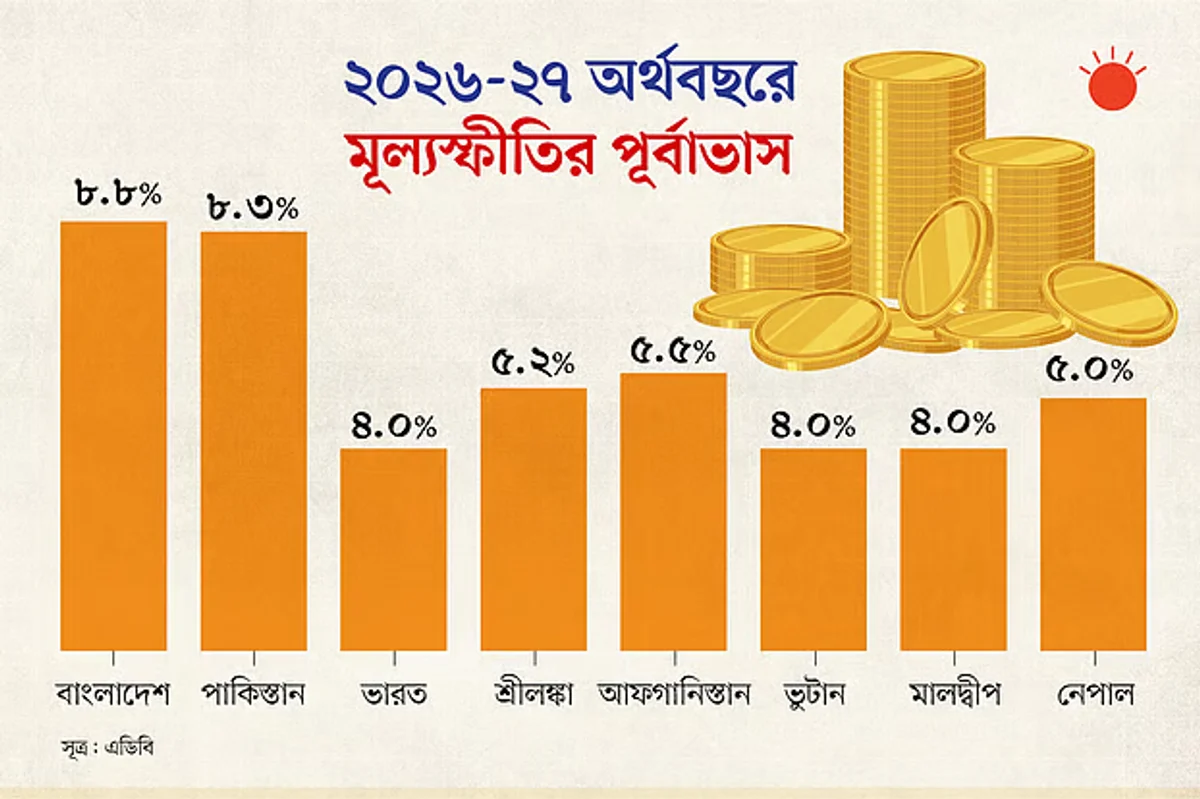
Bangladesh will again have the highest average inflation among South Asian countries this fiscal year, according to a forecast by the Asian Development Bank (ADB). The bank says the country’s average inflation could reach 8.8 percent this year – the highest in South Asia.
The projection appears in the July edition of the ADB’s Asian Development Outlook. Among the forecasts for South Asian countries including India, Pakistan and Sri Lanka, Bangladesh has the highest projected inflation. Recent adjustments to petroleum, gas and electricity prices will keep feeding into the cost of transport, services and other consumer goods, the ADB says, slowing the pace at which inflation eases.
Inflation in Bangladesh has stayed above 9 percent for three straight months. According to the latest figures from the Bangladesh Bureau of Statistics (BBS), inflation eased to 9.16 percent in June, from 9.42 percent in May – the highest in 16 months, that is, since February 2025. High inflation has persisted in the country for four years running; after the start of the Ukraine war, inflation rose in India, Sri Lanka, Pakistan and elsewhere, but while those countries later brought it under control, Bangladesh could not.
Rising prices hit limited- and middle-income people hardest. In June, inflation was 9.16 percent while the national average wage rate was 8.18 percent – meaning wages rose less than prices, eroding real incomes and forcing many households to borrow or cut back on food, clothing and transport.
By the ADB’s forecast for the 2026-27 fiscal year, Pakistan would have the next-highest inflation after Bangladesh, at 8.3 percent, followed by Afghanistan at 5.5 percent and Sri Lanka at 5.2 percent. India, Bhutan and the Maldives are projected at 4 percent and Nepal at 5 percent. Around 2023, inflation had climbed to 73 percent in Sri Lanka and 51 percent in Pakistan, but both countries succeeded in bringing it under control through a range of effective measures.
Explaining why Bangladesh’s average could reach 8.8 percent, the ADB report says the second-round effects of higher energy and transport costs, the impact of exchange-rate adjustments, and continued inflation in food and services will slow the decline. High inflation is reducing people’s real purchasing power and limiting private consumption, it says, while weak exports and only moderate import growth point to soft external demand and stagnant private investment. Export-oriented manufacturing will remain under pressure from high energy prices, weak foreign demand and structural constraints, and agriculture could be at risk from a fertilizer shortage – though remittance-driven household income will provide some support to growth in the service sector.
বাংলায় মূল প্রতিবেদন পড়ুন · Read the original Bengali report