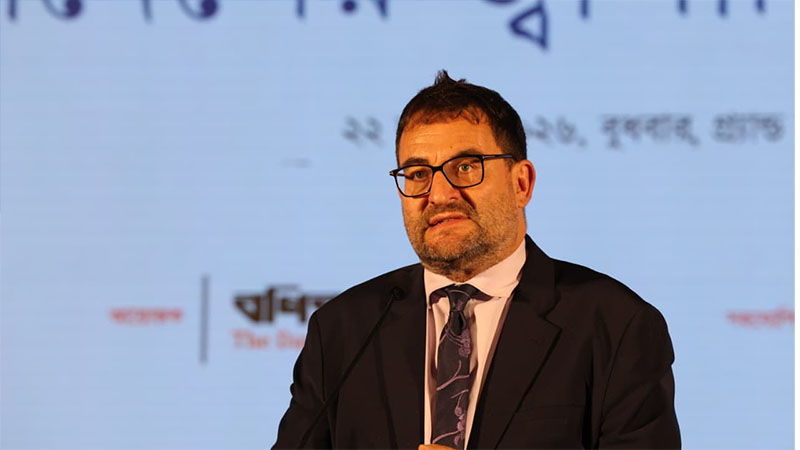
Bangladesh is under significant fiscal pressure because of excessive dependence on imported fuel and a large gap between production costs and the tariff structure, said Jean Pesme, the World Bank’s country director for Bangladesh and Bhutan. Escaping this situation requires short-term stability alongside long-term structural reform, expansion of renewable energy and an emphasis on regional energy trade, he said.
He was speaking on Wednesday, July 22, at a policy conclave on “Bangladesh’s energy security and transition” in the Grand Ballroom of the Pan Pacific Sonargaon in the capital, organised by Bonik Barta.
Jean Pesme said energy is not merely a sectoral priority; it is one of the foundations of private investment, economic growth, job creation, competitiveness and revenue sustainability. Bangladesh has achieved notable success in delivering electricity to all, but the sector still faces major challenges. The recent situation in the Middle East reminds us how deep the internal vulnerabilities are and how quickly effective steps are needed, he said — one main reason being excessive dependence on imported fuel and the growing gap between the cost of energy supply and consumer-level tariffs.
Setting out the import figures, he said 30 percent of the country’s gas demand, 95 percent of oil and 90 percent of coal are met through imports. Price volatility in global markets and supply-chain disruption have a direct negative effect on the country’s macroeconomy. But the problem is not limited to import dependence; it is also linked to falling domestic gas production and to old, costly obligations under power-generation contracts. This is creating major pressure on revenue and increasing financial vulnerability, so steps are needed now to help the sector adapt to changed circumstances while restoring confidence, reducing fiscal risk and clearing the way for the reforms needed to increase private investment.
He said the World Bank has set four priorities for tackling the crisis: first, energy-sector and tariff reform to ensure financial stability; second, diversifying energy sources, expanding renewable energy and strengthening regional energy trade; third, building green infrastructure and increasing the resilience of the energy system; and fourth, strengthening the gas value chain by increasing private investment.
Stressing the importance of tariff reform, Jean Pesme said energy subsidies are currently putting major pressure on the macroeconomy and public finances, creating the risk that spending on public-welfare sectors such as education and health will be squeezed. “By our calculation, these subsidies amount to about 1.1 percent of GDP,” he said, adding that a credible, phased tariff-reform framework is needed that takes account of the social impact of tariff adjustment and protects the most vulnerable.
On renewable energy he said diversifying sources is necessary for energy security. Importing hydropower from Bhutan and Nepal can provide comparatively low-cost clean energy, while initiatives to build gigawatt-scale solar parks on government-owned land could be expanded further — particularly using land owned by national special economic zones, deep-sea ports, economic zones or the railway. International experience shows that large solar projects can be implemented in a very short time given the right policy direction, investment-friendly tariffs and effective implementation arrangements, he said, citing Vietnam as a successful example.
বাংলায় মূল প্রতিবেদন পড়ুন · Read the original Bengali report