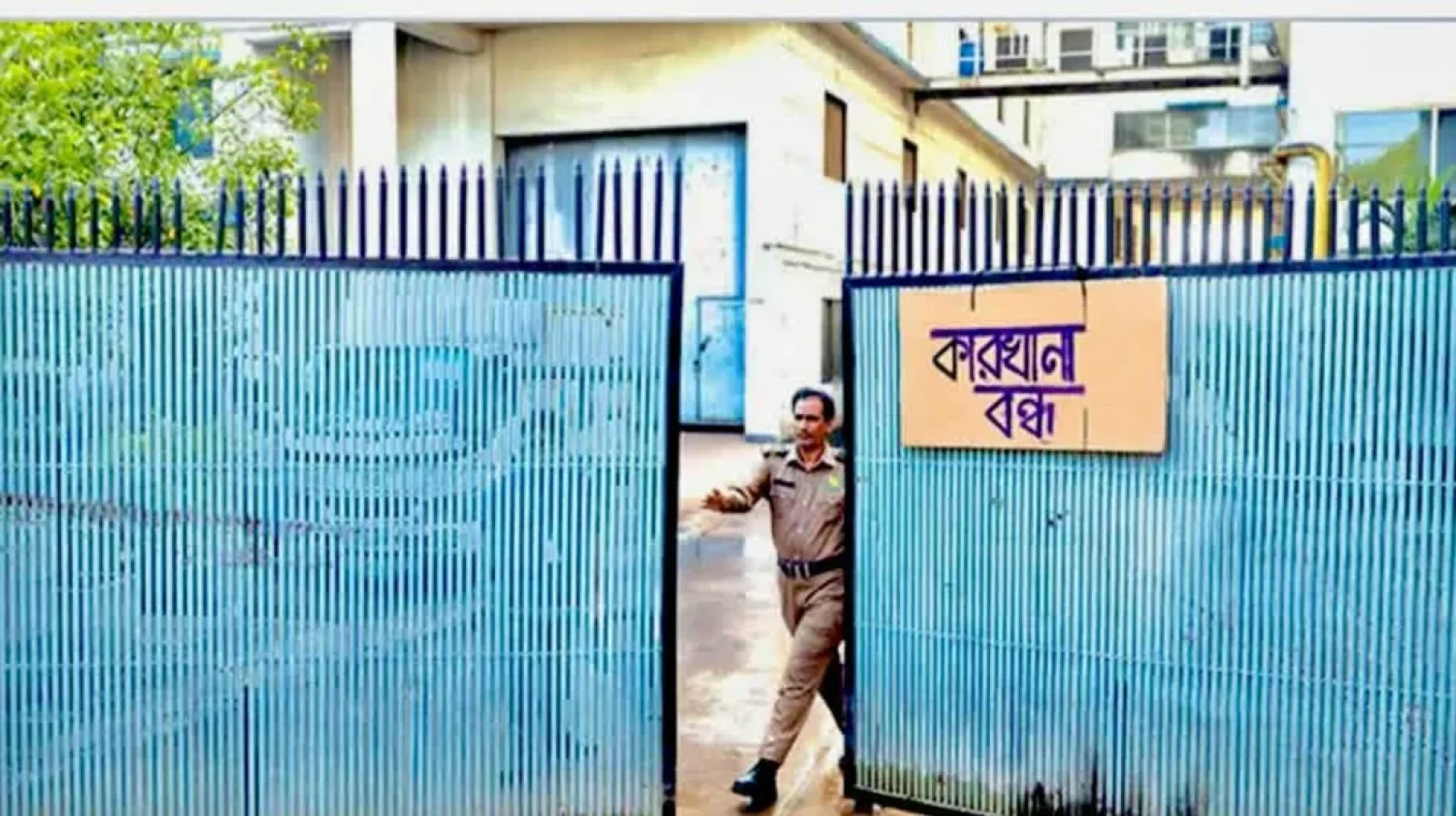
Two different kinds of notices are now appearing on factory gates across Bangladesh’s industrial zones. One reads: permanently closed. The other reads: on leave until further notice. From the outside, the two decisions may look similar, but they don’t mean the same thing. The first means a lost job; the second means a job hanging on in uncertainty. But amid a prolonged gas and electricity crisis, falling purchase orders, financial distress, labor unrest and mounting loan pressure, both realities are now playing out side by side across the industrial sector.
An analysis of data from Industrial Police, BGMEA, BKMEA and media reports, as of Friday, August 21, shows that in recent months, factories have shut down permanently on one hand, while hundreds of others have cut production or temporarily suspended operations on the other. Alongside this, layoffs and a shrinking workforce are under way. That raises the question: how many factories have actually closed so far?
There is no single answer. That’s because government and industry-association records don’t always keep permanent closures, indefinite closures, closures under special provisions of the labor law, temporary production suspensions and layoffs in the same list. Understanding the real picture therefore requires looking at at least four separate sets of figures.
27 factories closed in six months, nearly 20,000 workers lose jobs
An analysis of data from the first six months of 2026 shows that at least 80 BGMEA member factories laid off or dismissed about 19,188 workers. Of these, 27 factories closed altogether, according to an analysis published based on data from Industrial Police, BGMEA and BKMEA.
That is a worrying figure for the garment sector, since large export-oriented factories as well as small and medium-sized ones have been fighting to survive during the same period. In some places there are no purchase orders; in others, there is a shortage of bank credit and cash; elsewhere, there are disputes over unpaid wages; and in still other cases, production is being disrupted by gas and electricity shortages.
However, although data on 27 factory closures is available, a full, named list of these 27 has not been publicly released.
95 factories shut in three industrial zones in just seven months
An even bigger picture emerges from zone-based data. In Gazipur, Savar-Ashulia and Narayanganj-Narsingdi, 95 factories closed permanently over the past seven months. These factories employed about 61,881 workers and staff. According to Industrial Police data, 54 factories closed in Gazipur, 23 in the Narayanganj-Narsingdi area, and 18 ready-made garment factories in the Savar-Ashulia-Dhamrai area.
Almost all of the 54 closed factories in Gazipur are in the ready-made garment and textile sector. In that district alone, about 45,732 workers and staff lost their jobs at the closed factories. A large number of these job losses stemmed from the closure of factories at the Beximco Industrial Park.
One point is worth stressing here: the six-month figure of 27 closed factories and the seven-month, zone-based figure of 95 closed factories do not come from the same source or cover the same scope. So it would be incorrect to add the two numbers together and say “122 factories have closed.” Rather, these are two separate statistics reflecting the crisis in Bangladesh’s industrial sector.
Names of some closed factories
Public data and Industrial Police citations have identified the names of several factories that have closed recently.
Gazipur: Notable closed factories in Gazipur include TMS Apparels, Niagara Textile, Mahmud Jeans, Hardy Two Excel, Polycon Limited, Apparel Plus, Mahmud Jeans Apparels, TRZ and The Delta Knit. According to Industrial Police data, a total of 54 factories closed in Gazipur over the past seven months.
Savar-Ashulia-Dhamrai: Among the 18 ready-made garment factories that closed permanently in this area over the past seven months, notable names include Generation Next Fashion, Best One Sweater, MS Sweater, Savar Sportswear, Barda Group, Rams Fashion and Embroidery, Priyanka Fashion and Zavan Tex Knitwear. These closures left at least 10,127 workers and staff without jobs in the area.
Narayanganj-Narsingdi: Notable closed factories in this area include Green Bangla Home Tex Industries, Asian Falcon Garments, GL Fashion, Master Textile, West Best Attires and Star Cutting and Engineering.
Industrial Police said most of the closed factories in this area are small and medium-sized enterprises, with financial distress and a lack of sufficient purchase orders cited as the main causes.
Two factories permanently closed in Gazipur
The clearest and most verified case of permanent closure in recent times occurred at Boardbazar in Gazipur. Unique Washing and Dyeing Limited and Unique Designers Limited, which had been shut since June 16, decided to permanently cease operations. Industrial Police said the two factories were closed because of financial distress and other problems.
The closure of the two factories left about 1,800 workers facing employment uncertainty. A settlement was later reached at a tripartite meeting over payment of workers’ outstanding wages, service benefits and other legal dues.
Two factories in Ashulia closed indefinitely
On April 1, two garment factories in Ashulia, Fashion Forum Limited and JA Apparels, were declared closed indefinitely. Workers alleged that closure notices were posted on the factory gates following recent labor unrest, and that their wages, allowances and other dues had not been paid. Between the two factories, about 4,000 workers were left in uncertainty. However, since it is not confirmed whether these factories have since reopened, they cannot be included in a final list of permanently closed factories.
Five Lithi Group factories closed at once
In early July, five garment factories belonging to Lithi Group in Gazipur were simultaneously declared closed indefinitely, leaving about 2,500 workers without jobs. The episode showed that labor unrest or financial distress isn’t only a single-factory problem; multiple factories belonging to one industrial group can also shut down together. Whether these factories have since reopened after being declared indefinitely closed also needs to be verified separately from the permanent-closure figures.
Islam Garments also closed indefinitely
Islam Garments in Gazipur was declared closed indefinitely following labor unrest. This kind of episode highlights another vulnerability in the garment industry: if disputes over wages, service benefits or other labor issues aren’t resolved quickly, they can escalate into a production shutdown.
457 industrial units closed in two years
An even larger, two-year figure illustrates the depth of the crisis in the industrial sector. From August 2024 to June 2026, 457 industrial units closed permanently across the country’s seven major industrial zones. These included 108 BGMEA member factories, 35 BKMEA member factories, eight BTMA member factories and 19 factories linked to BEPZA. In other words, a significant number of the closed establishments are tied to the garment, knitwear, textile and export-oriented industries. The remaining 287 were non-garment industries.
This data points to falling purchase orders, owners’ financial distress, labor instability and the energy crisis as the main reasons for the closures. However, industry insiders also cite complications with bank loans, raw-material shortages, factory relocations, falling global demand and geopolitical uncertainty.
The new crisis: no gas, so no production
Beyond the list of permanently closed factories, a new crisis has now emerged in the industrial sector: production halted or curtailed because of gas and electricity shortages. In early August, a prolonged gas crisis in Gazipur forced about 17 to 20 percent of industrial factories to halt production or declare leave for three to four days. Various sources put the number of affected factories at 700 to 800.
Many factories effectively suspended production by combining extra leave with government holidays, sending thousands of workers home. This kind of factory leave cannot be called a permanent closure, but if the gas crisis continues over a long period, it could increase the risk of falling production, extended leave and, eventually, worker layoffs.
Most recently, in Mymensingh’s Bhaluka industrial zone, workers at 20 factories were sent on leave amid a severe gas crisis. Workers reported for their shifts Thursday morning, August 20, but with production disrupted, they were sent home in stages before lunchtime.
Md Ansar Uddin, superintendent of police for Industrial Police-5, said: “Because the gas crisis intensified from the morning, it wasn’t possible to run production at the factories. Production at the main factories in the industrial zone has fallen to an average of 50 percent. There’s some gas pressure around Bhaluka municipal area and the Titas office, but factories farther away have almost no gas at all.”
According to Industrial Police figures, 99 of the 293 factories in the Mymensingh industrial zone run on gas. Nearly all of these gas-run factories are now in crisis. Although some are trying to keep limited production going using generators and electricity, that is proving inadequate given the need. As a result, the production system across the industrial zone is being severely disrupted.
Mohammad Hatem, president of the Bangladesh Knitwear Manufacturers and Exporters Association (BKMEA), said: “To understand the real picture of factory closures, permanent closures, temporary leave and reduced production need to be looked at separately. Some factories have given a few days’ leave recently because of the gas and electricity crisis, but it wouldn’t be right to call that a permanent closure. Still, if the energy crisis continues for a long time, production will be disrupted, financial pressure on factories will rise, and employment could eventually come under threat.”
He said: “Because of the gas and electricity crisis, many factories are unable to produce at full capacity. Even with reduced production, they still have to bear workers’ wages, bank loan installments, gas and electricity bills and other fixed costs. On the other hand, using diesel, LPG or CNG as an alternative fuel raises production costs even further. Yet because prices are already fixed with international buyers in advance, it isn’t always possible to pass on this extra cost in the price of the goods.”
Hatem added: “Keeping factories running and protecting workers’ jobs is now the biggest challenge. If the energy crisis doesn’t normalize quickly, many financially weak and struggling factories will come under even greater pressure. So alongside ensuring uninterrupted gas and electricity supply to industry, financial support and policy initiatives are needed to help crisis-hit, partially or fully closed factories reopen.”
Is leave just leave, or the start of shrinking employment?
Some factory owners argue that there is no point keeping a factory open without gas. Workers still have to be paid even when idle, but without production, there is no sales or export income. On the other hand, switching to electricity-based alternative production raises costs. As a result, many factories are being forced to cut production. In some places, extra shifts are being canceled; in others, workers are being sent on leave; and in others still, new hiring has been frozen.
If this situation drags on, labor organizations and industry insiders fear that temporary leave could gradually turn into worker layoffs.
Four kinds of closure, four kinds of impact
Understanding the current situation requires looking at factories in at least four categories.
First, permanently closed factories. Here, workers’ jobs end outright, triggering a new crisis over unpaid wages, service benefits and compensation.
Second, indefinitely closed factories. Here, it isn’t always clear whether workers have lost their jobs. The factory may reopen, or it may end up permanently closed after a long shutdown.
Third, temporary production halts or leave. Because of a shortage of gas, electricity, raw materials or purchase orders, a factory may halt production for a few days or weeks. During this time, workers’ jobs may survive, but their income and future face uncertainty.
Fourth, worker layoffs. A factory may remain open while still cutting production and laying off workers. So looking only at the number of closed factories doesn’t give the full picture of the employment crisis.
Mohiuddin Rubel, a former BGMEA director and founder and chief executive of Bangladesh Apparel Voice, said: “If you look at the current gas and electricity crisis as just a temporary energy problem, you won’t understand how deep the situation really is. It’s gradually becoming a structural threat to the competitiveness of Bangladesh’s export industry and to employment.”
He said: “Factories that have already closed permanently faced a combination of causes behind their crisis — falling purchase orders, financial distress, pressure from bank loans and rising production costs. Now, with the gas and electricity crisis added on top, even operating factories can’t produce at full capacity. Many factories have changed their production schedules, combined extra leave with government holidays, or are running production on a limited scale. So while these can’t yet be called permanent closures, if the energy crisis continues over the long term, the risk of layoffs and factory closures will grow further.”
Rubel said: “There’s a fundamental difference between closing a factory for a few days and a factory shutting down permanently. But if production is disrupted for a long period, even this temporary shutdown can eventually turn into a financial crisis. Even without production, workers’ wages, bank loan interest, factory maintenance and other fixed costs don’t stop. And if goods can’t be delivered on schedule, it damages buyer confidence, which can also reduce future purchase orders.”
He added: “Bangladesh’s garment industry is now at a point where attracting new investment alone isn’t enough; protecting existing industry and existing employment is equally important. If uninterrupted gas and electricity supply can’t be ensured, small and medium-capacity factories will be at the greatest risk. And a single factory closing doesn’t just mean losing one business — it also hurts the families of thousands of workers, the local economy and the country’s export capacity.”
A factory closure means more than just a locked gate
A factory closing doesn’t just mean the owner’s business has ended. It also affects the families of thousands of workers — rent, children’s education, bank and NGO loans, local shops, and the surrounding small economy. When a factory closes in the industrial zones of Gazipur, Savar and Ashulia, its impact quickly spreads to nearby homes, shops, transport and local markets. And the biggest crisis arises when, even after losing their jobs, workers have to wait month after month to receive their outstanding wages and legal dues.
বাংলায় মূল প্রতিবেদন পড়ুন · Read the original Bengali report