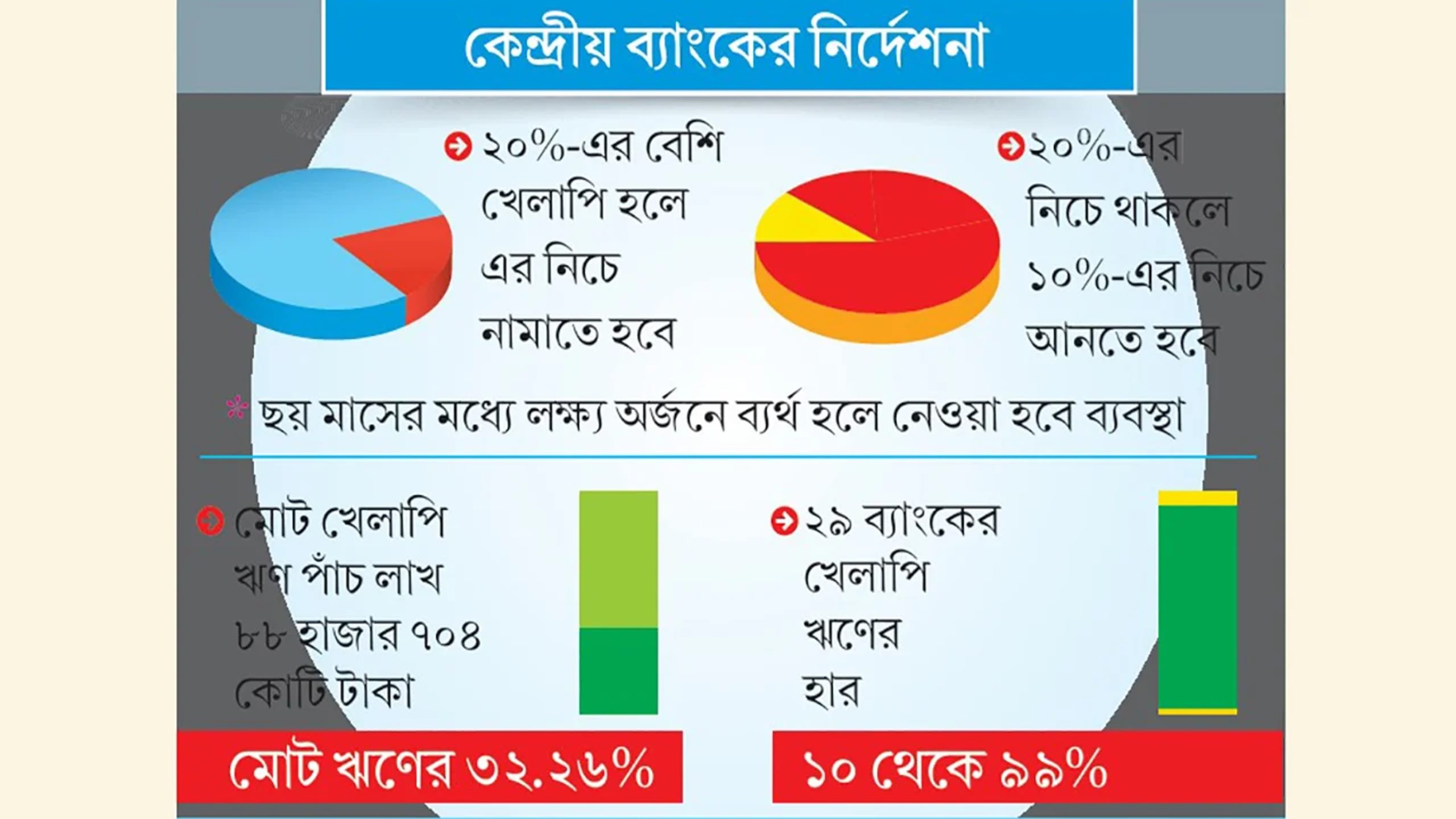
Bangladesh Bank has taken a tough stance to control defaulted loans in the country’s banking sector, setting separate targets for 29 banks at high risk of bad loans. Within the next six months, banks whose defaulted-loan ratio is above 20 percent must bring it below 20 percent, while those below 20 percent have been given an ultimatum to bring it below 10 percent. Banks that fail within this time must transfer their defaulted loans to an asset management company (AMC).
Bangladesh Bank governor Mostakur Rahman gave these directives in separate meetings with the managing directors (MDs) of the 29 banks from 12 to 19 July, with relevant central bank officials present. Several bank officials who attended said the governor was taking a tough line, because Bangladesh’s defaulted-loan ratio is much higher than in other countries. He made clear that bad loans must be reduced at any cost, and that banks failing to do so would have to hand the loans to an asset management company.
Banks were also told to prevent new defaults, regularly monitor rescheduled loans and take special steps to recover dues from large borrowers. The governor further directed that no dividends may be distributed by keeping toxic (bad) assets on the balance sheet and showing unrealised interest as income. Repeatedly rescheduled loans must be quickly settled through exit facilities, alternative dispute resolution (ADR) or legal process, and long-classified loans must be written off. Bad loans must be reduced within existing circulars, with no one-to-one circular to be issued. Emphasis was also placed on increasing new lending and raising capital to strengthen banks’ capital base. Officials said the governor warned of the maximum penalty for any bank irregularity and advised MDs to perform their duties free of political or other unethical pressure.
Asked about it, Janata Bank MD Mojibar Rahman said the governor had given strict directions to intensify bad-loan recovery, and that the central bank had provided various policy support and flexibility, with emphasis on quickly recovering unrealised loans and cleaning up balance sheets. He said the reach must extend not only to large loans but to the large number of customers in agriculture, rural and small and medium enterprise (SME) sectors. One managing director, who did not wish to be named, said that although MDs were sincere about recovery, boards of directors often did not cooperate, and the governor had been asked to meet board members.
At the end of March, 29 banks had defaulted-loan ratios above 10 percent. According to Bangladesh Bank data, the defaulted-loan ratio was 73.94 percent at Janata Bank, 50.58 percent at Islami Bank, 65.97 percent at Bangladesh Commerce Bank, 98.96 percent at Bank of Pakistan, 14.50 percent at Probashi Kallyan Bank, 84.48 percent at ICB Islamic Bank, 48.83 percent at Bangladesh Development Bank (BDBL), 40.72 percent at Rajshahi Krishi Unnayan Bank, 17.85 percent at Sonali Bank and 90.68 percent at Padma Bank. It was also 18.61 percent at SBAC Bank, 22.80 percent at Standard Bank, 67.40 percent at BASIC Bank, 35.62 percent at Premier Bank, 63.36 percent at IFIC Bank, 39.60 percent at Agrani Bank, 22.48 percent at NRBC Bank, 54 percent at AB Bank, 46.79 percent at Bangladesh Krishi Bank, 12.23 percent at One Bank, 15.96 percent at United Commercial Bank (UCB), 43.37 percent at Rupali Bank, 56.79 percent at National Bank, 17.78 percent at Al-Arafah Islami Bank, 68.58 percent at EXIM Bank, 96.79 percent at Union Bank, 97.39 percent at First Security Islami Bank, 79.54 percent at Social Islami Bank and 97.46 percent at Global Islami Bank.
According to Bangladesh Bank officials, reducing defaulted loans is now the biggest priority for restoring stability to the banking sector, which is why separate targets have been set for weak banks with a decision to monitor implementation strictly.
Defaulted loans in the banking sector are rising steadily. At the end of March last year, defaulted loans stood at 4,20,334 crore taka, or 24.13 percent of total disbursed loans. By the end of March this year, that had risen to 5,88,704 crore taka, or 32.26 percent of total loans. In the same period, the provisioning shortfall in the banking sector reached 2,05,000 crore taka.
With 32.26 percent of total disbursed loans defaulted at the end of March this year, Bangladesh now has the highest defaulted-loan ratio in South Asia. By comparison, India’s ratio has fallen from 3.4 percent to 2.20 percent. It is 4.5 percent in Bhutan, 5.6 percent in Nepal, 6.5 percent in Sri Lanka, 5.5 percent in the Maldives and 5.8 percent in Pakistan.
Bangladesh Bank officials say that during the previous Awami League government, huge sums were taken out of banks in real and benami names, now being identified as defaulted loans, and that the amount has risen further as loan-classification rules have been tightened to international standards. When the Awami government was formed in 2009, total defaulted loans in the country stood at 22,481 crore taka, rising steadily since. Economists allege that individuals close to and influential in the then government took huge sums out of banks through various irregularities, a large part of which was laundered abroad. It has emerged that, after the change of government, the real loan picture of banks freed from the control of the S Alam Group — a business group close to the Awami League and much criticised — has begun to surface, with the biggest rise in defaulted loans at Islami Bank. Defaulted loans have similarly risen at First Security Islami Bank, Global Islami Bank, Union Bank, Social Islami Bank and EXIM Bank; Bangladesh Bank has taken steps to merge these five banks. Defaulted loans have also risen at the state-sector Agrani and Janata banks and the private-sector IFIC, UCB, NRBC and NRB Commercial banks.
বাংলায় মূল প্রতিবেদন পড়ুন · Read the original Bengali report