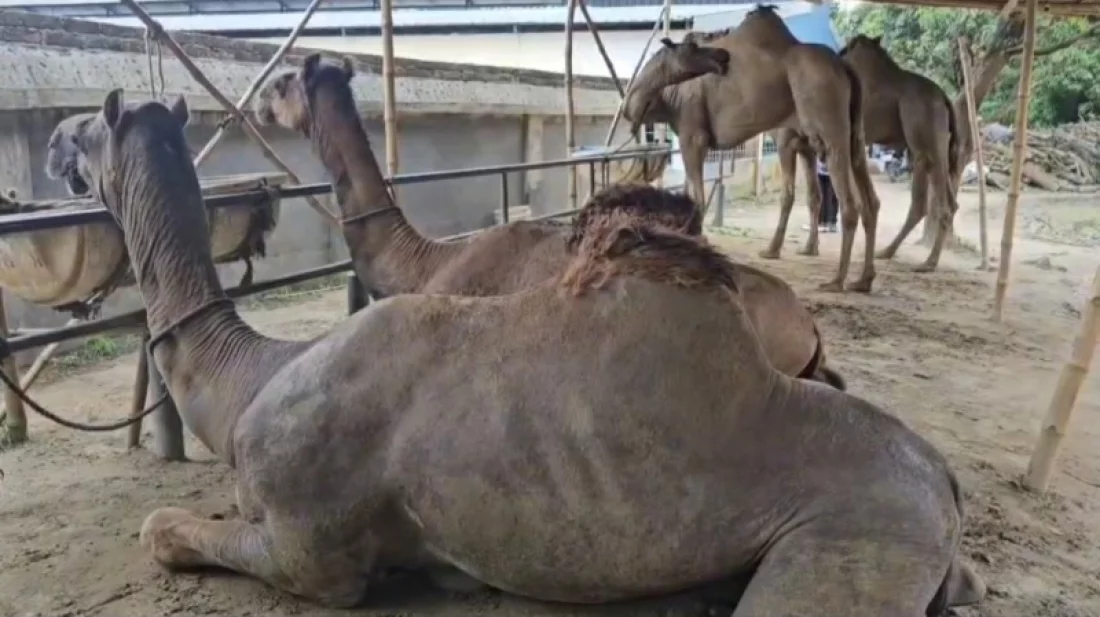
Bangladesh Bank has opened the door to agricultural loans for entrepreneurs interested in camel farming. The central bank’s new agricultural and rural credit policy has brought camel rearing under the umbrella of agricultural credit, meaning farmers and breeders who meet the required conditions will now be able to borrow from banks to raise camels.
At the same time, activities such as fish-fry production at hatcheries and duck and poultry chick production have also been brought under the agricultural credit program.
Bangladesh Bank has set a target of disbursing a total of Tk 600 billion in agricultural and rural credit for the current 2026-27 fiscal year, roughly 54 percent higher than the previous fiscal year’s target of Tk 390 billion.
Central bank Governor Md Mostakur Rahman announced the new “Agricultural and Rural Credit Policy and Program” Monday at the Jahangir Alam Conference Hall at Bangladesh Bank’s head office. The event was attended by deputy governors, executive directors, and other relevant central bank officials, as well as managing directors and senior executives from various state-owned and private banks.
Of the new target, Tk 204.95 billion has been allocated to state-owned commercial and specialized banks, and Tk 395.05 billion to private and foreign commercial banks.
Bank loans now available for camel farming
Bangladesh Bank has brought several new, promising sectors beyond conventional agricultural credit under its lending program this year, including camel farming. That means anyone wishing to raise camels commercially can now access agricultural credit from banks, subject to meeting the required rules and eligibility criteria.
Beyond camel farming, the policy also allows loans to individual or group farmers and breeders in the fisheries and livestock sectors. Fish-fry production at hatcheries and duck and poultry chick production have likewise been newly brought under agricultural credit.
As a result, the scope of agricultural credit will no longer be confined to rice, wheat, vegetables, or conventional farming, and financing opportunities will expand to cover livestock, fisheries, and new types of agriculture-based ventures.
Loans to become easier for farmers to access
To ensure credit reaches genuine farmers, Bangladesh Bank has also relaxed several rules this time. Farmers seeking a farmer’s card can now use certification from local agriculture extension officers, sub-assistant agriculture officers, fisheries officers, or livestock officers.
Directions have also been issued to extend rural credit to farmers engaged in crop production and other income-generating activities. The mandated limit on the number of members in a farmers’ group has also been relaxed.
The requirement to hold or issue a mandatory passbook to take out agricultural credit has also been eased somewhat, alongside a reduction, in certain specific cases, of the requirement to obtain Bangladesh Bank’s approval before disbursing loans.
Women and marginal farmers prioritized for loans up to Tk 500,000
For loans of up to Tk 500,000 in the fisheries and livestock sectors, the policy directs banks to prioritize women and marginal farmers. To make it easier for these farmers to access credit, the policy recommends using alternative forms of collateral instead of requiring land or immovable property as security.
Bangladesh Bank’s initiative is expected to expand access to bank credit for farmers and breeders who own little land but have the capacity to run agriculture-based businesses.
Why Tk 600 billion in loans
Bangladesh Bank says that ensuring an adequate flow of funds into the agricultural and rural sector will boost food production while also increasing rural employment and incomes. The credit program, it says, will also help control inflation by increasing the production and supply of agricultural goods.
To that end, the agricultural and rural credit target for the current fiscal year has been raised by roughly 54 percent over the previous year, to Tk 600 billion.
Refinancing and insurance benefits included
The new policy also includes provisions for refinancing funds of Tk 100 billion and Tk 30 billion, aimed at boosting banks’ capacity to disburse loans in the agricultural sector.
The policy also brings agricultural borrowers under insurance coverage to help address the risks of climate change, with the benefit to be extended based on mutual arrangements between banks and their customers.
To keep credit disbursement flowing in the agricultural sector throughout the year, the policy also aligns loan repayment deadlines for fruit cultivation, such as banana, papaya, mango, lemon, guava, and lychee, with each crop’s harvest season.
Bangladesh Bank’s goal with the new policy is to increase the flow of funds into the agricultural and rural sector to boost production, employment, and rural incomes. As part of that effort, the bank has now created lending opportunities for new ventures ranging from camel farming to fish-fry and poultry-chick production, alongside conventional agriculture.
বাংলায় মূল প্রতিবেদন পড়ুন · Read the original Bengali report