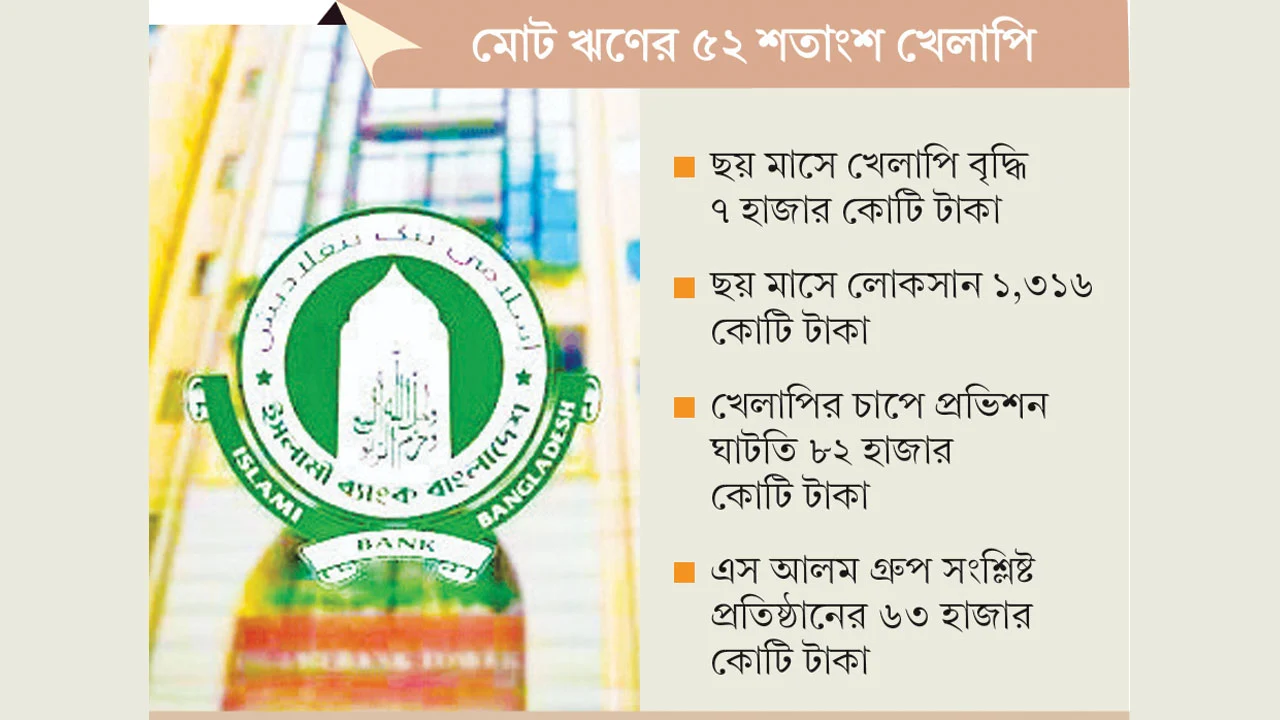
Islami Bank Bangladesh’s financial position has deteriorated further amid a renewed crisis of confidence and pressure from deposit withdrawals. The bank’s defaulted loans rose to nearly 990 billion taka by the end of June this year, equivalent to 52.14% of its total loans — now the highest default rate in the country’s banking sector.
Once known as one of the country’s strongest banks, a large share of Islami Bank’s defaulted loans belong to the S Alam Group and various entities directly or indirectly linked to it. During the period the group controlled the bank, large sums were lent under real and fictitious names, the true state of the loan portfolio was concealed, and the subsequent failure to recover these loans has now pushed the bank into a major financial crisis.
The bank’s provisioning shortfall has grown to more than 820 billion taka as a result of the heavy default load, with an effective capital shortfall of around 900 billion taka. At the same time, the bank posted a net loss of about 13.16 billion taka in the first six months of this year. Those familiar with the matter say the bank’s financial pressures are likely to intensify further amid a liquidity crisis, shrinking business and falling income.
A review of the bank’s financial data shows that its defaulted loans stood at just 77.24 billion taka, or 4.42% of total loans, as of June 2024. But after the political change of government that year prompted a push to verify the bank’s true loan portfolio, defaulted loans began rising rapidly.
By the end of September 2024, defaulted loans had risen to 177.52 billion taka, or 10.83% of total loans. By the end of December that year, the figure had climbed further to 328.17 billion taka, or 21%.
By the end of March 2025, defaulted loans stood at 476.18 billion taka, or 27.38%. In just three months, by the end of June, that figure jumped to 1,027.49 billion taka, with 56.57% of the bank’s total loans now in default.
Defaulted loans rose further still, reaching 1,062.75 billion taka, or 58.24%, by the end of September 2025. With the help of various regulatory relief measures and loan rescheduling, defaulted loans then fell to 921.15 billion taka by the end of December.
Industry sources say banks typically focus heavily on loan recovery in the final quarter of the year, while relief measures and rescheduling also allow some loans to be reclassified as regular. This is why defaulted loans typically show a temporary decline at year-end.
But defaulted loans began rising again in the March quarter of this year, reaching 956.29 billion taka by the end of March. By the end of June, the figure had risen a further 32.86 billion taka, to 989.15 billion taka.
Bank officials say defaulted loans have proven difficult to bring down because of the true scale of past questionable large loans coming to light, previously rescheduled loans falling back into default, and slow loan recovery. Combined with a fresh liquidity and confidence crisis, they say, this is also hurting the bank’s normal business operations.
Jamal Uddin Mazumder, additional managing director of Islami Bank, said the rise in defaulted loans is now being driven mainly by borrowers’ payment behavior. He said many customers, for various reasons, are unable to pay installments on schedule as required, and that under the rules, a loan is classified as defaulted once one or more installments fall overdue.
He said loans that had previously been brought current through rescheduling or other arrangements are falling back into default when their scheduled installments are not paid on time. He said Bangladesh Bank’s policy support has helped reduce the default status of many loans, but that relief cannot be extended to some borrowers who have been unable to meet the central bank’s specified conditions.
বাংলায় মূল প্রতিবেদন পড়ুন · Read the original Bengali report