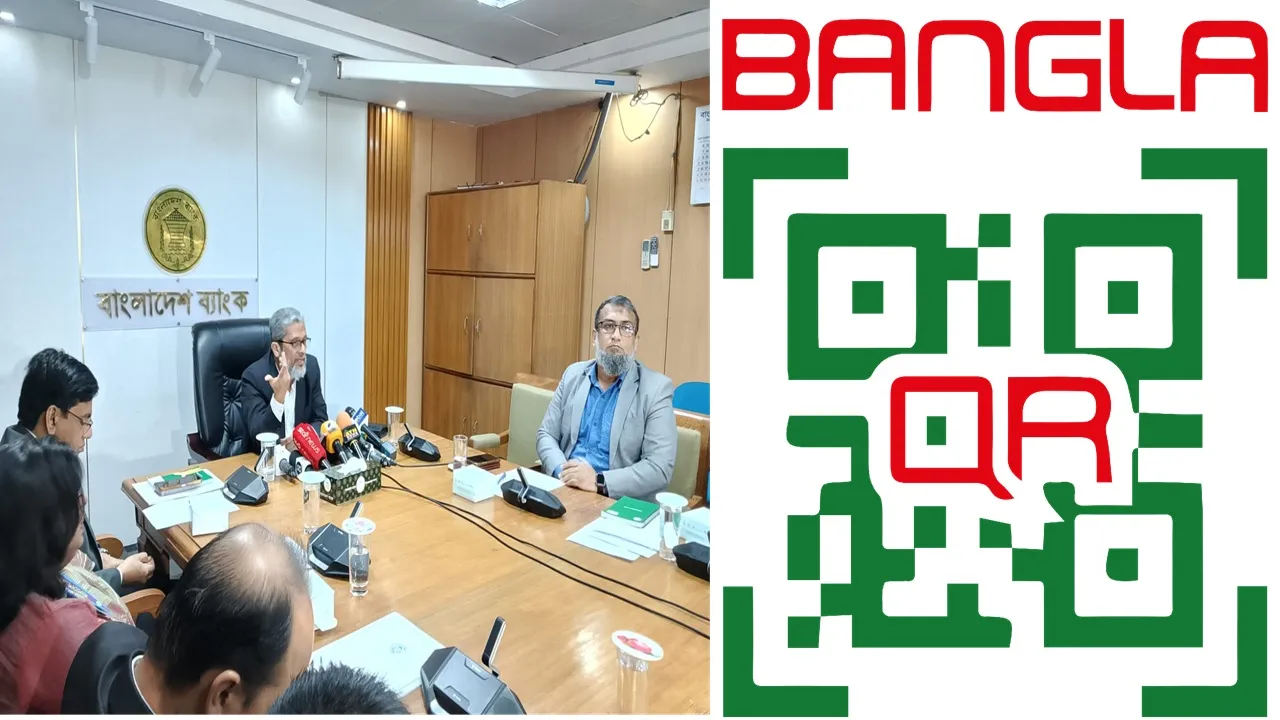
As part of building a cashless economy, Bangladesh Bank is giving top priority to rapidly expanding the use of Bangla QR in health, education and transport. From hospital tickets and fees to school fees, students’ daily purchases and road and bridge tolls, the central bank wants to cut small cash transactions by introducing Bangla QR in these areas of people’s regular engagement. Doing so will make transactions easier and faster and reduce problems with cash and small change.
Bangladesh Bank executive director and spokesperson Arif Hossain Khan gave the information at a press conference on Bangla QR on Wednesday (September 30). The central bank will take several steps over the next three months to establish Bangla QR as a simpler, safer and cheaper payment method. Use has already grown significantly: in the three months to September 30, the number of Bangla QR transactions rose about three and a half times compared with June, and their value about fivefold. About 4 million merchants now use Bangla QR.
Bangladesh Bank has long been working to build a cashless economy, with the main aim of creating a digital footprint for every transaction, Khan said. Linking the informal economy with the formal one would make the real size of the economy larger. Bangladesh’s economy is now about $510 billion, with a goal of reaching $1 trillion, he said, and bringing informal transactions into the accounts could make it bigger still, making the market more visible to foreign investors. “Foreigners consider whether there is a market and how big it is before investing. If Bangladesh can be presented to the world as a trillion-dollar economy, foreign companies will naturally be more interested in investing here,” he said.
Large transactions in the country are generally cashless, but small daily transactions are still mostly in cash, at grocery shops, markets and elsewhere, the spokesperson said. Bangla QR can play an important role in bringing these small transactions into the digital system. There is a shortage of low-denomination notes, buyers with a Tk 50 note often cannot get change for Tk 10 or 20, and old and soiled notes cause problems, slowing transactions and sometimes causing disputes. Bangla QR can solve much of this, he said.
Bangla QR has been mandatory at all levels since July 1, and the practical obstacles have been monitored over the past three months, Khan said. New steps are now being taken to remove them. Transactions through Bangla QR have risen almost fourfold since July. In the latest week, about Tk 1,000 crore was transacted through Bangla QR, an average of about Tk 143 crore a day, and the number of merchants has roughly tripled to nearly 4 million. But fees or charges remain one of the main problems, he said.
“If a trader has part of the money owed to him deducted after selling a product, he will naturally not be encouraged to use such transactions,” Khan said, adding that solutions have been worked out to make it simpler and cheaper for traders. Another major advantage of Bangla QR is interoperability: previously, a customer of one mobile financial service could not pay a merchant using another provider’s QR, for example a Nagad customer at a merchant with a bKash QR, and bank customers faced similar problems. With a single universal QR, customers of banks, mobile financial services and payment providers can now all transact.
A steering committee led by the governor and a working committee led by a deputy governor are working to popularise Bangla QR, including representatives of Bangladesh Bank, banks, mobile financial service providers, payment service providers and relevant government ministries, Khan said. Central bank instructions alone cannot rapidly expand its use, so people at various levels in about 19 districts and business organisations were consulted on what features and costs would make it acceptable and affordable.
Some steps take effect from October 1, others from November 1, and more from mid-November to the end of the year, he said, and Bangladesh Bank expects faster progress in the next three months than in the last. Education, health and transport are being given special priority. In health, he gave the example of buying a Tk 10 hospital outpatient ticket with a Tk 50 note and not getting change, lengthening queues; with Bangla QR, patients could pay by scanning with their phones.
In education, school fees and small purchases such as canteen food, stationery, pencils, erasers, sharpeners or geometry boxes could be paid through Bangla QR, he said. The education ministry has already instructed that private school fees be made cashless, and steps are being taken to collect them through Bangla QR. In transport, he cited long queues at toll plazas, including on the Padma Bridge, saying QR payment of tolls would save time and speed up collection without the need for cash.
Cashless systems can be introduced quickly in sectors under the ministries with which people have the most daily contact, the executive director said, and payment systems department officials have discussed Bangla QR’s usefulness, benefits and implementation with them. Alongside central bank instructions, the ministries and institutions concerned also need to issue their own directions, which would speed up implementation.
Bangladesh Bank wants to establish Bangla QR not just as a payment method but as one of the main pieces of infrastructure for a cashless economy, Khan said, and expects that the new steps over the next three months will widen its use and bring a large share of small daily transactions into the digital system.
বাংলায় মূল প্রতিবেদন পড়ুন · Read the original Bengali report