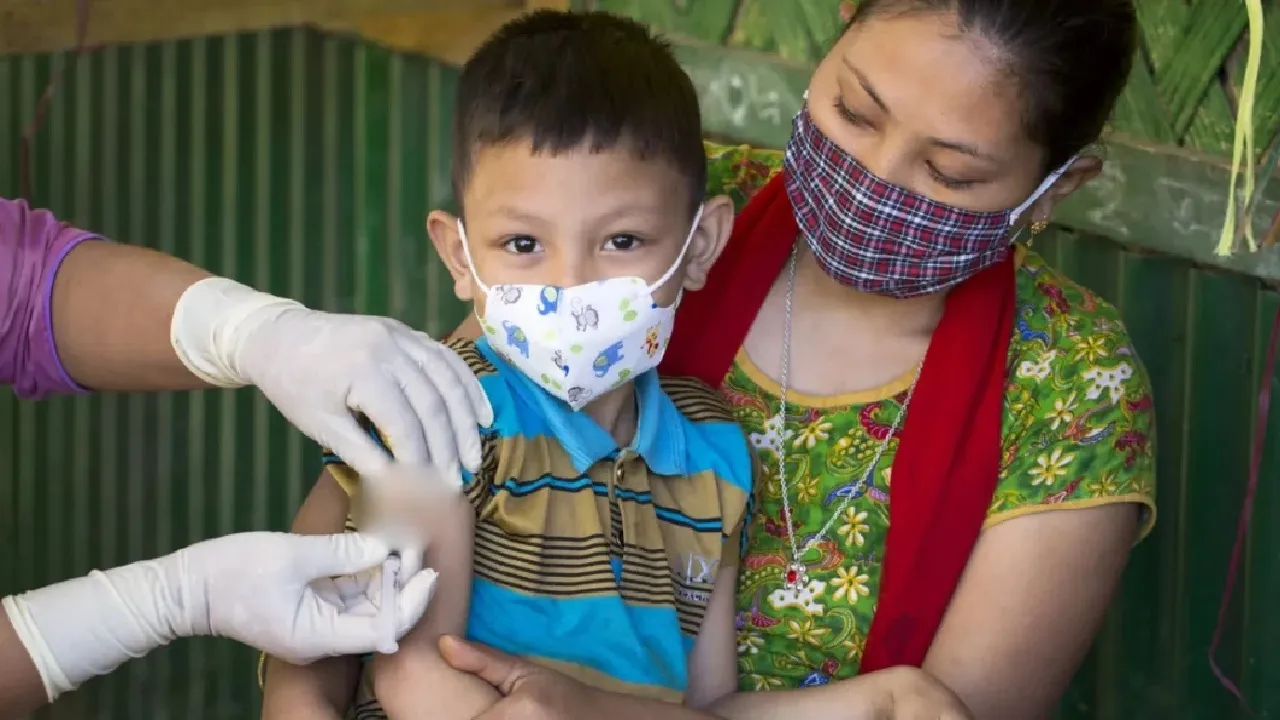
Bangladesh’s first oral cholera vaccine (OCV) campaign has reached 82.6 percent of its target in the first round. A total of 852,422 people missed the first dose, with the lowest coverage in Narayanganj.
According to the Directorate General of Health Services, the first round aimed to vaccinate 4,899,440 people, of whom 4,047,018 received the vaccine.
A large share of those missed are in Narayanganj, where the target was 1,032,963 people and 672,287 were vaccinated, meaning more than 360,000 people did not get the first dose. About 42 percent of all those missed in the first round are in Narayanganj.
On August 22 the directorate launched the country’s first two-dose oral cholera vaccination campaign, covering seven police station areas of Dhaka city and seven upazilas in four districts. The target was everyone aged one or over, except pregnant women and the seriously ill. The first dose was given from August 22 to September 21. The second-dose campaign began on September 26 and runs until October 25.
The campaign covers 14 areas at high risk of cholera. The seven in Dhaka are Lalbagh, Gendaria, Kadamtali, Kamrangirchar, Sher-e-Bangla Nagar, Khilkhet and Tejgaon. Outside Dhaka they are Sadar and Nabinagar in Brahmanbaria; Tarail, Karimganj and Hossainpur in Kishoreganj; Munshiganj Sadar; and Narayanganj Sadar upazila.
Brahmanbaria had the highest coverage at 98.4 percent, followed by Kishoreganj at 94.8 percent and Munshiganj at 80.8 percent. Coverage was 82.6 percent in the Dhaka North City Corporation area and 77.4 percent in Dhaka South.
Why the target was missed
A health directorate official involved in the campaign, speaking on condition of anonymity, said they had hoped to cover 95 percent of people but could not reach that goal.
The target was very large, making it hard to achieve, the official said. While routine or special vaccination campaigns usually target children, this time people of all ages were included. Many in the target population were also workers whose working hours clashed with the vaccination schedule.
Evening vaccination sessions were held in various parts of Dhaka, reaching more people, but that was not possible in Narayanganj, where scattered settlements made the campaign difficult, the official said. Among the city corporation areas covered, Narayanganj has the second-largest population, and people moving between areas was another reason for missed doses.
A delegation from Gavi, the Vaccine Alliance, which recently visited Bangladesh, expressed satisfaction with the coverage achieved, the official said. Gavi supplied the vaccine free of charge.
Professor Halimur Rashid, director of the directorate’s disease control wing, told the media on Tuesday that there was no specific target. “This is a preventive vaccine. We have reported the coverage we achieved,” he said. Everyone aged one or over was included, and coverage in such campaigns is usually somewhat lower than in those aimed at children, he said. “We campaigned as much as we could.”
Asked about the low coverage in Narayanganj, he said to contact the district’s civil surgeon. Narayanganj civil surgeon SM Sakhawat Hossain said he had joined recently and was not aware of the reasons. Narayanganj Sadar upazila health and family planning officer Umme Farhana has recently been transferred and could not be reached for comment.
Part of a five-year plan
Another directorate official said a 2022-23 study by the directorate and icddr,b identified 144 areas, upazilas and city corporation police station areas, as cholera hotspots. The government then decided to vaccinate people in these high-risk areas under a five-year plan, choosing the 14 most at-risk areas for the first phase. The vaccine used has been prequalified by the World Health Organization (WHO).
“There are plans to bring the remaining areas into the programme gradually. But everything depends on funding,” the official said on condition of anonymity.
বাংলায় মূল প্রতিবেদন পড়ুন · Read the original Bengali report