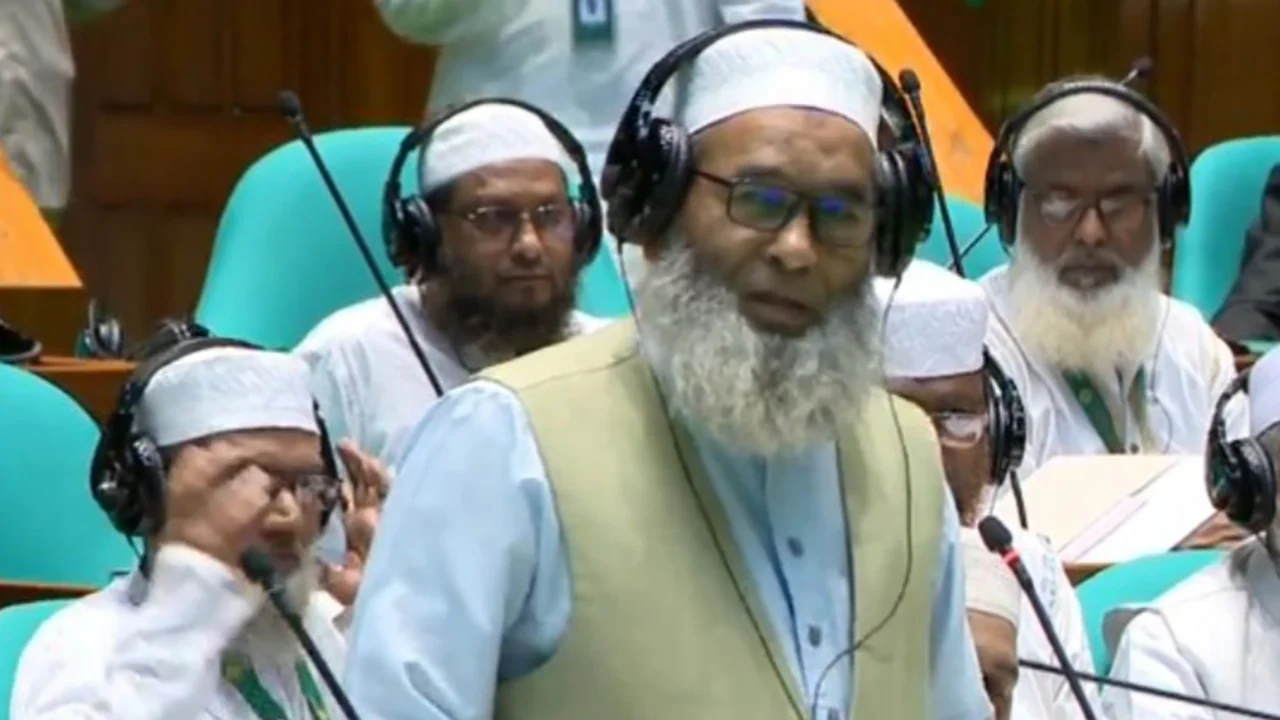
Unless the country wants to wage war with Allah, it must end the interest-based economy and launch a zakat-based one, Jamaat-e-Islami MP for Rajshahi-1 Professor Mujibur Rahman has said. To this end, he also called for forming a committee of religious scholars, establishing a zakat ministry and running it under their leadership.
He made the remarks on Sunday while taking part in the discussion on the proposed budget in the National Parliament, with Speaker Hafiz Uddin Ahmed in the chair. On the rules and harms of interest, Professor Mujibur Rahman said taking interest had been described as tantamount to waging war with Almighty Allah and the Prophet (peace be upon him). So, if one did not want to wage war, the interest-based economy must be ended. Many countries had interest-free economies and banks, he said. Although an Islamic bank had been established in Bangladesh, it had been almost destroyed; many banks had opened Islamic counters, proving that interest-free banking works.
The Jamaat leader said that if interest continued, Allah’s punishment would become lawful, and the part of the body built with interest money would burn in hell. If zakat were properly collected, Tk 2 lakh crore could be raised, filling the deficit budget, he said — but it would not do to hand zakat to those who do not understand it and steal. He called for forming a committee of scholars to launch a zakat-based economy and bury the interest-based one.
He said black money must not be whitened; if that continued, nothing would remain wrong. He thanked the government for raising the prices of alcohol and bidi so that people would not consume them, but said he did not know why Gayeshwar Chandra Roy had asked for the prices to be cut.
On the Islam of Medina, he said there had been no interest in the Islam of Medina, only zakat, so interest must be ended and zakat launched. There was ushr on crops, he said, and zakat on other goods and kaffara also had economic links. He demanded a zakat ministry in Bangladesh, run under the leadership of scholars, and said there should be a budget for qawmi madrasas.
On the proposed budget, Professor Mujibur Rahman said the finance minister had delivered a 234-page budget speech with 346 sections. Allah is the owner of the budget, he said: “He has said, eat and drink, but do not waste. But I do not know that the finance minister spoke of waste in this budget speech. He did not speak of zakat.”
On the harms of debt, he said one would have to die having repaid one’s debt; no debt could be taken lightly. Crores of taka had been borrowed from banks, but one could not die leaving debt behind, he said. Taking debt was like a beggar’s hand; one could not eat ghee on borrowed money, nor run the country on debt, which he believed would harm the nation and the country.
On politics in mosques, he said that if the state could be run from the Prophet’s Mosque, why could it not be done from every mosque in Bangladesh?
He demanded that, just as the prime minister would give shoes and clothes to primary-school children, madrasa students be given shoes and clothes too.
He said teachers were worthy of respect, and that when respected teachers held protests at the Press Club and elsewhere, there was a duty towards them and all their demands should be accepted. Education would improve, he said, if eligible institutions were brought under the MPO scheme, those with shortfalls brought in conditionally, and the rest vetted and brought under MPO in three instalments.
Workers must be paid properly, he said. On the farmer card, he said: “Put work in people’s hands, not a card. Otherwise their hands will remain begging hands. The Prophet (peace be upon him) encouraged work. Give work, and Bangladesh will become the best nation on earth, inshallah.”
Mujibur Rahman said the rights of women workers had not yet been established, and that a national decision should be taken that nationalising the education system would solve problems. All problems, including ambulances in hospitals, must be solved, he said, drawing the prime minister’s attention to ensuring constructive development work to protect the honour of all MPs.
Professor Mujibur said those in parliament who had remembered leaders directly while leaving out Allah, and had not offered prayers, had violated Allah’s command. Following Allah’s commands would bring well-being in this world and the hereafter, he said.
বাংলায় মূল প্রতিবেদন পড়ুন · Read the original Bengali report