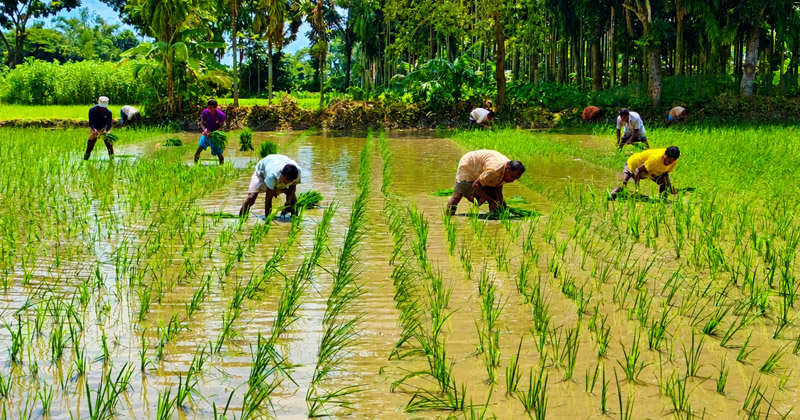
As the first light of dawn breaks, farmers are hurrying to the fields with rice seedlings on their shoulders, spades in hand and fresh hopes. Some stand in mud, others in waist-deep water, planting seedling after seedling. From a distance it looks as though they are painting a vast canvas of green. The fields of Khansama upazila in Dinajpur have taken on just such a lively look.
With enough water in the fields after steady monsoon rain, farmers in the upazila’s unions are smiling with relief. From morning to afternoon the village fields are busy with the movement of women and men agricultural labourers. In some places seedlings are being lifted from the seedbeds; in others farmers are planting them in neat rows. Nature and human labour together seem to be writing a story of new possibility.
A visit to the extensive farmland of Alokjhari, Bhabki, Bherbheri, Goaldihi, Angarpara and Khamarpara in the upazila and the surrounding area showed that farmers now have no time to catch their breath in the work of aman planting. Many are working in the fields with members of their families to finish planting within the stipulated time. Cultivation has not stopped despite a shortage of labour, because farmers believe that if the seedlings can be planted on time the yield will also be good.
In the farmers’ own words, nature has been largely on their side this year. Timely rainfall has cut the cost of irrigation, which will also bring production costs down somewhat. They have some worries about the prices of fertiliser, labourers’ wages and other agricultural inputs, but they are working tirelessly in the hope of a good harvest.
বাংলায় মূল প্রতিবেদন পড়ুন · Read the original Bengali report