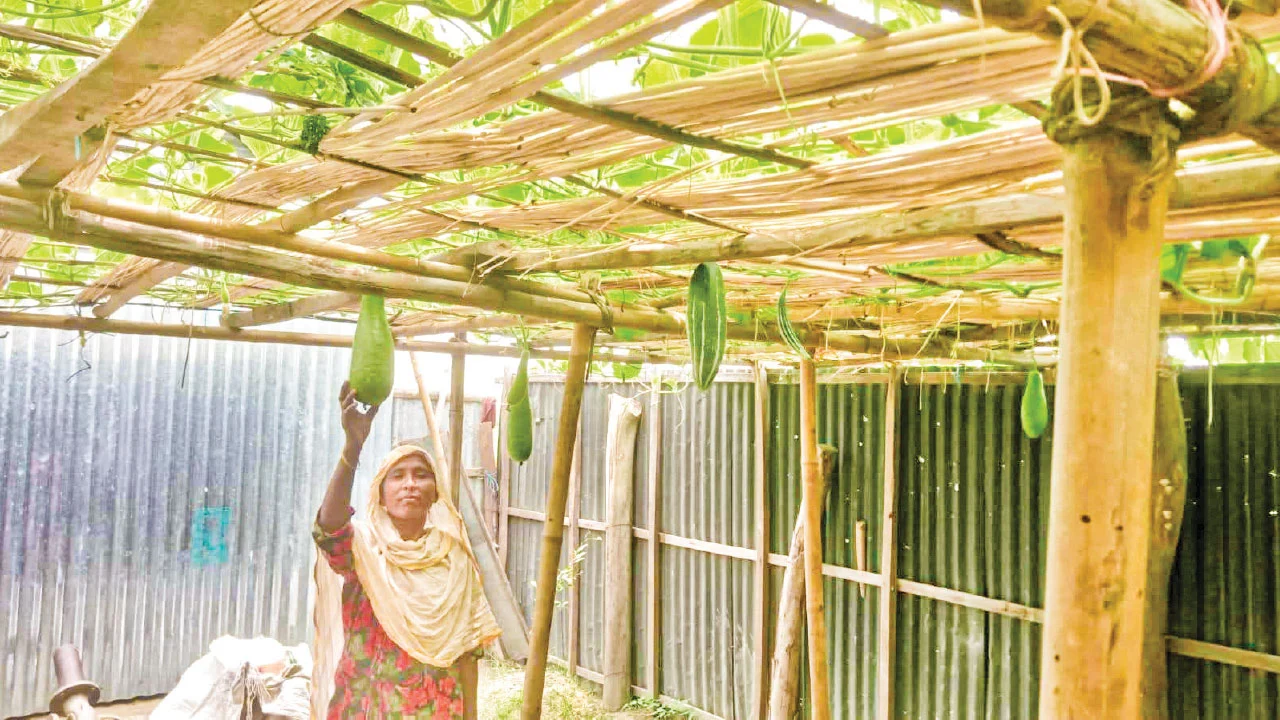
Gaibandha’s defining features are floods and river erosion. People living on the chars surrounded by the Jamuna and Teesta rivers wage a daily struggle against the elements. Yet amid that struggle, Jamful Begum of Ratanpur village in Fulchari upazila has set a remarkable example.
Her homestead once disappeared beneath floodwaters every year. With a family of six — her husband, two sons, and two daughters — she lived in perpetual uncertainty. That has now changed. Through hard work and a timely intervention, her fortunes have been transformed.
Unable to grow anything on land that flooded annually, Jamful received support from the ‘PROOFS’ project implemented by the development organization Gana Unnayan Kendra (GUK), which raised her homestead above flood level. Even during severe floods, her home now remains safe, and the elevated ground has opened up space for vegetable cultivation.
Using modern techniques and improved seeds provided through the project, Jamful now grows bottle gourd, spinach, ridge gourd, snake gourd, bitter gourd, and other nutritious vegetables around her home. The family’s daily vegetable needs are now largely met from their own production, while surplus is sold at the local market for additional income.
“I received timely training and quality seeds from the project, and the yields have been excellent,” Jamful said. “I no longer fear losing everything to floods. Seeing my success, my neighbors are now interested in growing vegetables around their homes too.”
GUK coordinator Aftab Hossain said: “Raising homesteads in flood-prone char areas and engaging rural women in economic activities is an effective approach to sustainable development. Jamful Begum’s success is a shining example.”
বাংলায় মূল প্রতিবেদন পড়ুন · Read the original Bengali report