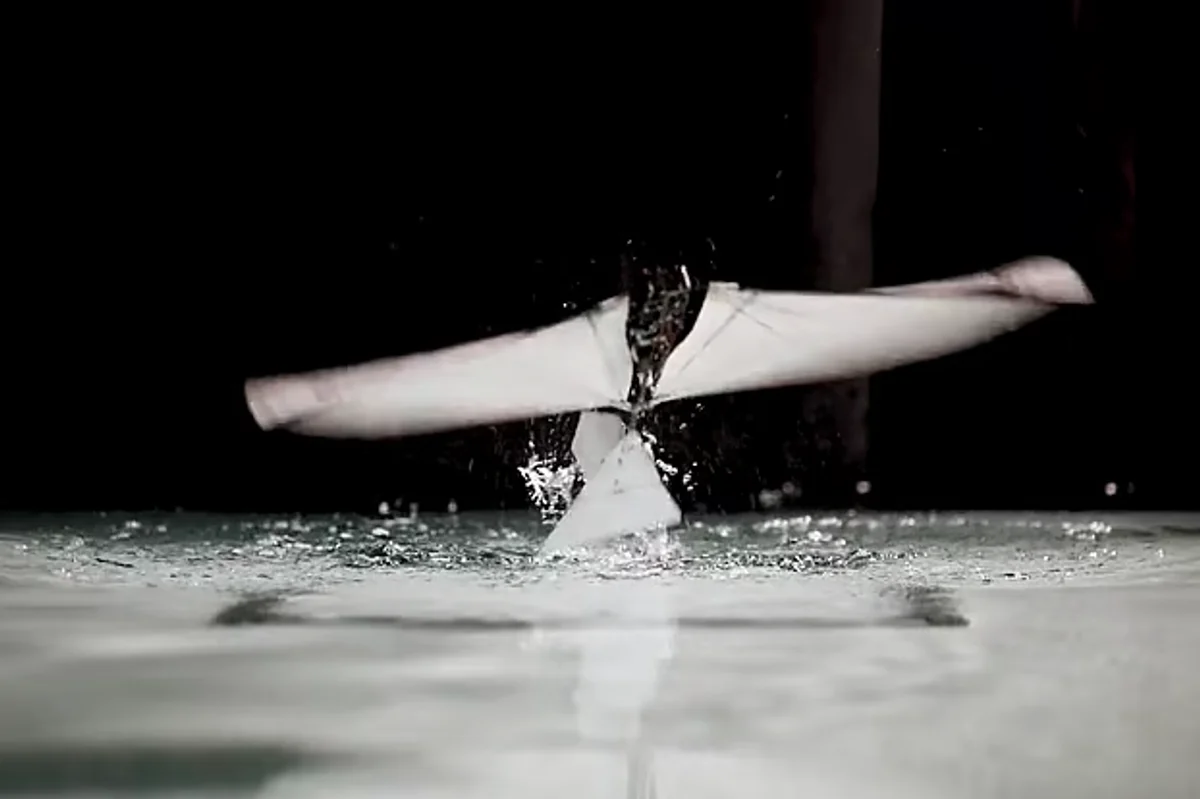
A $300 wing-flapping robot that can both fly through the air and swim underwater has been built at the laboratory of the Massachusetts Institute of Technology (MIT) in the United States.
The lightweight robot could in future be used for surveillance over the sea and, ultimately, to protect the marine environment, its inventor hopes.
To build the robot, capable of moving through both air and water, the researchers studied the physical structure and characteristics of petrels, puffins and other diving birds. These birds use their wings to propel themselves through both air and water.
The team also closely observed how the complex dynamics of these birds’ bodies work when moving from one medium to another.
The study’s lead author and MIT assistant professor of mechanical engineering Rafael Zufferi said the wings of diving birds, and how they simultaneously fly and swim, had been studied before, but no one had found a way to turn it into a fully functional moving robot.
Zufferi said his team reviewed all previous research papers on diving birds. They mapped how many times per minute different birds’ wings flap in air and water, and how this relates to wingspan. In birds, it turns out, the larger the size, the slower the wing-flapping.
Based on this idea, the researchers built a 250-gram (9-ounce) battery-powered “flapping aerial-aquatic vehicle” (FAAV). The robot’s nylon wings and tail were coated with water-resistant nanoparticles.
Whatever it may look like externally, the FAAV is not built as an exact imitation of nature, Zufferi stressed. The reason is the vast difference in the density of air and water: depending on temperature, pressure and humidity, water can be several hundred times denser than air.
A diving bird’s wings partially fold underwater. This reduces how far the wing moves up and down in a single flap. It also reduces water resistance and generates the force needed to move forward.
To do the same in the robot would have required at least four more pairs of joints, making its design more complex and greatly increasing its weight. To avoid this, the team built a kind of wing that does not contract like a bird’s wing but is far more flexible than a diving bird’s. This flexibility reduces the amplitude of the wing-flapping.
Zufferi said the robot itself cannot tell whether it is in water or air. It is programmed so that, whatever the surrounding medium, it keeps trying to flap its wings at a set rate per second.
Speed and capability tests
The robot can fly through the air at just over 6 metres per second (13.4 miles per hour). Underwater, its swimming speed is about 1 metre per second (2.2 miles per hour).
Theoretically, on a single battery charge it can fly 6 kilometres (3.7 miles) or swim 2 kilometres (1.2 miles). But these long distances have not yet been tested.
MIT’s laboratory tested the robot’s performance for a full year in a water tank in Massachusetts and later in Lake Geneva, Switzerland. A large part of this long test involved precisely measuring at what angle the robot would dive into the water and spread its wings from the water into the air.
The researchers found that a 70-degree angle is ideal for entering the water. Zufferi said the current version can work in gentle waves and light winds but is not effective in adverse or rough weather.
Marten Furlong, director of engineering at the UK’s National Oceanography Centre, said of the new invention: “From an engineering point of view, it really is a wonderful design.”
Furlong added: “Building a vehicle capable of moving effectively through both air and water is quite a major technological challenge. Ensuring the successful combination of these two media is undoubtedly a significant engineering achievement.”
Plan for use in risky missions
The robot can be launched from anywhere — sea or land — Rafael Zufferi believes. He said it could be pre-programmed to fly automatically along a specific route, then take off, reach a specified location, dive underwater and collect the necessary samples.
Zufferi added: “I quite like the idea of using these robots in risky or dangerous situations.” As examples, he mentioned collecting samples from areas affected by harmful algae, from volcanic lakes, or from areas near icebergs.
বাংলায় মূল প্রতিবেদন পড়ুন · Read the original Bengali report