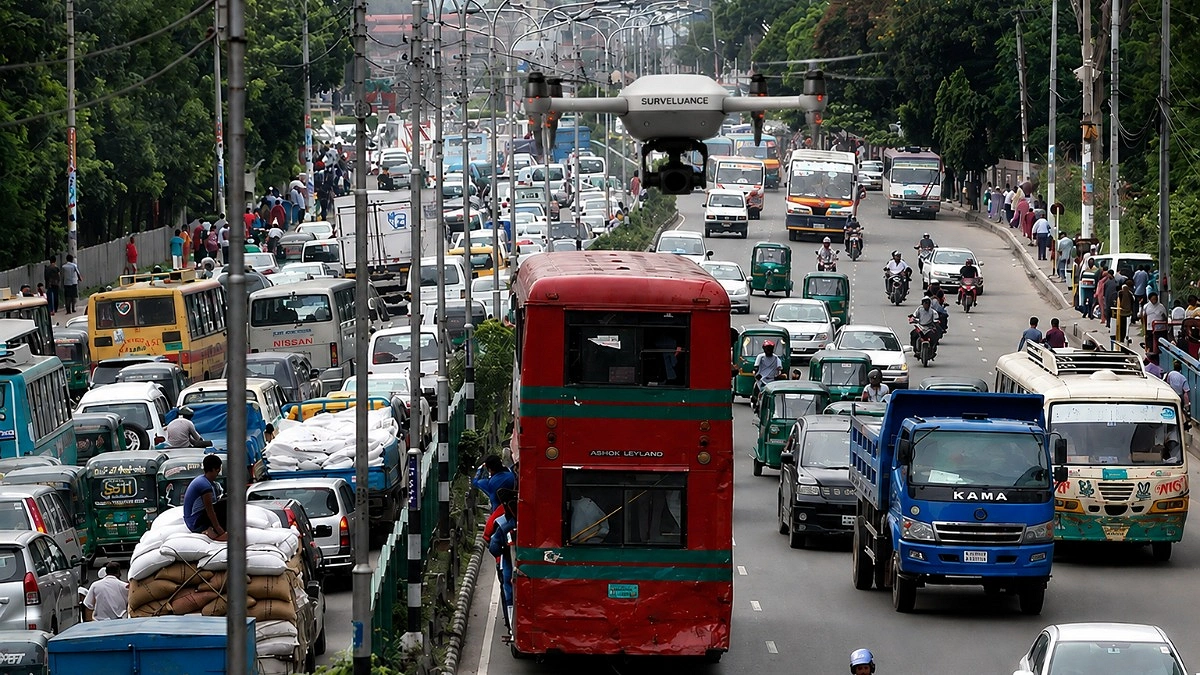
Traffic congestion is a long-standing problem in the capital, Dhaka. It wastes valuable working hours. The financial losses are enormous. Various initiatives have been taken at different times, but a lasting solution to this crisis has remained elusive. However, the recent use of artificial intelligence (AI) cameras to control traffic congestion and restore order on the roads has brought some relief. Now, Dhaka Metropolitan Police (DMP) has taken the initiative to launch drone surveillance.
DMP Additional Police Commissioner (Traffic) Md Anisur Rahman expects that adding this new technology to restore traffic discipline on the roads will substantially reduce congestion in the capital. He expressed this hope in a recent interview.
According to this DMP traffic official, in the initial experimental phase, a single drone will be used to collect real-time information on important roads and congestion-prone areas. There are also plans to identify vehicles violating traffic laws and issue warnings, and later to incorporate Automatic Number Plate Recognition (ANPR) technology to issue video-based citations.
Anisur Rahman said drone surveillance exists in many countries around the world. “But for us, this is an entirely new concept. We sometimes find that congestion builds up not just on roads but also on flyovers and elevated expressways. Often, the exact cause of this congestion cannot be identified, or it takes time to find out. That’s why we thought: if we could launch drone surveillance at various important locations, it would give us instant, real-time information. This would make it easier for us to issue directions.”
This DMP traffic additional police commissioner believes that if Automatic Number Plate Recognition (ANPR) technology is integrated into the drones, it would become possible to issue video-based citations from the office.
Anisur Rahman said: “A major problem in Dhaka is that buses don’t stop at designated spots. Based on the bus’s condition, drivers pay the owner a ‘per day’ fee. Because of this payment structure, they compete among themselves. Because of this competition, buses stop wherever they like instead of at passenger shelters, blocking the entire road behind them.”
This DMP traffic additional police commissioner believes that, in developed countries, buses run at fixed intervals. Which bus follows which, and where and when each bus will stop — everything is managed through a defined system. “We don’t have that kind of system in our country. Because of this, buses compete with each other to pick up passengers. As a result, almost every bus in Dhaka is covered with countless scratches and dents. They look something like the face of a smallpox patient. As long as this doesn’t stop, and as long as we can’t properly implement e-ticketing and bus route rationalization, this suffering won’t ease.”
Asked exactly what kind of work the drones would do, Anisur Rahman said the drones will have a voice or sound system. Through this, warnings can be issued to vehicles violating the law. For example, if a vehicle is causing congestion, the drone could announce: “You are causing congestion, move along.”
“It will also be possible to issue citations for traffic-law violations captured by the drones. Various traffic conditions can be monitored through this. But this is still at a very early stage. An organization has given us a drone on an experimental basis. We are testing it. We hope to be able to start field-level work with it very soon,” added this DMP traffic official.
Asked whether real-time data could be obtained directly through the drones, Anisur Rahman said: “It’s entirely possible to get real-time data. But to get that, we’ll need infrastructure. Because all of this is internet-based, server-based. It requires space, it requires infrastructure. There are costs involved.”
Asked whether separate training is needed to operate drones, the additional police commissioner said operating a drone is a technical matter. “So we have already begun training our members. Training first began at the Tejgaon division. A team of ours has already received training there. In the next phase, members of the Uttara division will be trained.”
Discussing the challenges of introducing this technology, Anisur Rahman said: “It will take some time at the start. We first began work on traffic signals. Starting from Shahbagh, 14 signals, plus one on Lake Road — 15 signals in total — have been brought under AI technology. Alongside this, DMP has other signals as well.”
“We first wanted to see whether this system works. So far, it is working. But that doesn’t mean there are no problems — there are problems. Even so, we are trying to get people to learn to follow traffic signals. But building that habit is taking some time. I expect it will take time with the drones too. We will test this and observe. If we see any negative aspects, it will not be launched,” added this police official.
বাংলায় মূল প্রতিবেদন পড়ুন · Read the original Bengali report