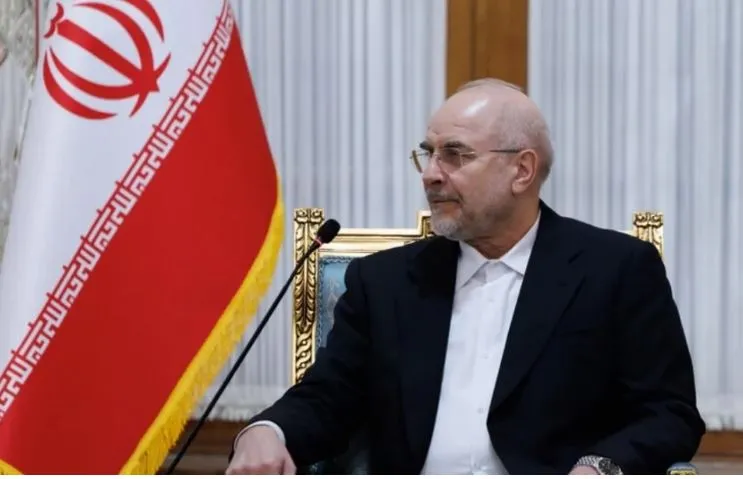
Iran’s delegation has walked out of the meeting room, boycotting the ongoing high-level bilateral peace talks with the United States in Switzerland, after fresh and severe threats from US President Donald Trump.
On Tuesday (June 23), Iran’s chief negotiator and parliament speaker, Mohammad Baqer Qalibaf, formally confirmed the boycott of the talks.
Setting out his country’s position, Qalibaf said: ‘We have certain core principles, and we never wanted to take part in direct dialogue, sitting at the same table with the Americans.’ Iran had agreed to take part only in indirect talks, at the special request of the mediators.
Qalibaf said: ‘Mid-way through the talks, I learnt that Trump had issued severe threats of fresh military strikes on our esteemed president, on our delegation and on the Iranian mainland.’ As soon as he received the news, he lodged a strong protest with the head of the US delegation and US Vice-President JD Vance, he said.
The Iranian speaker said he had clearly reminded the US vice-president that such reckless statements by Trump directly violated the terms of the historic peace agreement signed between the two countries. ‘I told Vance that we are sitting here at the negotiating table and that, under the first clause of our signed understanding, threatening or using military force against any party is completely prohibited. But your president has threatened us anew today,’ he said he had told Vance in the room. He added: ‘You should know that Iran never conducts negotiations by bowing to any kind of threat or pressure.’
Immediately afterwards, Iran’s entire delegation declared the meeting over, rose together from the negotiating table and left the room. ‘We ended the talks and walked out of the meeting, and never went back,’ Qalibaf said. He said the US delegation had strongly pleaded for another emergency meeting in the presence of the mediators, but Tehran flatly rejected Washington’s proposal.
After the US proposal was rejected, special mediators from Qatar and Pakistan came to meet the Iranian delegation at their residence. ‘The Qatari and Pakistani mediators came to us, and we told them we would speak only with them, but would not sit in any dialogue with the Americans,’ the Iranian speaker said. The Qatari and Pakistani mediators then held intensive talks with Iran for 80 minutes to resolve the deadlock between the two countries, before finally issuing a joint diplomatic statement.
Separately, in an interview with the US news outlet Fox News, Donald Trump, referring to speaking with Iranian officials at midnight, issued an extreme threat, saying that if Iran made any fresh attempt to close the Strait of Hormuz, Iran’s very existence on earth would be in peril.
Using highly offensive language, he said: ‘You will not even get the chance to return to your own country, and if need be, we ourselves will take full control of the entire Strait of Hormuz into our own hands.’ In the same interview, addressing Iran’s President Masoud Pezeshkian, who had spoken of the right to enrich uranium, Trump said: ‘He should watch his own mouth, and if he does not straighten up, we will take the rest of the country under our control as well.’
After a long conflict, the United States and Iran had, through Pakistani and Qatari mediation, reached a special 14-point peace understanding on June 14. The historic ‘Islamabad Memorandum,’ or MoU, was then formally brought into effect on June 18 through the electronic, or digital, signatures of Iran’s President Masoud Pezeshkian and US President Donald Trump.
The main terms of the agreement included permanently ending the Lebanon war, reopening the Strait of Hormuz for international trade, and fully withdrawing the long-running US naval blockade imposed on Iran.
বাংলায় মূল প্রতিবেদন পড়ুন · Read the original Bengali report