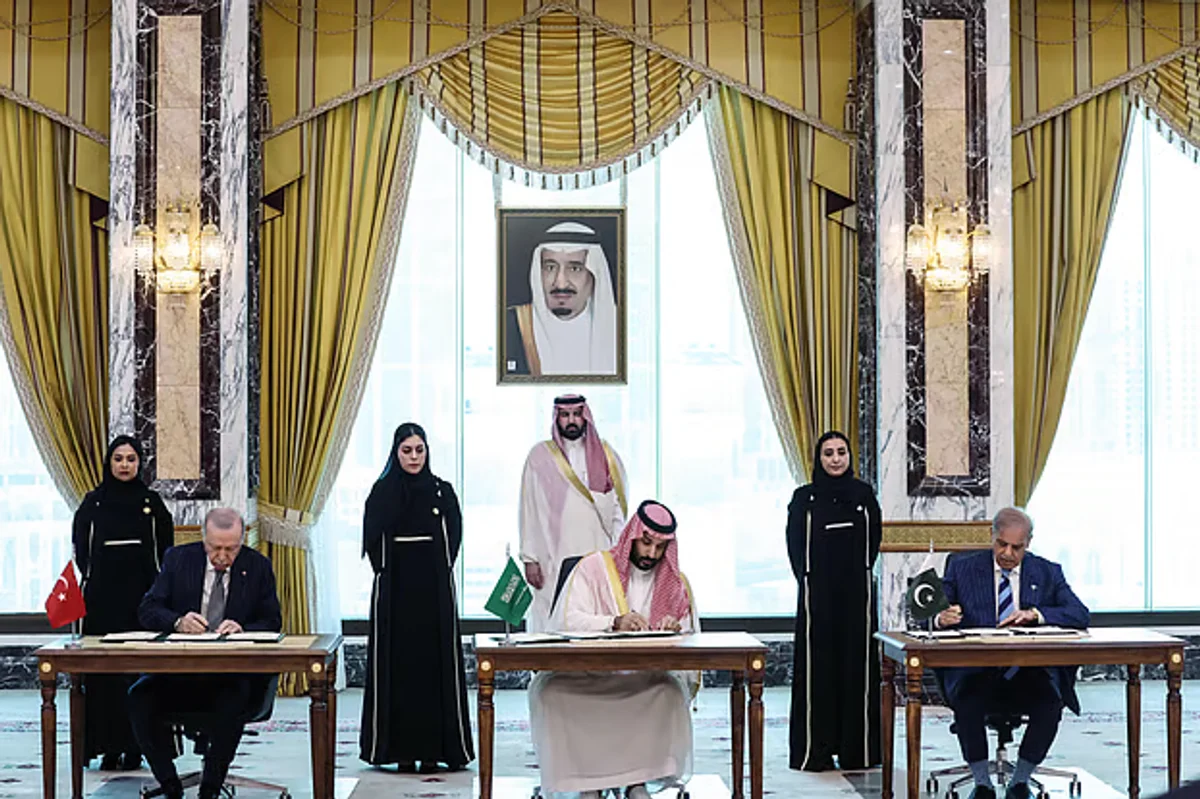
A new joint defence pact among Saudi Arabia, Turkey and Pakistan has raised fresh questions about the Middle East’s shifting geopolitics. After the US and Israeli aggression against Iran, some Middle Eastern countries are being forced to consider new arrangements for their own security.
The agreement, known as the “Mecca Joint Defence Pact”, was signed in the Saudi city of Mecca on Friday.
A statement issued after the meeting said: “The aim of this pact is to strengthen joint deterrence against any aggression. An armed attack on any one of these three countries will be considered an attack on all of them.”
The statement also said the pact “will create an opportunity to develop all aspects of defence cooperation among the three countries”.
How the pact will take shape in practice is not yet clear. But analysts say it points to growing questions about the durability of US security guarantees.
Kristian Coates Ulrichsen, a Middle East fellow at Rice University’s Baker Institute for Public Policy, told Al Jazeera by email: “Middle Eastern countries have for more than a decade grown increasingly sceptical about the reliability of US security partnerships.”
Coates said: “The decision to launch a US military operation against Iran, the subsequent conduct of the war, and the frequent shifts in position on resolving the crisis have all deepened those concerns. All of this has accelerated efforts to diversify security and defence ties.”
But Ulrichsen added that the main aim of building the new defence pact was probably not to replace or cancel the United States, but to create additional strategic and policy options.
US President Donald Trump’s administration has not yet commented on the pact. But analysts believe it is an attempt by the three countries to reorganise themselves after the chaos of the Iran war.
Sina Toosi, an analyst at the Center for International Policy, told Al Jazeera it could be called the first major geopolitical signal, showing that the regional order is taking a new shape because of the US and Israeli aggression against Iran.
Toosi said the pact’s significance expressed something more than a formal military alliance: it also captured how regional countries are reassessing their own security.
Toosi noted the long US-Saudi alliance, in which the two countries have enjoyed a strong relationship built on shared security interests for decades. But the pact could signal that Saudi Arabia wants to widen the scope of its security alliances.
Toosi explained that Saudi Arabia appears to be expanding the scope of its security partnerships without relying on Washington and building the foundation of a region-based security system — conditionally, the most important aspect.
Media reports also said US allies in the Middle East had been angry with the Trump administration, because in February it launched the aggression against Iran without considering how it would affect any regional partners.
Iranian forces carried out repeated missile and drone attacks on US military bases in the Middle East, causing civilian casualties. Iran also attacked civilian infrastructure, including energy and water-purification plants.
Tehran’s decision to close the Strait of Hormuz, the region’s main energy-export route, also imposed a heavy cost on the local economy.
Despite extensive US and Israeli attacks, Iran has largely retained the ability to control shipping through the Strait of Hormuz. By contrast, Washington struggled to supply its allies with enough air-defence munitions, because most of that air defence had been sent to Israel.
Amid the situation created after the war was launched, the pact has put the Middle East’s long-standing dependence on Washington for security under greater pressure.
Brett McGurk, one of the main planners of Middle East policy under former US President Joe Biden, wrote on social media: “This is a shifting and entirely new opening chapter in the Middle East.”
But analysts believe it is most reasonable to see Friday’s security pact as an effort to strengthen regional security cooperation with other countries and to deter Iran.
Yasmine Farouk, an analyst at the International Crisis Group, told Al Jazeera: “These countries are all US allies. They know there is no framework that can fully replace the United States.”
Farouk added that it would be wrong to see the pact as a step towards a major conflict with Iran, noting that since the US and Israel first launched aggression against Iran in late February, the three countries have generally called for mediation and de-escalation.
What these countries have in common is that none of them wants to raise regional tensions, the International Crisis Group analyst said, making the pact closer to “ideological deterrence”. She explained that after the war Iran has become tougher and more confident in using force to achieve its goals, and said this was not only about deterrence but also reflected a long-term view of strategic cooperation.
বাংলায় মূল প্রতিবেদন পড়ুন · Read the original Bengali report