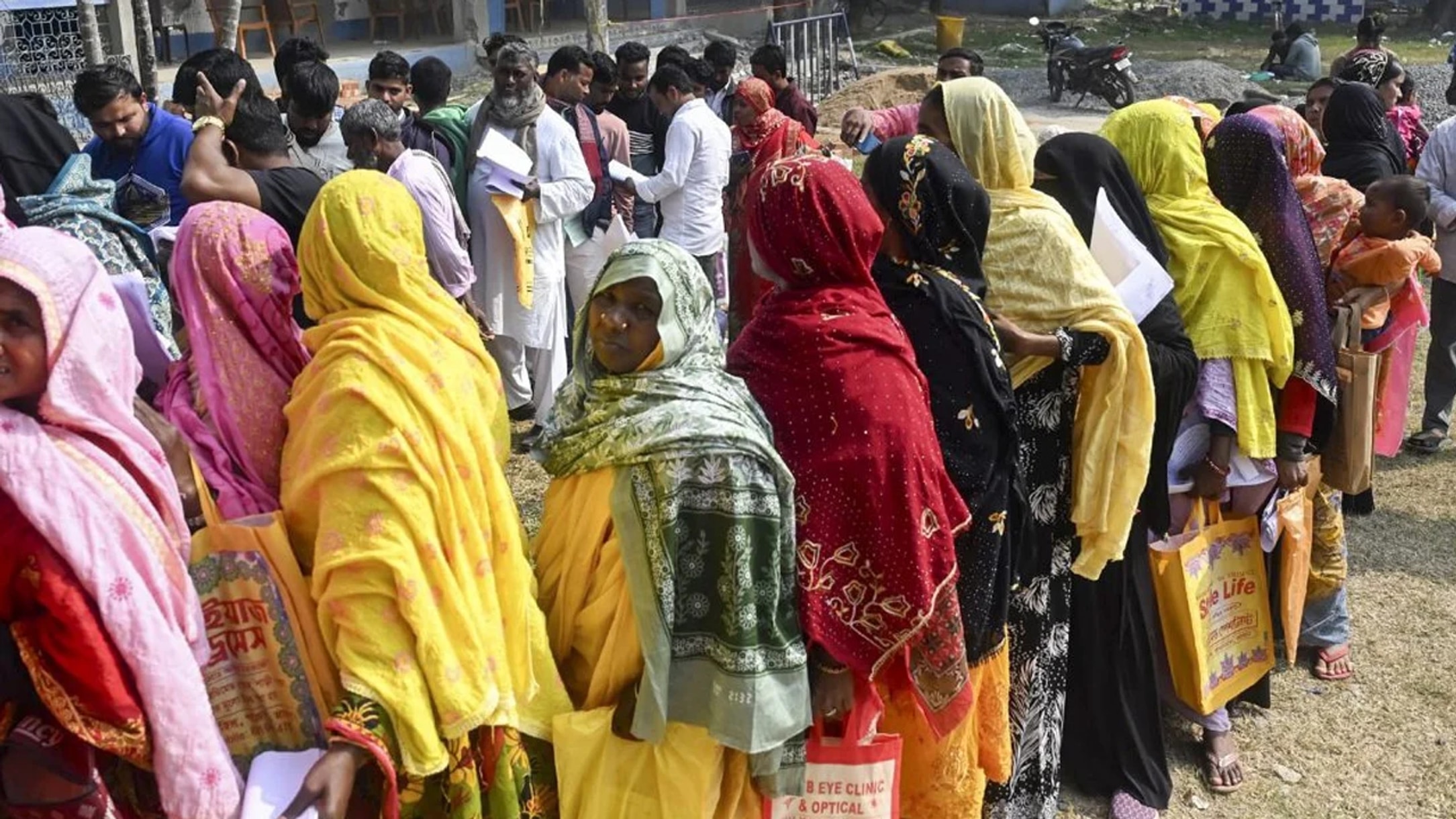
KOLKATA — Millions of voters in India’s West Bengal state have been stripped of the right to vote after a contested electoral revision, with critics calling it a “bloodless political genocide” and the mass disenfranchisement of minorities.
About 9.1 million names have been removed from the voter rolls in West Bengal, more than 10 percent of the state’s voters. While some were dead or duplicates, about 2.7 million people are appealing the decision to drop them, but their names have still been deleted.
The voter roll revision, known as the special intensive revision, or SIR, is underway in states and union territories across India. The government of Prime Minister Narendra Modi has described it as a way to stop voting by “infiltrators,” a derogatory term used mainly to refer to illegal Muslim immigrants from Bangladesh.
The federal government, led by the Bharatiya Janata Party, has come under fire for many divisive moves. Among them, Home Minister Amit Shah’s voter roll cleanup has triggered fierce anger in West Bengal.
The new voter rolls were prepared at unprecedented speed before West Bengal state elections, which begin Thursday. Modi’s BJP has been hoping to take power from the Trinamool Congress, which has governed the state for the past 15 years.
“What has happened in Bengal is a constitutional crime. And it is a crime against the people of India, against the people of Bengal,” said Trinamool member of parliament Sagarika Ghose.
“This will be recorded as a scandal in post-independence Indian history,” Ghose said. “One person, one vote is a great right given to Indians by the constitution. However poor or helpless you are, you have the right to vote. But that has been taken away.”
Experts and several organizations say Muslims and other religious minorities have been disproportionately removed from the rolls in West Bengal, raising allegations of deliberate targeting and persecution.
Sabir Ahmed, head of the Sabar Institute, who said his team had closely tracked and documented the cases based on official data, said: “According to our research, religion has become the single biggest distinguishing factor. Muslims have been disproportionately affected.”
Although the BJP has come to dominate most state governments in India, it has failed to consolidate its position in West Bengal. One reason is the lack of support from the state’s large Muslim population, which is wary of the BJP’s Hindu nationalist agenda.
In some Muslim-majority constituencies, nearly half of voters have been removed from the rolls. Many of those struck off held documents proving they are Indian citizens by birth. Many had themselves or had parents on the 2002 voter roll, the cut-off used to establish eligibility.
All of those removed were Muslim
In Sherpur village in Murshidabad district near the Bangladesh border, those struck from the rolls included Jaber Ali, 36, who was one of the officials responsible for collecting documents for the voter roll revision.
Over more than four months, Ali visited more than 700 families, verified documents and uploaded records late into the night. He said the work was exhausting. “I worked 12 hours a day in the field and then spent most of the night at the computer. I hardly slept,” he said.
But when the revised roll was published at the end of February, Ali said, most of the people he had verified were missing — including his own name. “People started calling me to say I had not done my job properly,” he said. “The irony is that my own name and the names of my brothers were also dropped from the rolls.”
Ali said panic had spread through the village because residents have long feared being labeled illegal immigrants from Bangladesh and pushed out of the country. He believes the removals in his area followed a specific pattern. “Everyone who has been removed from here is a Muslim,” he said. “People feel they are being targeted and stripped of their right to vote.”
Critics have challenged the SIR in court as unconstitutional and have described it as an attempt to rig the electoral system to favor the BJP.
Political opposition leaders and legal experts say the Election Commission, which is supervising the process, is no longer seen as an independent and impartial body.
Among those who have raised concerns about the rationale and process of the SIR in West Bengal and other states is former Indian election commissioner S.Y. Quraishi, who said it had raised serious questions about the Election Commission’s role.
“I am very uncomfortable and hesitant to comment on my successor, but as a citizen I see what is happening and I have to speak,” he said. The SIR, he said, was “completely unnecessary, designed to harass. Administratively it is a disaster and the motive behind it is not noble.”
Quraishi added: “It took us 30 years to achieve 99 percent accuracy in the rolls. And they expect to do better in three months. If the real motive was accuracy, what is the reason for this mad rush?”
Quraishi was among those who raised concerns about the Election Commission’s decision to apply a new AI-assisted algorithm to identify so-called “logical inconsistencies” in voter data in West Bengal. The decision forced millions of Bengalis, including the Indian Nobel laureate Amartya Sen, to prove their citizenship. Many of them ended up on the list of 2.7 million dropped voters.
Experts say the algorithm failed to take into account several important cultural factors. There is no standard way to write Bengali names in English, and changes in Bengali surnames over generations have produced spelling inconsistencies in family records. The algorithm also flagged parents under 16 and more than five siblings as a “logical inconsistency,” even though both were common in older generations.
Quraishi said the Election Commission in his time had been highly aware and sensitive on this. “If software is used to drop voters from the rolls on the basis of such minor discrepancies, it is a weapon against citizens’ rights and is not appropriate for this purpose,” he said.
Many who have devoted their lives to serving the Indian state have suddenly been disenfranchised. Senarul Haq, 62, who retired two years ago from India’s paramilitary Central Reserve Police Force after 35 years of service, found his name missing from the rolls even as his wife and two sons remained on them.
“It is very disheartening,” Haq said. “I served in some of the toughest areas of the country. Then when my name was dropped from the rolls, I duly submitted my documents, and still my name is not there.”
He added: “I served on election duty across the country. Now I am being denied the right to vote, and no one is being held accountable. It feels like a mockery of the system. How can so many people be wiped off the rolls just before an election?”
Tribunals are running to hear appeals against voter cancellations, but only a few cases had been heard before voting in the state election began Thursday. Himani Roy, 55, a government school teacher in Howrah district, was one of them. Her case was not heard in time, meaning she will not vote for the first time in her life. The irony, she said, is that her name is still on the list as a polling officer.
“I met with the relevant officials and they have no clear answer for why my name was dropped,” Roy said.
“When we talk about India’s democratic backsliding, this is exactly what it looks like,” she said. “It is a very dark time for democracy and for our country’s independent institutions.”
More than a dozen BJP national and state spokespeople declined to comment on the allegations when contacted by The Guardian.
In past comments, however, BJP Home Minister Amit Shah described the SIR as essential in states such as West Bengal. “This is essential not only for the country’s security but also for preventing infiltration in order to protect the country’s democratic system from being corrupted,” he said.
Indian economist and author Parakala Prabhakar argued that the unilateral removal of large numbers of citizens from the rolls had serious implications well beyond a single state election.
“If this is done, two classes will be created in India: one with full participation in political society and the political process, and another that is excluded,” Prabhakar said. “The aim is to kill the citizenship of minorities. It is a bloodless political genocide.”
বাংলায় মূল প্রতিবেদন পড়ুন · Read the original Bengali report