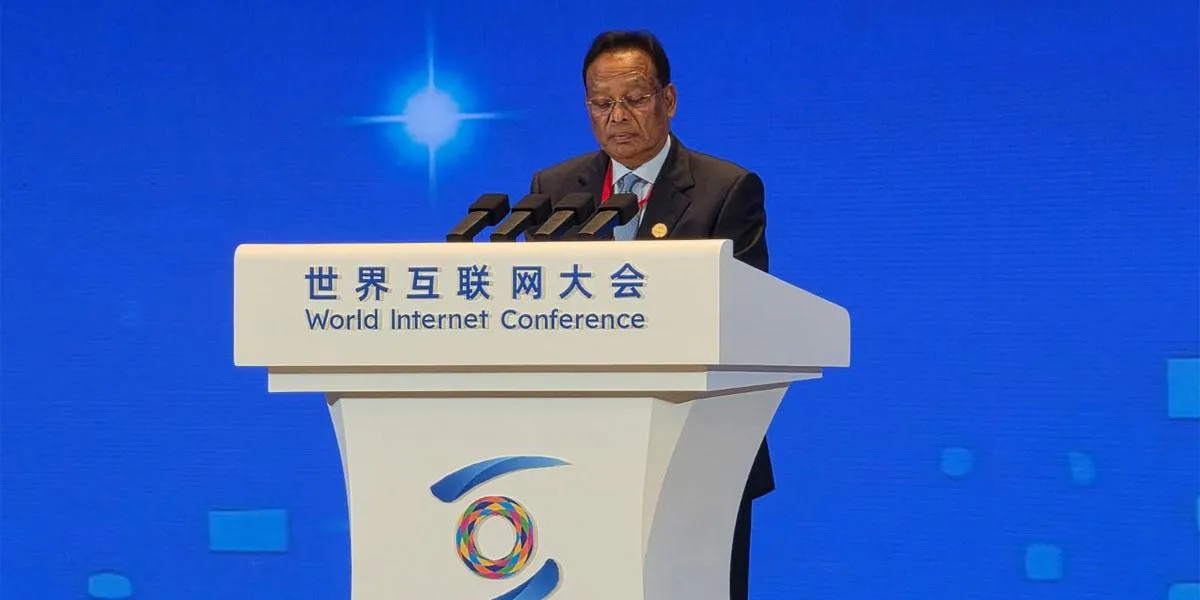
Fakir Mahbub Anam, minister for posts, telecommunications and information technology and for science and technology, has presented three forward-looking proposals for building multilateral cyber governance, ensuring access to technology and knowledge, and eliminating the digital divide, at the opening of the World Internet Conference 2026 in China.
He made the proposals as special guest at the opening ceremony on Wednesday, July 22, at the International Convention Centre in Xi’an, the historic Silk Road city, held under the theme “Pooling Intelligence on the Silk Road, Embarking on a Digital Future: Jointly Building a Community with a Shared Future in Cyberspace.”
Recalling the historic role of the ancient Silk Road, the minister said: “Today’s theme aligns deeply with Bangladesh’s national spirit.”
He said 65 percent of Bangladesh’s 180 million people are young and of working age. Under the farsighted leadership of Prime Minister Tarique Rahman, Bangladesh is working to use this demographic dividend to build a modern, technology- and intelligence-driven country, he said.
Highlighting Bangladesh’s digital transformation, the minister said more than 90 percent of people are now covered by mobile connectivity. Mobile financial services have brought banking to the doorsteps of marginal farmers and small entrepreneurs, while official work is being done through the national portal and “D-Nothi.” Digitizing everything from land records to healthcare is saving citizens tens of millions of working hours each year.
Digital transformation is not only about physical infrastructure but also about artificial intelligence and talent, Fakir Mahbub Anam stressed. Bangladesh is investing heavily in AI research, fintech innovation and large data-centre infrastructure, while building technological solutions to local problems — using machine learning for flood forecasting in a riverine country and drones for precision agriculture.
Calling the “Digital Silk Road” an economic lifeline for Bangladesh, situated at the geopolitical junction of South and Southeast Asia, the minister said high-speed submarine cable connectivity is linking Bangladesh’s digital economy with China’s technological expertise and the ASEAN region’s production networks.
The minister presented three main pillars for joint progress: first, skills development and knowledge transfer — investing not only in hardware but in developing Bangladesh’s young talent, and forming joint platforms to create cyber scientists; second, affordable connectivity — making technology transfer affordable and preventing the digital divide in cooperation with global technology leaders; and third, digital public goods — treating digital development as a public-welfare asset and opening intellectual property and data architecture to the global community.
Noting the threats in cyberspace, the minister said cyber governance must be multi-dimensional, transparent and grounded in international law to counter risks such as cybercrime, disinformation and data colonialism.
Closing his address by recalling the ancient Silk Road’s principle of “trust and confidence,” the minister said: “We must build the digital superhighway on that same trust. Bangladesh is ready to be a reliable partner in this journey with its connectivity, youth power and innovative spirit.”
About 800 guests and delegates from 52 countries and regions took part in the conference, held on July 21-22, with discussions on artificial intelligence, digital trade, Silk Road e-commerce, cultural-heritage preservation, smart healthcare and global digital cooperation. Representatives of leading Chinese and global technology firms including Qualcomm, Lenovo, ZTE, 360, Sugon, Waterdrop, Kisson Technology and Penghua Fund also attended.
বাংলায় মূল প্রতিবেদন পড়ুন · Read the original Bengali report