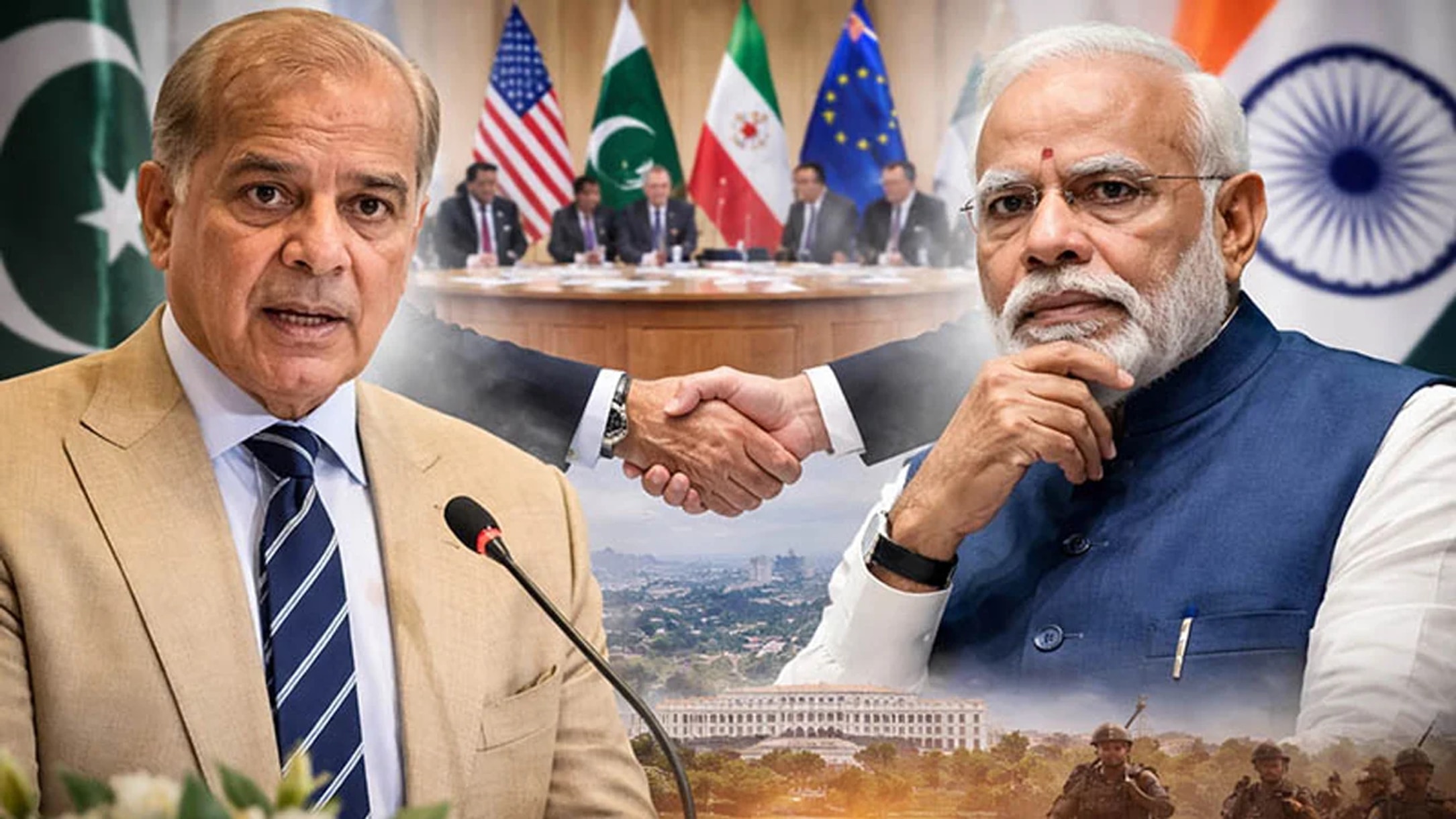
Dhaka: In the contest for influence in global politics, economic power and military strength are not the final word; what often matters more is how indispensable a state can make itself. By that measure, Pakistan has long pursued a strategy of turning constraints into assets, while India, despite its larger economy and global presence, has often failed to make itself indispensable. Recent geopolitical developments have made that contrast sharper.
The mutual defense agreement signed between Pakistan and Saudi Arabia in September 2025 is a key example. Built on decades of quiet military cooperation, the pact deepens bilateral ties and confirms Pakistan’s central place in the security architecture of the Gulf region. India has substantial economic interests in the area — remittances from migrant workers, energy dependence and trade ties — but New Delhi has not built a defense agreement, a permanent military presence or a joint security framework there. Its economic clout has not translated into a security role.
The same pattern is visible in Pakistan’s emergence as a significant mediator in efforts to ease tensions between the United States and Iran. Such roles in international politics typically go to states whose interlocutors have few alternatives. Pakistan has built that position through its military links, regional acceptance and ability to maintain ties with rival powers at the same time.
History has shown the pattern repeatedly. Pakistan’s mediation was the driving force behind Henry Kissinger’s secret 1971 trip to China, which opened the way for the Richard Nixon administration to rebuild ties with Beijing. In the 1980s, Pakistan became the main channel for U.S. and Saudi support to the Afghan mujahideen during the Afghan war. Even after 2001, Pakistan played the dual role of ally and challenge in the U.S. war on terror, maintaining its relevance in international discussions. This continuity shows the strategy is not the product of any single government but an institutional, long-term policy.
At the center of Pakistan’s position is its nuclear capability. Since becoming a nuclear-armed state in 1998, it has fundamentally shifted the balance of power in South Asia. India’s conventional military dominance has been effectively constrained, because the risk of full-scale war is catastrophic for both sides. The 2025 war scare with India made that clearer still: Pakistan responded militarily but was able to keep the conflict within defined limits. Nuclear deterrence has become not only a security tool but a powerful instrument of diplomatic bargaining.
A subtle but important aspect of the Saudi-Pakistan defense pact is the possibility of a “nuclear umbrella.” Pakistan’s Defense Minister Khawaja Mohammad Asif initially suggested as much before quickly walking the comment back. The episode showed that Pakistan deliberately maintains strategic ambiguity — signaling the possibility of security guarantees without making formal commitments. Such ambiguity makes Pakistan more important to states such as Saudi Arabia, particularly at a time when the regional security environment is uncertain.
Geography reinforces the strategy. Sitting at the meeting point of South Asia, Central Asia, the Middle East and China, Pakistan has become a natural corridor. For China it is the endpoint of an economic corridor; for the United States, a historic security partner; for Saudi Arabia, a reliable military ally. The interests of multiple powers converge there, with Pakistan at the center.
India’s strengths, by contrast, have in many ways become its limits. Its large economy, capable military and policy of “strategic autonomy” give it room to make independent decisions but discourage it from taking on risky or binding security roles. Under Prime Minister Narendra Modi, India has expanded relationships around the world, but it has not turned them into security dependencies. India is in many cases an important partner — but not an indispensable one.
The result, analysts said, is that Pakistan has turned economic fragility, security dependence and geographic position into strategic assets, while India has remained relatively cautious and neutral. In a moment of renewed regional conflict, power competition and shifting alliances, Pakistan has used those gaps to put itself in a position where it cannot be ignored — and is, in that sense, strategically outpacing India.
বাংলায় মূল প্রতিবেদন পড়ুন · Read the original Bengali report