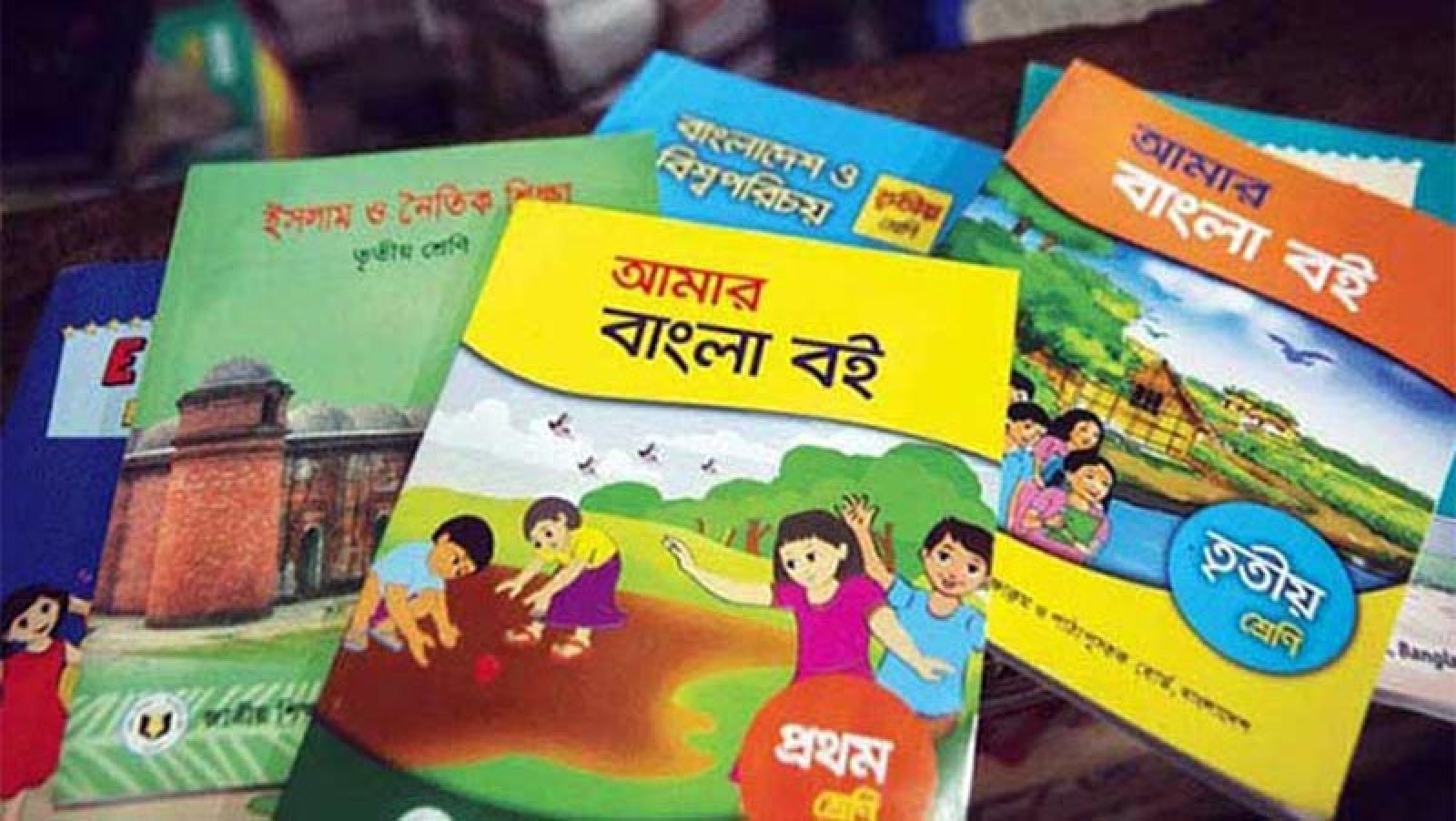
Concerns over the quality of next year’s free textbooks have not gone away this year either. There are allegations that paper of lower GSM than the tender requires and poor-quality ink are being used, and binding faults have been found in places, according to sources at the National Curriculum and Textbook Board (NCTB), which is responsible for printing and distributing textbooks.
NCTB sources said some action has already been taken over the poor quality. About 700,000 formes have been rejected so far because of substandard paper and printing. At least 14 printing firms have been served show-cause notices over the irregularities, as has Independent Inspection Services BD, which is responsible for checking book quality.
Education minister ANM Ehsanul Hoque Milon visited six printing presses in the capital at around midnight on Monday to check the quality of the books and the progress of printing.
The tender requires 80 GSM paper for primary textbooks and 70 GSM for secondary textbooks, but some presses are alleged to have printed books on lower-GSM paper, and there are also complaints about the ink and binding. Allegations are raised every year over the printing of free textbooks.
NCTB officials say the government is taking a tough stance on textbook quality this year, so when inspections find irregularities, the firm’s formes are rejected and the press is asked for an explanation.
“Printing is progressing according to the roadmap. We take action whenever we find any deviation. Many firms have already been served show-cause notices. Formes found to be of poor quality are cut immediately,” said NCTB chairman Professor Mohammad Fakhrul Moula.
About 310 million books will be printed for the coming academic year, from pre-primary to class nine, including more than 220 million at secondary level and about 82 million at primary level, at an estimated cost of about Tk 1,879 crore. Primary and secondary books are being printed at 133 presses, most of them in Matuail in Dhaka, with printing also under way in Narayanganj, Noakhali and Bogura.
According to the NCTB, as of September 28, 85 percent of pre-primary books had been printed, with pre-delivery inspection (PDI) done for 62 percent. Fifty-two percent of primary books had been printed, with PDI for 24 percent, and 14 percent of secondary books, with PDI for only 4 percent.
NCTB officials say most show-cause notices were issued for printing on unapproved and substandard paper, with other complaints over faulty printing and binding and failure to start work on time. This year the biggest irregularities are in the quality of paper and ink, they say. Most firms are not using paper of the GSM specified in the tender, and many lack brightness and durability. Instead of the ink brands specified, poor-quality ink is being used, and in some cases ink samples tested were found to be fake. Binding faults are also being found.
NCTB sources say paper from some firms that had received PDI clearance was later tested and found not to meet the standard, even though the inspection firm had cleared it.
According to the NCTB, Ananda Press, Redwani Press and Meghdut Press have been served show-cause notices over irregularities, as have Likhon Art Press, Sagarika, National Press, Sarkar, Anwara Press, Bangladesh Digital, Anwar, Amin, Muttahida and Dashdisha Press.
This year the NCTB has appointed separate PDI firms for primary and secondary books: Infinity Survey and Inspection BD for primary books, and Independent Inspection Services BD for secondary and ebtedayee books. The NCTB has also served a show-cause notice on Independent Inspection Services BD, which faced allegations of colluding with some presses to clear books printed on substandard paper.
“What can we do if the rot is within? The education ministry should take action against them,” an NCTB official said on condition of anonymity. Sheikh Belal Hossain, owner of Independent Inspection Services BD, denied the allegations, saying they were not true.
Power cuts are raising costs
Several printers with work orders say power cuts are disrupting textbook printing. Power is off for two to five hours a day, they say, stopping machines and wasting paper, and they have to buy fuel at higher prices to run generators to keep printing.
On August 23, the NCTB wrote to power distribution companies in the areas concerned, asking them to ensure uninterrupted supply to presses printing textbooks and describing the supply of free textbooks for the 2027 academic year as an important government priority.
At least five press owners in Matuail said that despite the NCTB’s letter, power is still off for more than two to three hours a day on average. Machines cannot be left idle even without power, as workers have to be kept waiting and printing is disrupted. Other owners said the power situation has not improved, making it hard to deliver books on time. People involved fear that some firms may use substandard paper to offset the extra cost of running generators.
“Printing is going according to our target. We hope to get the textbooks to students on time,” said Professor Mohammad Abu Naser, NCTB member (textbooks).
বাংলায় মূল প্রতিবেদন পড়ুন · Read the original Bengali report