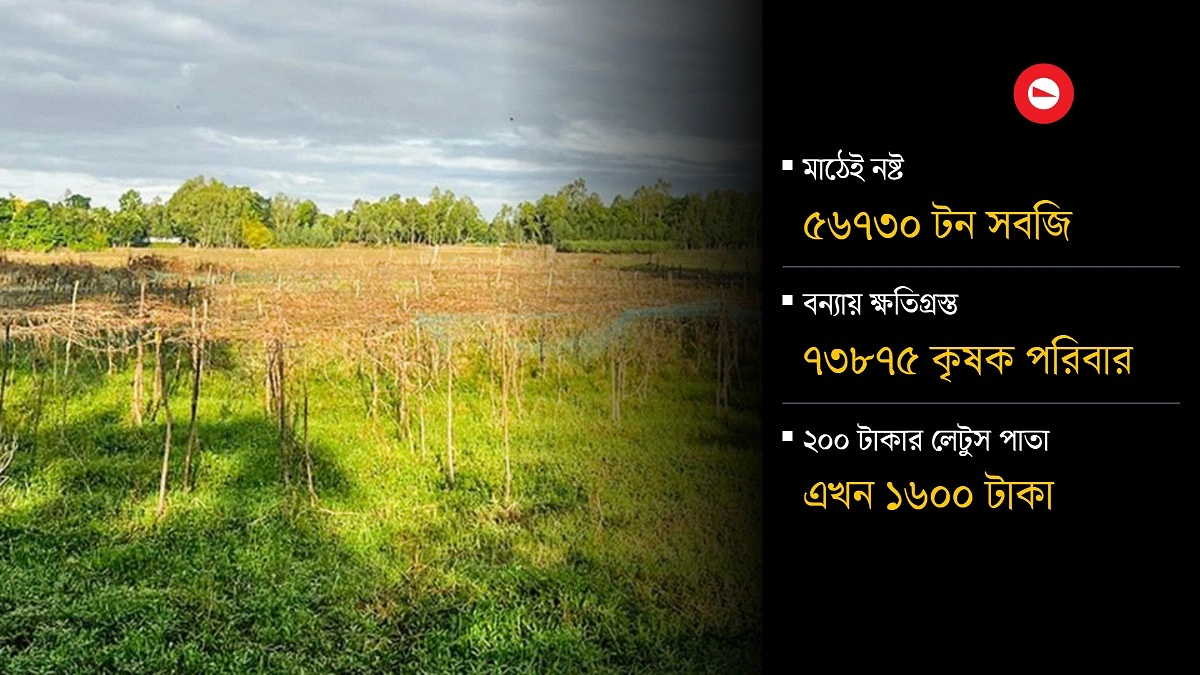
Vegetable fields in Chattogram and Cox’s Bazar have been completely destroyed by floods. There are no vegetables in the fields. For the past week, northern Bangladesh has been meeting the region’s vegetable demand. Buyers are therefore having to buy at high prices. Farmers say that if the weather is favourable, it will take at least two months for new vegetables to reach the market. Until then the people of the Chattogram region will have to depend on vegetables from the north.
According to the agriculture department’s figures, the floods destroyed vegetables on 9,208 hectares of land in the Chattogram and Cox’s Bazar region, damaging a total of 56,730 tonnes of vegetable production. In money terms that is about 140 crore 82 lakh taka. A total of 73,875 farming families have been affected in this sector. That is, 56,500 tonnes of vegetables were destroyed in the fields. Chattogram could have run for at least two months on that vast quantity of vegetables.
The additional director of the Chattogram regional Department of Agricultural Extension, agriculturist Mohammad Ali Jinnah, said: “The agricultural losses have been calculated and sent to the ministry for compensation. We are waiting for approval.”
With the fields wiped out, vegetable prices have risen sharply from the wholesale markets of Chattogram and Cox’s Bazar to the retail markets. At the wholesale market of the port city’s Riazuddin Bazar, the cheapest vegetable is papaya at 22 taka a kilogram. The most expensive is ridge gourd at 100 taka.
In addition, at the wholesale markets brinjal is selling at 80 taka, potol at 50, bottle gourd at 40, snake gourd at 35-40, arum flower at 35, yardlong beans at 90, okra at 70, bitter gourd at 80, kakrol at 90, ridge gourd at 100 taka and arum shoots at 50 taka. Tomatoes imported from India are 100 taka a kilogram. Chilli is 200 taka. Lettuce, at 200 taka a kilogram, is now 1,600 taka. Spring onion, at 150 taka, was seen selling at 400 taka. Vegetables are selling in retail markets at between one and a half and two times the wholesale price.
The owner of Ekta Banijyalaya at Riazuddin Bazar, Nasir Uddin, said: “For a week the supply of vegetables has fallen by half. No vegetables are coming from Chattogram and Cox’s Bazar. Vegetables from northern Bangladesh are now meeting Chattogram’s demand. That is why prices have shot up. I do not know how long this will go on.”
Two kinds of vegetables come to the Riazuddin Bazar wholesale market: from Chattogram, southern Chattogram and Chakaria-Pekua in Cox’s Bazar — these are fresh, somewhat more expensive and better in taste — and the rest from northern Bangladesh, known as “line vegetables,” which are somewhat cheaper. The wholesale market used to receive 60 truckloads of vegetables a day from the north alone. That has now halved to 30 truckloads. Thirty truckloads means 450 tonnes of vegetables. Besides this, vegetables used to come in trucks of 1 to 3 tonnes from southern Chattogram, the upazilas around Chattogram and Chakaria-Pekua. That quantity was also 250 tonnes a day. All of that 250 tonnes has stopped reaching the market. That is mainly why prices have shot up.
The extensive vegetable fields of Kakara union in Chakaria upazila have now been swallowed by the flood. Only the vegetable trellises can be seen. The farmer Abu Taher said: “If I plant vegetables today it will take 50 days for the yield to come. And that is only if there is no fresh flooding and the weather is favourable. But there are no seedlings ready to plant today. So after planting seedlings it will take two months for vegetables to reach the market.”
Vegetables produced in Chakaria and Pekua used to be supplied to Cox’s Bazar as well. Now vegetables from northern Bangladesh are meeting demand there.
A professor of Pekua Shaheed Ziaur Rahman Coastal College, Mostafa Zaman Kharech, said: “Unless seed, seedlings, agricultural inputs and financial incentives can be ensured for the 73,875 farming families severely affected by the flood to get back on their feet, it will be hard to recover from this blow.”
বাংলায় মূল প্রতিবেদন পড়ুন · Read the original Bengali report