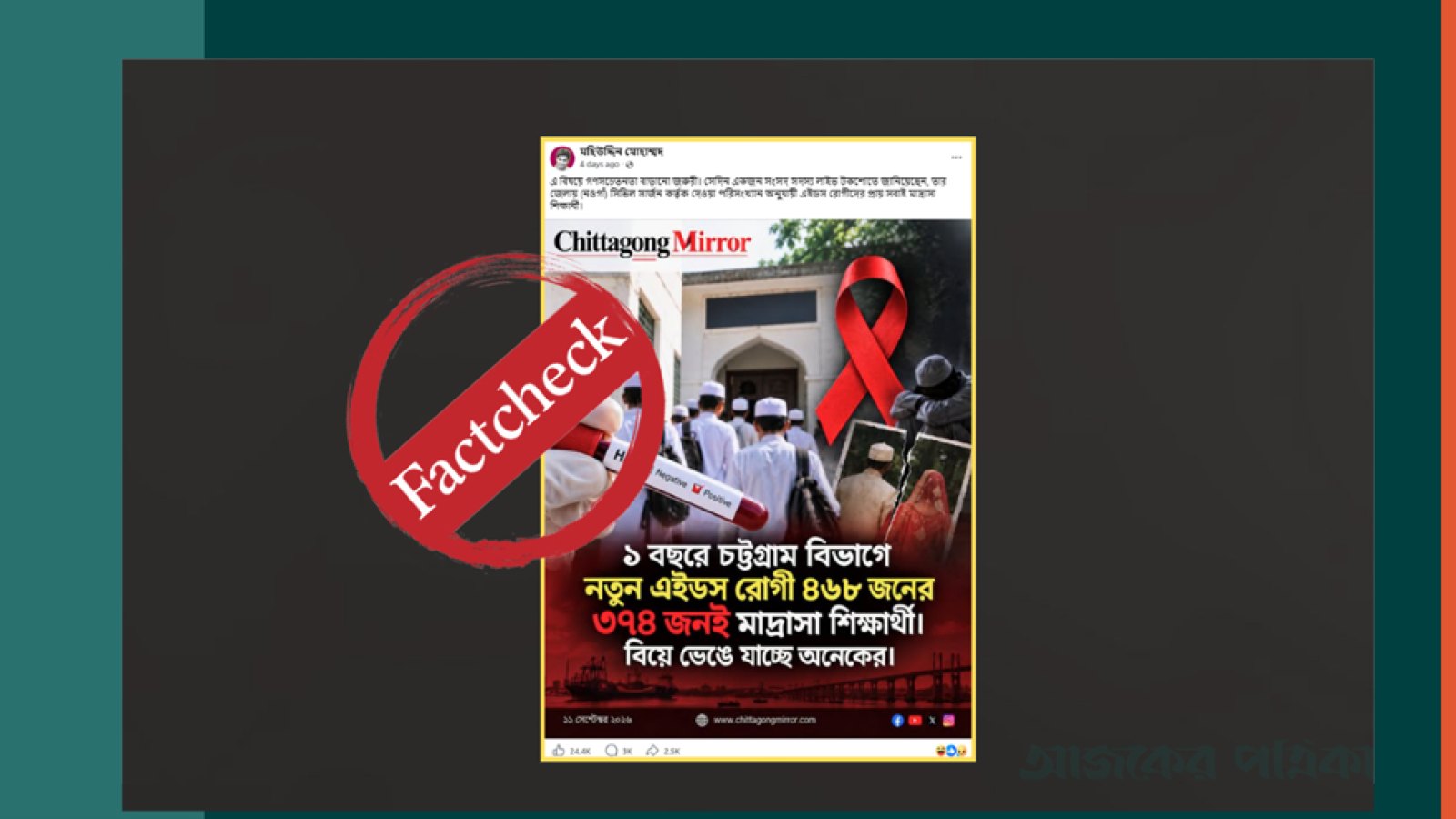
A photocard has spread on social media claiming that 374 of 468 newly detected HIV patients in Chattogram division are madrasa students.
The photocard was shared with that claim on Friday (September 11) from a Facebook page called Mohiuddin Mohammad. The caption claimed it was urgent to raise public awareness on the matter, and said a member of parliament had stated on a live talk show that day that, according to figures given by the civil surgeon of his district, Naogaon, almost all HIV patients were madrasa students.
By 4pm on Wednesday (September 16), the shared photocard had 24,400 reactions, 3,000 comments and 2,500 shares. The photocard was shared with the same claim from several other accounts as well.
A review of the comments on the posts showed that most users took the claim to be true. One commenter said: “As you sow, so shall you reap.” Another said: “Say anything now and they will say the hajji sahib’s mouth is unclean.” Another said: “There is a ghost in the mustard seed.”
Ajker Patrika’s investigation
The photocard being circulated carries the words “Chittagong Mirror”, the address www.chittagongmirror.com and the date September 11. A search on those details found no account or page by the name Chittagong Mirror. The website mentioned on the photocard could not be accessed either.
Closer examination of the photocard also showed that the image used on it was created with the help of OpenAI’s artificial intelligence technology.
No national news outlet was found to support the circulated claim. A report by the private television channel DBC News was found, however. Published on September 3 under the headline “HIV patients rising by the day in Chattogram”, it said a large share of those infected were young people, gay men and returnees from abroad, and that deaths were rising as well.
According to the anti-retroviral therapy (ART) centre at Chattogram Medical College Hospital, opened in 2017 to treat people with HIV, a total of 959 HIV-positive patients have been registered at the centre so far. Of those, 723 are currently receiving regular treatment: three female sex workers, 32 male sex workers, three third-gender people, five drug users, 90 local couples, 127 expatriates and couples, and 320 from the general population.
Setting out last year’s figures, the report said new patients were coming to light each year as the scope of testing widened. In 2020, 558 people were tested and 44 were found to have HIV. Up to July this year, 59 tested positive out of 2,500 tests.
Further searching found a report in the national daily Prothom Alo on February 11 this year, headlined “HIV infection is higher in border districts — why is it lower in the Chittagong Hill Tracts?” That report said a notable number of those infected with HIV in the country in 2025 were found in border districts. By division, Dhaka has had the highest number of detections not only last year but for several years, followed by Chattogram division.
Of the total infected last year, the highest number, 650, was in Dhaka division, followed by Chattogram division with 376. Of the newly detected patients, 56 percent were from the mainstream population, 12 percent expatriates, 11 percent Rohingya and the remainder from the general population. By sex, 81 percent were men, 18 percent women and 1 percent hijra. The report also noted that people who injected drugs with syringes, gay men and migrant workers made up larger numbers among those with HIV.
The report said the public health specialist Abu Jamil Faisal considers illegal movement across Bangladesh’s borders a reality. He said that when someone carries the infection across in this way there is no opportunity to screen them at the border, and the problem grows in that case.
The report further said the Chittagong Hill Tracts cover about a tenth of the country, across the three districts of Rangamati, Khagrachhari and Bandarban. All three have borders with India and Myanmar, yet HIV infection is low in all three. Among them, Bandarban recorded no infection in 2025, while two people each were infected in Rangamati and Khagrachhari.
In 2016 there was no infection in Bandarban or Khagrachhari, while Rangamati had one. An official of the health directorate said HIV infection has long been low in the three hill districts and that they have seen this over time. The lower population density and smaller number of migrant workers in those districts appear to be part of the reason, the official said.
On why infection is low in the three districts despite their borders, Parash Khisa, a doctor in Rangamati and general secretary of a non-governmental organisation called Tongya, said the hill borders do not see the movement of people that Bangladesh’s other borders do. There is also less opportunity there for injecting drugs or for unsought sexual contact, he said.
Nowhere in any of these reports, however, was there any information that the number of new HIV patients in Chattogram in one year was 468, or that 374 of them were madrasa students. On the contrary, the total number of people infected in the division last year was 376.
What lay behind the Naogaon MP’s claim
In August this year, on a talk show on the private television channel DBC News, Fazle Huda Babul, member of parliament for the Naogaon-3 (Mahadevpur-Badalgachhi) constituency, cited information given by the upazila health officer and claimed that 12 HIV-positive patients had been detected in his district. He also said on the programme that all of them were madrasa students and that they lived in hostels.
Several reports from the time were found on this information. Those reports described the claim as baseless, citing Naogaon civil surgeon Aminul Islam. In them, the civil surgeon said the claim that 12 madrasa students in Naogaon were HIV-positive was baseless. The number of HIV patients in the district is only three. They are now under the supervision of the civil surgeon’s office and are well. Three patients tested HIV-positive in the district in 2025, and those three are the patients; nobody was newly infected with HIV in 2026.
Aminul Islam said 12 people came for blood tests in Naogaon in July and had HIV tests. HIV was not found in any of them. Kanis Farhana, the Badalgachhi upazila health and family planning officer, gave the same information.
The reports quoted Fazle Huda, the MP for Naogaon-3, as saying by mobile phone that three of the 12 had tested HIV-positive. He then ended the call.
Verdict
No truth was found in the photocard circulated with the claim that 374 of 468 newly detected AIDS patients in Chattogram division are madrasa students. Various figures on newly detected HIV patients in Chattogram division were found in the investigation, but none of them mentions any such number of madrasa students. Likewise, the claim that 12 madrasa students in Naogaon were HIV-positive has been described as baseless by the civil surgeon and the upazila health officer concerned.