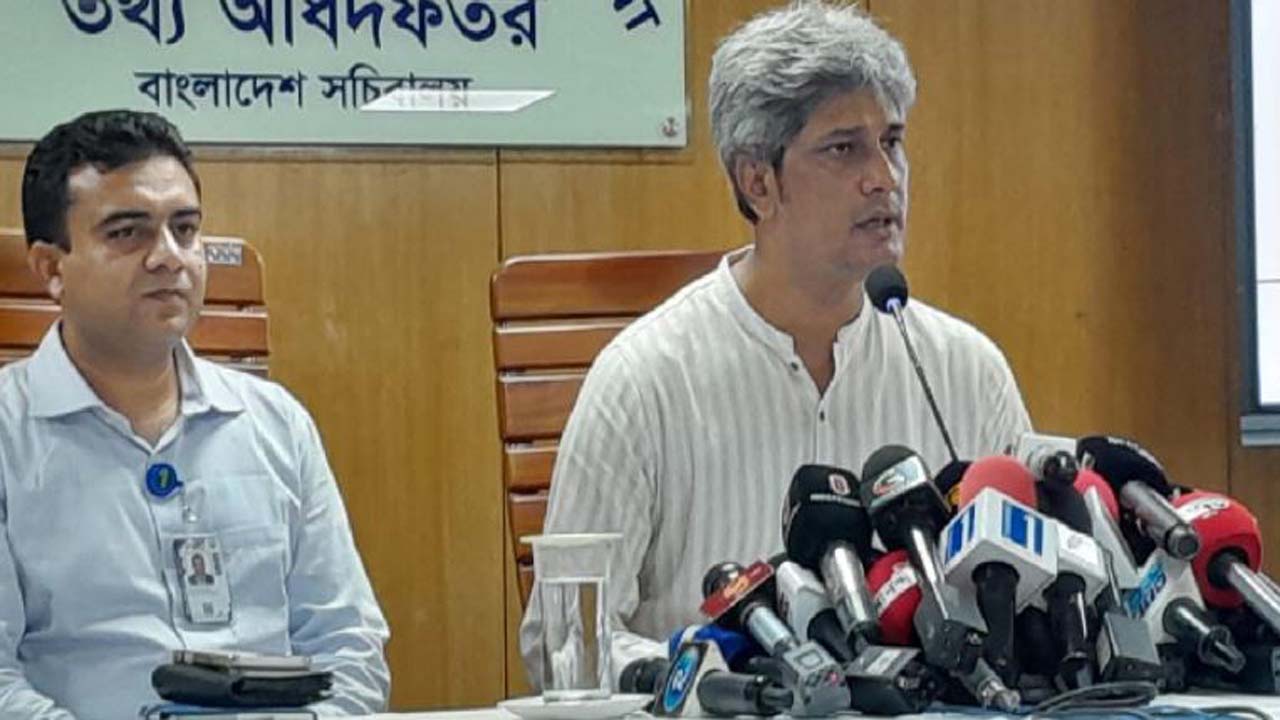
State Minister for Planning Md Jonayed Abdur Rahim Saki has said the government has adopted a comprehensive action plan to reduce delays in project implementation, strengthen accountability, frame a new policy for appointing project directors (PDs), revise the rate schedule for construction costs and increase monitoring through digital platforms.
The state minister spoke at a briefing for journalists at the Press Information Department (PID) on Wednesday after a meeting of the Executive Committee of the National Economic Council (Ecnec) at the Cabinet Division.
Jonayed Saki said the government had taken these steps to prioritise economic recovery, implement development projects quickly, prevent unnecessary spending and make public investment more effective.
He said the current government had inherited a project implementation system in which delays, weak coordination, overlapping responsibilities and a lack of accountability had raised project costs and delayed implementation.
He said eight development projects costing a total of 14,041.21 crore taka had been approved at that day’s Ecnec meeting.
A project to protect the Shibpur, Dhania and Medua areas of Bhola Sadar and Daulatkhan upazilas from Meghna river erosion was returned with observations. It will be revised according to Ecnec’s recommendations and placed before the next meeting.
Saki said the prime minister had reviewed each project in detail and given project-specific directions to cut unnecessary spending, ensure financial discipline and secure the best possible use of the public’s tax money. Every approved project will now be implemented according to those directions, he said.
“The prime minister and the government’s top policymakers are reviewing every stage of project preparation, financing and implementation,” he said. “Where unnecessary spending is happening is being identified, and it is being ensured that every taka of the public’s money is spent more efficiently.”
The state minister said the abnormally long time taken to implement development projects is one of the government’s main concerns. Under existing rules, he noted, it takes a year and a half to two years merely to complete formalities and obtain a work order even after Ecnec approval. In many cases field-level work starts late, slowing development and raising project costs.
“This delay has a negative effect on implementation of the Annual Development Programme (ADP) and postpones the expected economic benefits of public investment,” he said. “Rapid implementation of development projects is extremely important for accelerating economic activity, creating jobs and attracting domestic and foreign investment.”
The government is therefore building an integrated implementation framework to simplify project approval, reduce bureaucratic complexity and ensure faster implementation, Saki said. Ongoing projects and those included on the ADP’s “green page” are being reviewed through a “re-scoping” process, with project components to be added, dropped, expanded or reduced according to need and priority. The aim is to align public investment with the government’s election manifesto, the five-year strategic development framework and long-term national priorities.
The state minister said the planning ministry is implementing four major reform initiatives. First, a five-year strategic development framework has been prepared and approved in principle by the National Economic Council (NEC); its summary has been sent onward and it will be published as a national policy paper after formal approval. Second, a digital dashboard is being built to monitor the progress of every development project in real time. Third, the institutional weaknesses responsible for implementation delays are being reviewed and recommendations framed; the Implementation Monitoring and Evaluation Division (IMED) has already submitted a report identifying obstacles, which is under review.
Saki said a draft policy is also being framed for appointing project directors, providing for a transparent appointment process, specialised training, merit-based selection and institutional capacity-building for PDs. Training modules and institutional courses have already been prepared, and the government expects to complete the reform work within the next 180 days.
Fourth, extensive automation is under way to bring the Planning Division, IMED, the Bangladesh Public Procurement Authority (BPPA), the Bangladesh Bureau of Statistics (BBS), the National Board of Revenue (NBR), the Office of the Comptroller and Auditor General, Bangladesh Bank and IT-based citizen databases onto an integrated digital platform.
He said a high-level committee has already met twice on framing a revised rate schedule for construction work, in line with the prime minister’s earlier instruction, and will meet again the following day.
Asked why costs had risen on the Dhaka-Ashulia elevated expressway project although about 80 percent of the work is complete, Saki said the increase was caused by changes in foreign-exchange rates, changes in VAT and tax calculations, relocation of utility lines not included in the original DPP, and the addition of five new components.
On accountability, he said the preliminary report of an inquiry committee headed by the cabinet secretary into delays in the Rupsa road construction project in Khulna had been presented to the Ecnec meeting. The prime minister has directed that responsibility be fixed and appropriate action taken against those responsible on the basis of the inquiry report.
Expressing optimism about the reforms, the state minister said the government expects major institutional reform to be completed within the next six months. Once the new system is in place, project implementation will improve significantly, public accountability will strengthen, ADP implementation will speed up and Bangladesh’s economic recovery and sustainable development will accelerate, he said.
বাংলায় মূল প্রতিবেদন পড়ুন · Read the original Bengali report