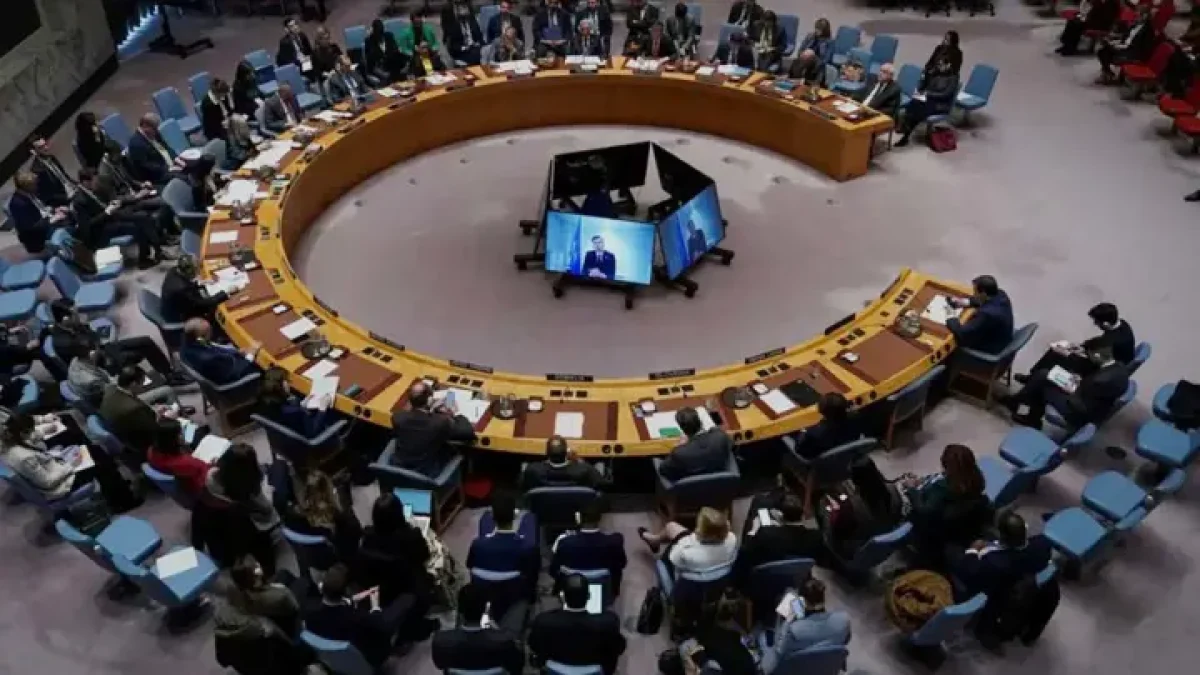
India has stepped up its effort to gain a permanent seat on the United Nations Security Council. Four central European countries — Hungary, Poland, Slovakia and the Czech Republic — have now given collective support to its claim. This adds new diplomatic backing for India in the decades-long discussion of Security Council reform.
India held its first meeting with the Visegrad Group, or V4, on the margins of the 81st session of the United Nations General Assembly in New York. The alliance’s four member states backed India’s aspiration to a permanent seat at the meeting.
After meeting India’s foreign minister S Jaishankar, Slovakia’s foreign minister Juraj Blanar said the V4 countries agreed that India, as an important country of the Global South and a rising power in the Indo-Pacific, needs to be included as a permanent member of the United Nations Security Council.
India argues that the realities of the world today have changed greatly from the world of 1945, when the Security Council was established. Vast areas of Asia and Africa were then under colonial rule. Many countries that are important today in population, economy and international influence were not even independent states at the time. Delhi has therefore been demanding that the council’s present structure be brought into line with the changed realities of the world.
India has so far served eight times as an elected member of the Security Council, most recently in 2021 and 2022. Its case for a permanent seat rests on its population, economic capacity, contribution to United Nations peacekeeping and growing influence in international diplomacy. India is also active on issues such as countering terrorism, development, maritime security and international peace.
In a document on its priorities published ahead of the 81st General Assembly, India said the United Nations’ failure to respond effectively to various conflicts has raised questions about the organisation’s effectiveness, credibility and legitimacy. For Delhi, therefore, Security Council reform is not confined to making India a permanent member; it also involves making the whole structure more effective so that it reflects current global realities.
France, the United Kingdom, the United States and Russia have already supported India’s claim. Among the council’s five present permanent members, however, China has still not directly backed a permanent seat for India. Beijing has said it understands and respects India’s aspiration while noting that broader consensus is needed on the matter.
India is a member of the G4 alliance along with Brazil, Germany and Japan. The four support each other’s claims to permanent membership and coordinate their positions in the discussion on Security Council reform. Under the G4’s proposal, the council’s present 15 members could be increased to 25 or 26.
The proposal speaks of creating six new permanent seats: two for Africa, two for Asia-Pacific, one for Latin America and the Caribbean and one for Western Europe and other states. It also speaks of adding four or five additional non-permanent seats.
The five present permanent members — the United States, Russia, China, France and the United Kingdom — have not yet agreed on any common framework for expanding the council. There are differences over the number of new members, how many seats each region would get, whether new permanent members would be given the veto, and how the council would operate after reform.
One of the most important arguments is over the veto. At present the five permanent members can block important decisions, while elected members cannot. The African Union favours abolishing the veto in the long term. If the veto is retained, however, it demands that new permanent members be given the same rights as the present five.
India’s position is much the same. In a statement in April 2026, Delhi said there should be no separate class of permanent member in which some countries hold the veto while other permanent members are deprived of that right. India has spoken of an all-or-none principle: in Delhi’s position, all permanent members, present and new, should have equal rights, privileges and responsibilities.
Jaishankar, meanwhile, sees the meeting with the V4 as a new chapter in relations between India and the countries of central Europe. Thanking Slovakia’s foreign minister Blanar for arranging the meeting, he called it a new historic occasion.
Security Council reform was not the only subject of discussion at the meeting. India and the V4 countries also agreed to widen bilateral institutional relations. As part of that, plans have been made for an annual business forum and regular meetings of the two sides’ foreign ministers.
Jaishankar said that against the background of India’s deepening relationship with the European Union, there was agreement on taking some particular initiatives with the V4, including an annual business forum and regular meetings at foreign minister level.
The V4’s support is not enough to secure India a permanent seat. Security Council reform still depends on continuing discussions with many countries and on the positions of the present permanent members. But this collective support from four central European countries has widened the scope of international backing for India’s claim.
In Jaishankar’s words, India has good relations with the V4 countries, which have notable capacity in industry, innovation and technology. How the V4 proceeds in future is its own decision, he said, but India welcomes the opportunity to work more closely with them.