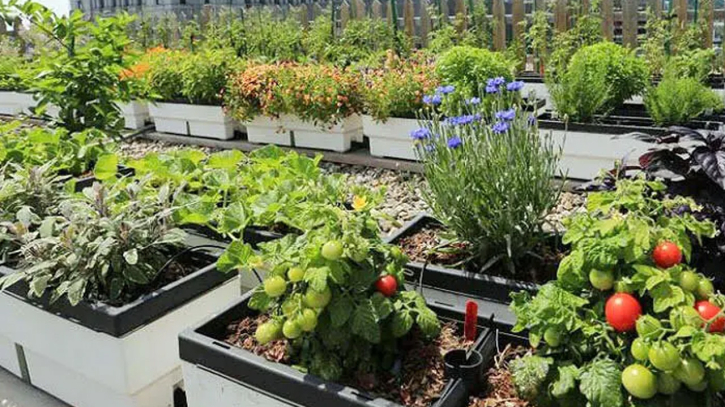
Rooftops in both cities and villages can be used to grow safe, poison-free vegetables, fruits, spices, and herbal plants. Planned rooftop farming using pots, drums, beds, buckets, or various containers can meet a household’s nutritional needs while reducing grocery expenses. Rooftop farming also plays an important role in cooling the environment, increasing oxygen levels, and providing mental relaxation. Md Rafiqul Islam, Sub-Assistant Agriculture Officer of Jashore Sadar upazila, offered this advice in a regular segment by “Runner Krishi.”
Rooftop farming involves growing vegetables, fruits, spices, and herbal plants in pots, drums, beds, or trays on a home’s roof. This type of farming can be planned on rooftops in both urban and rural homes.
Rooftop farming provides fresh, poison-free vegetables and fruits. It also helps cool the environment, increase oxygen levels, and boost urban greenery. Alongside reducing a household’s grocery expenses, tending to plants on the roof can also provide mental relaxation. Rooftop farming is beneficial from environmental, health, and financial perspectives alike.
Roof preparation and container selection
Before starting a rooftop garden, ensure water doesn’t pool on the roof. Waterproofing on the roof is beneficial. However, excessive weight should not be placed on the roof. Rooftop farming should be planned considering the roof’s load-bearing capacity, including the weight of containers and soil.
Earthen pots, plastic containers, drums, buckets, and foam boxes can be used for planting. Each container must have drainage holes at the bottom. Larger plants may require containers with a capacity of 20 to 30 liters.
Soil preparation
A suitable soil mixture must be prepared for good yields in rooftop farming. An ideal soil mixture can include 50 percent loamy soil, 30 percent decomposed cow dung or compost, and 20 percent sand or coco peat.
The soil should be kept loose and well-draining. The amount of soil should be determined based on container size, and containers should be selected based on the type of plant.
What crops can be grown
Various vegetables, spices, herbs, and fruits can be grown on rooftops. Among leafy greens, red spinach, spinach, coriander, and lettuce can be grown; among vegetables, tomatoes, eggplant, okra, cabbage, cauliflower, and broccoli.
Among spice crops, chili, cardamom, and ginger can be grown, and among herbal plants, holy basil, sweet lime, seedless lemon, henna, and neem. Among fruits, mango, guava, pomegranate, dragon fruit, and various other fruit trees can be grown in suitable rooftop containers.
Irrigation and fertilizer management
Rooftop farming requires regular irrigation. Generally, watering can be done daily or every other day. However, irrigation should account for weather, plant type, and soil moisture. Watering is best done in the morning or afternoon. Overwatering should be avoided — if water pools in containers, plant roots can be damaged.
Organic fertilizer, compost, or vermicompost can be applied every 15 days. Depending on the plant type and container size, 1 to 2 kilograms of organic fertilizer can be applied per pot. Good yields can also be achieved using liquid fertilizer or biofertilizer.
Pest and disease control
For pest and disease control in rooftop farming, it’s best to first use organic and eco-friendly methods. Neem oil can be mixed at 3 to 5 milliliters per liter of water and sprayed on plants. Garlic and chili extracts can also be used for pest control.
For controlling harmful pests such as mites and red spiders, consult an agriculture officer before using approved pesticides, and follow the dosage and instructions on the product label. Chemical pesticide use should be avoided as much as possible.
Maintaining a home’s structural balance must be carefully considered in rooftop farming. Children’s safety should also be kept in mind. Containers should be placed in a way that eliminates any risk of accidents for children.
Rooftop farming doesn’t just make unused space productive — it also helps create a safe food source for the family, maintain environmental balance, protect health, and reduce household expenses. For this reason, planned expansion of rooftop farming is needed.
বাংলায় মূল প্রতিবেদন পড়ুন · Read the original Bengali report