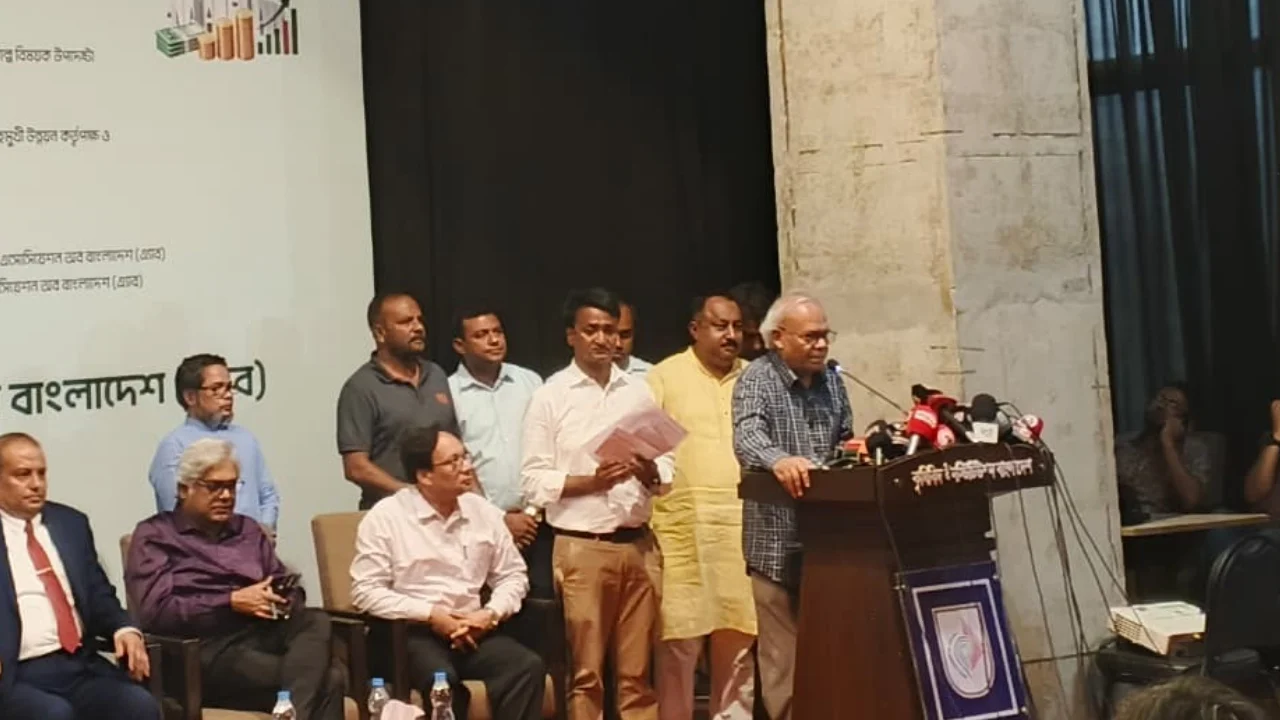
Agriculture should get a higher budget allocation given its importance for the country’s food security, employment and the control of inflation, said Ruhul Kabir Rizvi, the prime minister’s adviser on political and industrial affairs and BNP senior joint secretary general.
He made the remarks on Monday at a seminar titled “Budget 2026-27: The blueprint for agricultural development and the challenges of implementation,” organised by the Agriculturists’ Association of Bangladesh (AAB) at the Krishibid Institute in Farmgate, the capital. Rizvi said the target of providing agriculture cards to 42,50,000 farmers under the Tk 9,38,000 crore budget was an important initiative that would play a major role in agricultural development through rural financing.
Recalling his experience as chairman of Krishi Bank and RAKUB, he said a rural agricultural-credit programme had been launched in the time of the late President Ziaur Rahman after the 1974 famine, when Tk 100 crore was allocated for farmers — playing an important role in reviving the rural economy. Initiatives such as agricultural mechanisation, the spread of power tillers, canal excavation and rice exports had also helped advance the sector, he said.
Rizvi said that although the allocation for agriculture had risen from last year, the increase was not very large once inflation was taken into account. While agriculture’s contribution to the economy currently stood at five to six percent, he said, a target should be set to raise it to seven to eight percent. He said about 40 percent of the country’s total employment was centred on agriculture, so the sector needed greater emphasis.
He said that although the national budget had grown by 17.7 percent, the increase in the agriculture allocation was not large in comparison. More allocation and oversight were needed in the sector to achieve the government’s targets, otherwise the desired transformation of agriculture could be disrupted. Drawing on a recent visit to Vietnam, Rizvi said the country had expressed interest in taking one lakh metric tonnes of potatoes from Bangladesh, of which 30,000 metric tonnes were being taken this time. Expanding export markets for agricultural goods such as potatoes would make it easier to market farmers’ produce and prevent surplus output from going to waste, he said.
Calling for greater emphasis on agricultural research, he said large numbers of agriculturists were graduating from the country’s agricultural universities and colleges, and ensuring proper use of their talent and research would allow the sector’s potential to be fully realised.
Rizvi also stressed using modern technology to preserve agricultural produce. If technology to preserve fruit and vegetables — besides potatoes — for long periods could be brought to the country, surplus seasonal produce would not be wasted, he said, urging the use of advanced technology and encouragement of entrepreneurs.
He said import dependence could be cut by further increasing the production of items such as onion, ginger and garlic, which would require expanded research and extension work.
Rizvi said that although the country lacked sufficient raw materials for heavy industry, agriculture could be Bangladesh’s main industrial base. Citing the examples of New Zealand and Denmark, he said those countries had prospered by building agriculture-based industries, and Bangladesh too had scope to expand such industries.
He said that if agriculture weakened, food security, employment and inflation would all suffer, so achieving the government’s targets required more allocation, research and the training of scientific manpower in the sector.
The seminar was chaired by AAB convener Dr Kamruzzaman Kaiser and conducted by member-secretary Shahadat Hossain Biplob. Agriculture ministry secretary Dr Rafiqul I Mohammad, Bangladesh Agricultural University agricultural finance and banking department head Dr Md Aktaruzzaman Khan, Deepto Television head of news SM Akash and Chhatra Dal vice-president Dr Touhidur Rahman Auwal, among others, were present.
বাংলায় মূল প্রতিবেদন পড়ুন · Read the original Bengali report