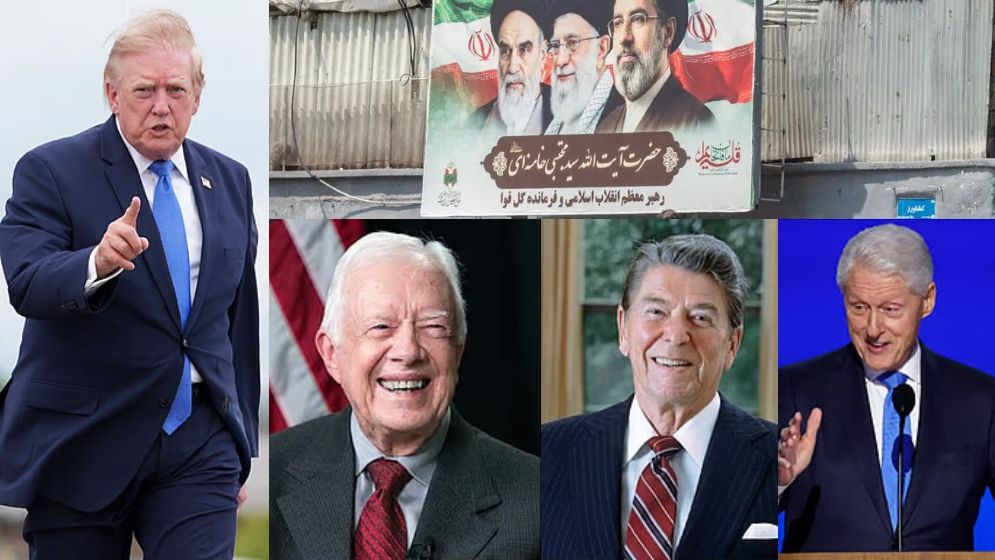
On Monday, Trump angrily claimed that Iran was behaving with unbelievable deceit in its dealings with the United States — the latest sign of how hard he is finding it to understand Tehran’s leaders.
Trump considers himself a master at sizing up opponents and exploiting their weaknesses. But Iran’s leaders have made a fool of him, the piece argues. Last week he told reporters that they (Iran) just make him angry.
More frustration may lie ahead for the US president. Trump administration officials say a new deal to reopen the Strait of Hormuz may be close, but Iran is holding firm on charging a toll, which Trump has dismissed as unacceptable.
Trump’s failure to reach a favourable deal with Iran has not only hurt him politically with war-weary voters, but the ongoing conflict around this vital waterway has also destabilised the oil market, harming the world economy and US consumers.
Trump is not the first US president to struggle to understand Iran. Since the 1979 Islamic revolution, almost every one of his predecessors has tried to grasp Iran’s mysterious power structure and the mindset of its political leadership.
Most have failed; some have been seriously damaged. A rare exception was President Barack Obama, whose 20 months of diplomacy produced the 2015 Iran nuclear deal. Obama considered it a major achievement, but Republican and some Democratic leaders criticised it, saying Iran had feigned moderation to lure him into a flawed agreement.
But Kenneth Pollack, a former CIA analyst and National Security Council official who has worked on Iran for decades, said Trump may be the president who has understood Iran’s leadership the least.
Pollack said Trump was in many ways the ultimate expression of America’s frustration with Iran: he was the most eager to make a deal, yet also applied the most force against it — and found that neither brought him his desired goal.
Trump often talks as if applying massive force will quickly produce a deal. After the war began with the death of Iran’s supreme leader Ali Khamenei — in power for nearly 40 years — in an air strike on 28 February, Trump called on the Iranian people to rise up against their government. He even said he would then choose Iran’s next leader himself.
Many other senior Iranian officials were also killed in the air strikes. But there was no popular uprising. Instead, Iran’s hardline government took an even tougher stance. In March it appointed Khamenei’s son Mojtaba Khamenei as the new supreme leader. US officials believe he is even more inflexible than his father and more keen on acquiring a nuclear bomb.
Iran simply ignored Trump’s public declaration that the younger Khamenei would be an unacceptable choice. The new Khamenei did not even respond to Trump’s offer of a direct meeting.
Even so, Trump did not give up hope of a big change. In late April he said that if Iran made a deal, it could be in a very good position — becoming a legitimate country rather than one dependent on death and terror.
Iranian officials say they can talk to Trump about issues such as the Strait of Hormuz and their nuclear programme, though they have rejected many of his core demands. But in a political system built on hostility to the United States, no one shows interest in any broader accommodation with America.
In the way Trump has bargained with Iran for months, there is no sign that he has understood the country’s system of government well. During the conflict, Trump constantly changed his assessment of Khamenei and his ministers — sometimes calling them crazy, sometimes rational, sometimes very clever and sometimes completely mad. In a sense, Trump is going through the same frustration that afflicted his predecessors.
Suzanne Maloney, foreign-policy director at Washington’s Brookings Institution, said US policymakers had for decades consistently underestimated the Islamic Republic’s ideological commitment and deeply institutionalised power structure.
Maloney said one big problem was the extreme lack of direct contact between US officials and top Iranian leaders. No US official had ever met Iran’s first supreme leader Ayatollah Ruhollah Khomeini, the recently deceased Ali Khamenei, or his son.
Maloney also said the war had probably further consolidated the power of Iran’s religious and military leadership, leaving no effective alternative centre of power.
In Iran’s semi-democratic political system — where the president and parliament remain under the supreme leader’s absolute religious authority — high officials favouring friendly relations with the United States have occasionally emerged. But whenever Washington tried to reach out to them, the result was mostly disappointing.
Dennis Ross, a veteran Middle East diplomat who served under presidents of both parties, said: “It seems the Iranians understand us far better than we understand them.”
In 1980, President Jimmy Carter authorised secret talks with Iran’s foreign minister to free 52 Americans taken hostage at the US embassy in Tehran. Carter’s diary shows that, like Trump today, he was preoccupied with the intricacies of Iran’s political maneuvering and the rivalries among top Iranian officials. In early 1980 Carter thought he had reached a deal on the hostages’ release (in exchange for returning Iran’s frozen billions and a US pledge of non-interference in its internal affairs).
But what Carter called a bitter disappointment came when Khomeini rejected the offer, surprising US officials and even Khomeini’s own subordinates. Carter eventually ordered a hostage-rescue mission that failed. He later freed the Americans through a deal on his last day in office.
Five years later, President Ronald Reagan ordered aides to examine a message from an Iranian arms dealer claiming that, after the ageing Khomeini’s death, Iran’s moderate officials would be keen to establish friendly relations with the United States.
As part of what Reagan called a strategic opening, he secretly authorised the sale of US weapons to Iran in exchange for the release of American hostages held in Lebanon. This later became known as the Iran-Contra scandal, because the money from the arms sales was sent, without Congress’s knowledge, to a hardline anti-communist rebel group (the Contras) in Nicaragua.
When the affair was exposed, Reagan’s presidency faced a huge scandal. Several US officials pleaded guilty or were convicted; Reagan’s former national security adviser even attempted suicide.
The attempt to build ties with Iran turned out to be nothing but a mirage. No friendly, liberal leader was found in Tehran, and the CIA believed the arms dealer who started it all was a fraud. Reagan denied knowing the key facts and apologised to the nation in a speech, but stood by his main goal of drawing in Iranian moderates.
In 1997, a big opportunity came before President Bill Clinton when the reformist candidate Mohammad Khatami was elected Iran’s president. Khatami called for good relations with the United States and even expressed regret over the hostage crisis — a genuinely positive step.
Clinton responded positively. He lifted a ban on imports of Iranian pistachios and carpets and softened his tone by acknowledging some of Iran’s historical grievances. Secretary of State Madeleine Albright even publicly apologised for the CIA’s support in the 1953 overthrow of Iran’s prime minister (who had nationalised the Western-controlled oil industry).
But powerful hardliners opposed Khatami’s liberal approach, seeing reconciliation with the United States as a major threat to their anti-Western ideological base. Days after Albright’s speech, Ali Khamenei (who became supreme leader after Khomeini’s death in 1989) flatly rejected her words and ruled out any prospect of dialogue with Washington.
According to Karim Sadjadpour, an Iran expert at the Carnegie Endowment for International Peace, Khatami later said privately that Khamenei believed Iran could never make peace with the United States.
Only Obama managed a big diplomatic deal with Iran (the 2015 nuclear agreement), which imposed limits on Iran’s nuclear programme for 15 years in exchange for lifting economic sanctions.
Many Obama administration officials hoped the deal, reached with another moderate Iranian leader, Hassan Rouhani, might be a first step towards improving relations. It was not. Khamenei approved the deal but showed no desire to take it further; critics said this proved their warning that Rouhani would turn out to be just another Khatami.
Iran’s suspicion that the United States could not be trusted was soon proved right. In 2018, Trump withdrew from the nuclear deal and imposed even harsher economic sanctions than before.
In response, Iran accelerated its nuclear programme, which ultimately led to a devastating conflict with the United States through the war Trump began last February.
Dennis Ross said that since then, Iran had consistently stayed a step ahead of Washington, and that Trump’s obvious rush to end the war had made their task easier. “They use our haste as a bargaining tool. We always look as if we are in a hurry to finish quickly. They work on the principle that time serves their interests more than ours,” Ross said.
বাংলায় মূল প্রতিবেদন পড়ুন · Read the original Bengali report