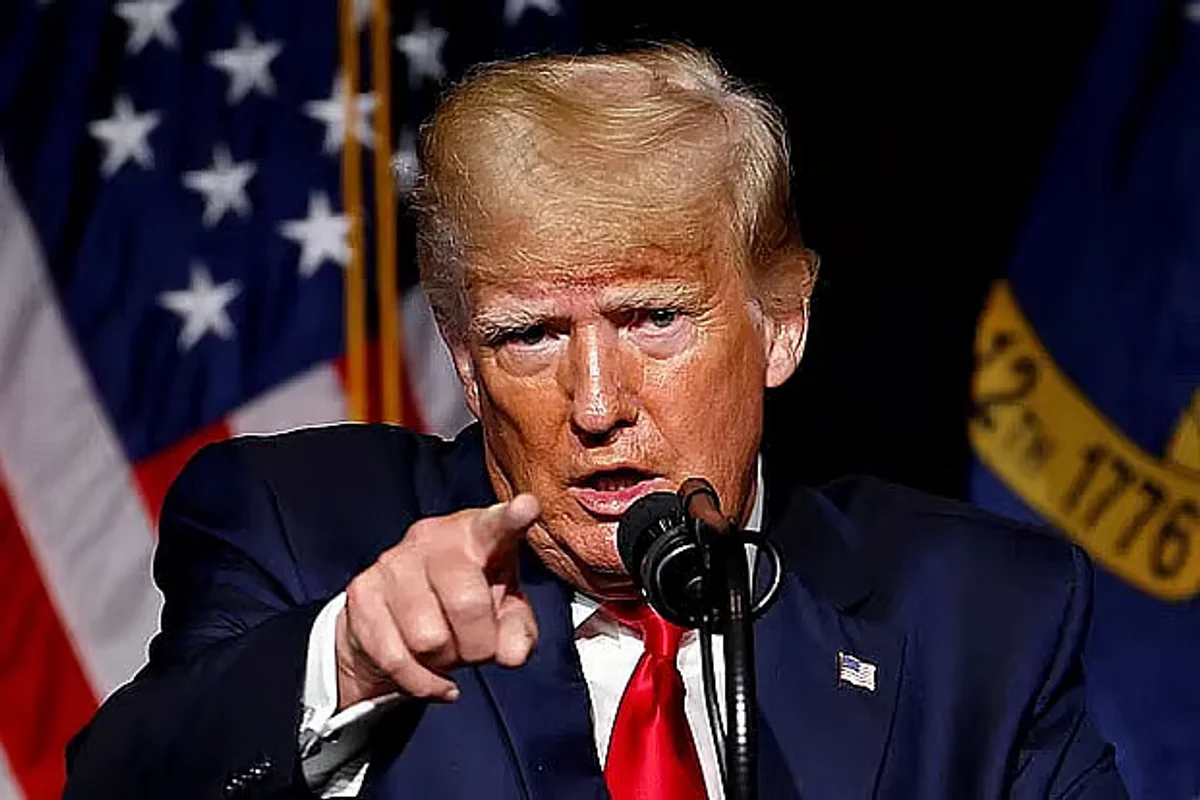
Experts believe fresh thinking is needed to escape the ongoing conflict between the United States and Iran. The US struck Iran again last Wednesday, and President Donald Trump has once more threatened Iran with a “devastating strike.” Yet he has shown no strong sign of using such strikes to bring Tehran back to the negotiating table.
Meanwhile, the vaguely worded memorandum of understanding that Trump had hailed as a diplomatic effort to bring “historic peace” to the Middle East has now ended in failure.
The options before Trump to change the current equation — whether risking the lives of hundreds of US troops in a ground war or accepting Tehran’s control of the Strait of Hormuz — have both become bitter prospects. “There’s no suitable path open” has become a stock phrase. Lyle Goldstein, director of Asia programs at the US think tank Defense Priorities, said: “We are really in a deep dilemma.”
The effects of the Iran war are not confined to the parties directly involved. Its negative political and economic fallout is intensifying across the Middle East and Europe, and outside parties are steadily pressing to restart the stalled diplomatic process.
If the Strait of Hormuz remains unusable for most civilian shipping — a “no-go zone” — the war’s severe negative effects will worsen further. That would both drain global oil stocks and send prices for fuel and farm inputs such as diesel and fertiliser soaring.
Fears are also growing of a severe shortage of liquefied natural gas (LNG) in Europe in the coming winter. The war has shattered the image the Gulf states had built as safe havens for luxury tourism and expatriates.
Because the war has driven up the cost of living abnormally, Europe’s shaky governments now face public anger and difficult challenges.
In the United States, the war risks shaping the course of Trump’s second term. A new CNN/SSRS poll released Wednesday found public support for Trump’s policies on the Iran situation and on controlling fuel prices has fallen below 30 percent.
These polling figures could prove disastrous for Republicans in November’s midterm elections. They also risk hollowing out or casting doubt on the very promise — cutting the cost of living — with which Trump drew voters in 2024.
One idea is the creation of a new international body under which Iran and the Gulf states would jointly manage the trade route and arrange its commercial operations in a way that keeps world oil prices stable.
Ironically, the solution to the crisis may have existed plainly within that scrapped memorandum. The document called on Iran and Oman to work out, through talks with other Gulf coastal states, a framework for the “future administration and maritime services of the Strait of Hormuz.”
Another possible way to break the diplomatic deadlock could emerge from outside the United States. A UK-led international conference on the safety of shipping in the strait was reportedly planned this week but did not take place. Still, the core idea of widening diplomacy has a strong chance of resurfacing — largely because third parties such as Europe and East Asia have much to lose from the current instability.
The only diplomatic activity to surface publicly in recent days was deputy foreign minister-level talks between Iran and Oman. Oman is also a country on the strait’s coast. The talks focused mainly on possible ways to manage maritime shipping if the strait is reopened.
CNN reported this week that Oman has opposed Tehran’s position on imposing a transit fee on oil tankers passing through the Strait of Hormuz. Oman based its objection on the international-law provision for free and safe passage through straits used for international navigation.
To break the deadlock, however, the Omani government is putting forward a compromise proposal to charge a “fee” for “maritime services” rather than a direct toll. That could serve as a strategic alternative to resolve the current tangle.
The article sketched a possible revenue model, drawing on the fee used at the Netherlands’ Rotterdam port, where huge tankers pay about $0.08 per gross metric tonne of cargo as a “sustainability fee.” By the authors’ calculation, a similar fee in the Persian Gulf could earn the proposed new body about $26 million a year.
The idea could ultimately work even if Iran demands a far larger share, because adding a few dollars to each barrel of oil is far cheaper economically than the current extreme volatility in the oil market. That instability pushed oil prices up by about 8 percent last Wednesday alone, past $90 a barrel.
Esfandyar Batmanghelidj, one of the article’s authors, believes Tehran may be more flexible about the financial prospects of such a project than many outsiders assume. Given how worried Iran is about its economy, he said, it has far bigger goals in the Strait of Hormuz than merely imposing a fee.
For example, Batmanghelidj said, any diplomatic path opening with the United States could lead to sanctions on Iran being lifted or to Iranian oil exports flowing freely again.
He also suggested such an understanding would give Tehran a major strategic advantage, letting it signal that the Strait of Hormuz will never return to its pre-war state. Through this, Iran would seek to prove it was not defeated but managed to keep its own authority and strength intact even through a long conflict with the United States.
Lyle Goldstein, however, believes Trump now faces such a shortage of options that reaching an understanding despite countless constraints may ultimately be inevitable.
“This is going to be the most painful of all possible settlements,” Goldstein said. “For exactly this reason, as a state, and the Western world as the world’s leading power, we have long claimed freedom of navigation as one of our most basic principles.”
Most modern US presidents have turned to allied countries to strengthen diplomatic pressure on Iran. In the Obama-era nuclear deal, for instance, Europe was one of the main drivers of diplomacy. Europe maintains some diplomatic ties with Iran that the United States severed after the 1979 Islamic revolution.
But Trump has done extensive damage to the historic trans-Atlantic alliance. Through one tariff after another and cutting remarks, he has treated longstanding allies almost as enemies.
Before a war that allied countries consider “illegal and reckless,” Trump even refused to consult them. At the same time, he sharply rebuked those same allies for not joining the US military operation.
As a result, politically weak European leaders now have little urge or incentive to help Trump. NATO allies also have their own constraints on acting. European countries have offered to deploy their powerful mine-clearing equipment in the Strait of Hormuz, for instance, but only on condition that all hostilities and warlike activity stop.
Any European initiative in the Middle East risks facing the same obstacle as Oman’s: the erratic and confusing diplomatic strategy of a superpower that appears to shift largely according to Trump’s moods.
Ian Lesser, a distinguished fellow at the Brussels-based think tank the German Marshall Fund of the United States, said: “Seeking Europe’s cooperation to implement a specific, agreed strategy is one thing. But right now there is no such agreed strategy. In fact, exactly what America’s strategy is at this moment is not at all clear.”
Similar distrust of US intentions could also hinder diplomacy. Batmanghelidj said: “My conversations with parties connected to Tehran suggest they are not rejecting the proposal Oman has put forward.”
But he added that, with the United States continuing to escalate, giving up control of the strait right now is giving Iran pause. In his view: “Iran will probably let the situation in the strait return to normal at some point. That is essential in its own interest. It will probably do so under some regional framework. But it will not walk that path until it is sure the Americans have learned their lesson.”
Because Trump has been unable to stop the war, other Gulf states such as Oman and European powers are paying a heavy price. If Washington and Tehran cannot quickly break out of this mutually escalating, destructive spiral, others will have no choice but to intervene or step in to help.
বাংলায় মূল প্রতিবেদন পড়ুন · Read the original Bengali report