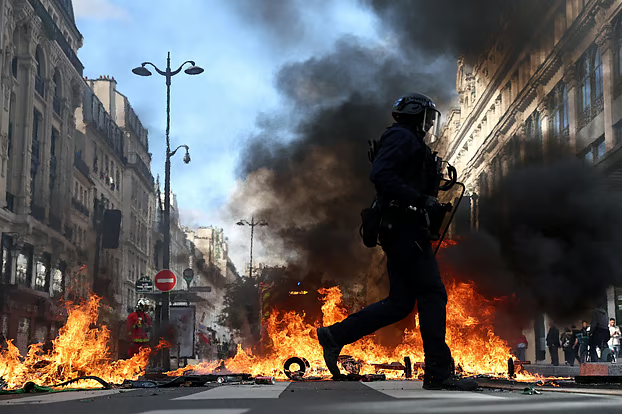
Young people have taken to the streets in several European countries, including Spain, France and Portugal, protesting against mismanagement in schools and universities and a steep rise in the cost of living.
In France, upper secondary students are protesting against long class hours, teacher shortages, dilapidated classrooms and an opaque university admissions process. They have often clashed with police during the protests. With teaching posts vacant at many schools, many students have gone without lessons for months.
At one point many others besides students joined in, protesting against rising living costs including fuel. They blamed the price rises on the closure of the Strait of Hormuz following the US attack on Iran.
The General Confederation of Labour (CGT), one of France’s largest unions, has backed the protests, demanding lower prices, higher pensions and higher wages.
Emmanuel Macron’s time as French president is also nearing its end, and his government now faces the biggest protests in decades.
In neighbouring Spain, protesters took to the streets in September against rising house prices and rents.
The protests in Spain grew around the eviction of an 87-year-old woman, Maricarmen Abascal, from her home. She lost her home after an investment fund raised her rent by 230 per cent, and she died two weeks after being admitted to hospital.
The protesters are demanding lower rents, an end to evictions and a ban on investment funds buying property.
On Saturday, thousands also marched in Lisbon, Portugal, with the same demands. House prices there rose by 124 per cent between 2015 and 2024, almost double the European Union (EU) average.
There were also protests in Milan, Italy, against the rising cost of living. Protesters took to the streets peacefully on Saturday, but at one point the protest turned violent.
Masked rioters threw stones and other objects at police and set fire to barricades made of tables.
In Albania, protests against Prime Minister Edi Rama entered their sixth day on Sunday. Protesters said they were unhappy with the government over corruption, a lack of jobs and a poor education system.
When did the protests begin?
Student protests in France began in late September and have grown since, peaking on Saturday. On the same day, protests against the rising cost of living began in Italy, Portugal and Belgium.
In Albania, protests have been going on since the summer. They began over a luxury coastal development project backed by Jared Kushner, son-in-law of US President Donald Trump.
Have the protests changed anything?
The French government has said it will hire 3,000 more part-time teachers to tackle the teacher shortage, and that students will be involved in decision-making on schools.
The government has also dropped a plan in next year’s budget to raise some university admission fees.
After protests over fuel prices in mid-September, the French government announced higher petrol subsidies for certain sectors.
Spanish Prime Minister Pedro Sanchez tried to pass an emergency housing law to protect tenants, but it failed in Congress because of opposition from right-wing and far-right parties.
Sanchez then called an early election for 29 November, saying he needed a broader progressive majority to carry out new reforms.
Are there signs the protests will stop?
French President Macron is to meet key ministers to deal with the crisis and will then address the nation on television.
Remarks by interior minister Laurent Nunez suggested the government does not want to make further concessions to the protesters. He blamed “far-left” protesters for looting and vandalising buildings across France.
France is due to hold an election in April 2027.
In Spain, protests could ease before the coming election if the government manages to pass at least some housing decrees through parliament’s standing committee.
Sanchez’s Socialist party and the conservative People’s Party have both promised to prioritise building more homes and tackling the housing crisis if they win next month’s election.
বাংলায় মূল প্রতিবেদন পড়ুন · Read the original Bengali report