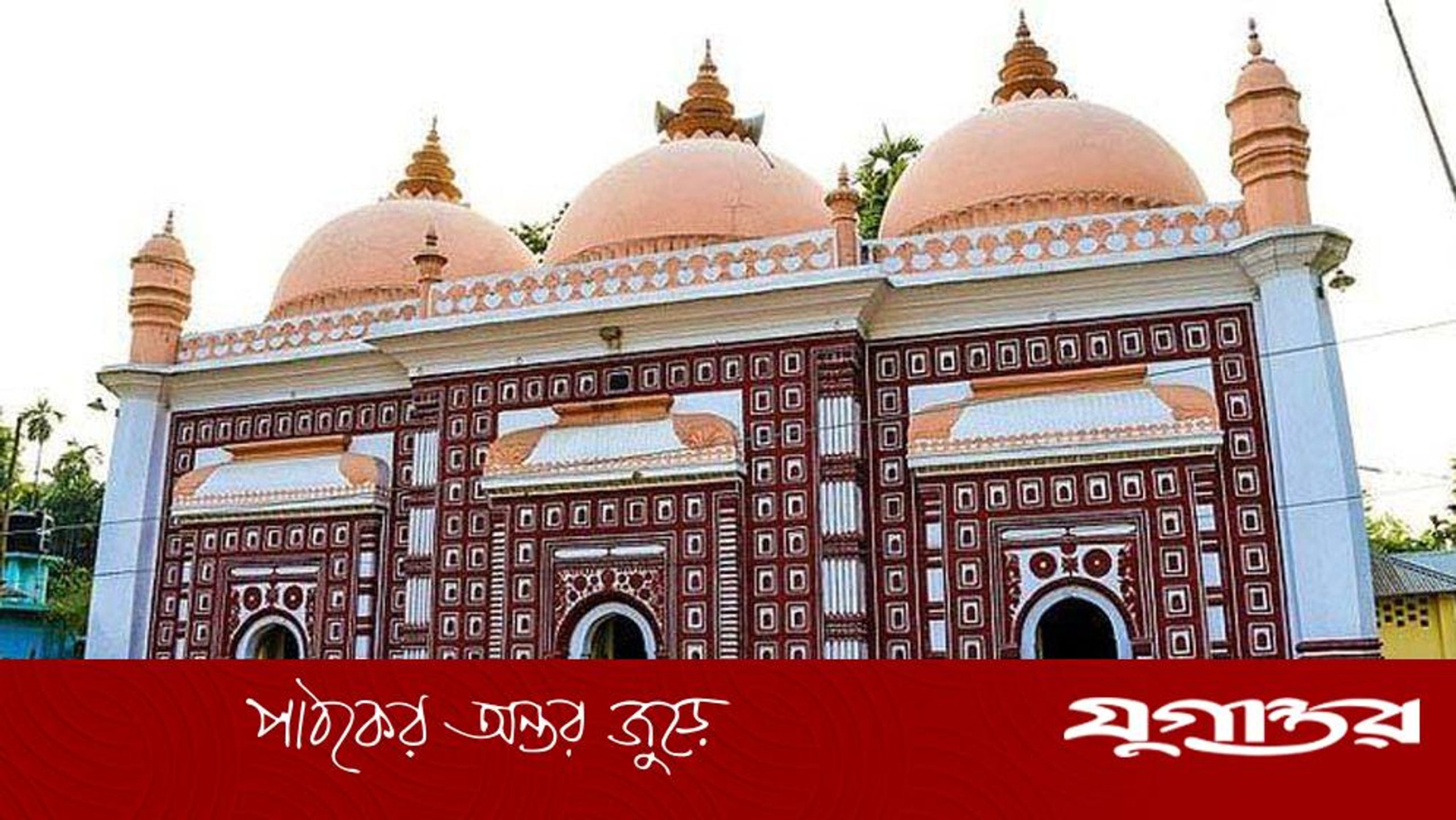
PANCHAGARH — The roughly 250-year-old Mirzapur Shahi Mosque in Mirzapur village of Atwari upazila in Panchagarh stands as a striking example of Mughal-era mosque architecture. The mosque is covered with Islamic terracotta floral and vine designs. The bricks used in its construction are thin, deep-red and ornamented.
The three-domed mosque is 40 feet long and 25 feet wide. A single row of three domes in a rectangular layout is a hallmark of Mughal architecture. The tops of the domes are ringed with belts that taper toward the apex. At the four corners are four slender minarets with layered and decorated belts.
Two smaller minarets, built to align with the central dome, flank the central door on the front wall. The base of these minarets is square. Two similar small minarets stand on the western wall.
The front wall has three medium-sized doors adorned with ornate vines and Islamic terracotta patterns. Recessed panels lie a short distance from each door. On all three doors, a bulging sloped, arch-shaped feature extends outward between the roof and the top of the door, adding novelty to the design.
Three more doors with similar patterns and recessed panels appear on the western wall. The middle western door appears to have been built as an architectural feature; there is no clearly defined mihrab. The northern and southern walls also carry decorative patterns. The bulging sections above the doors on these walls are not parallel; in the traditional rural Bengal style, they are pitched-roof shaped. According to local tradition, the front bricks are said to have been fried in ghee.
The wall decorations include images of birds and other animals alongside flowers and leaves. The builders may have included Hindu artisans, or the animal motifs may have been added as a tribute to the neighboring Hindu community. The animal images have since been removed.
According to a small black Persian-script plaque above the central door, the mosque was built during the reign of Mughal Emperor Shah Alam. The date on the plaque uses the Persian calendar.
Other mosques and buildings of the same period in Bangladesh use the Hijri or Christian calendar. The presence of a Persian-calendar inscription suggests that the artisans and architects who worked on the construction, repair and ornamentation came from Persia or Iran, according to experts. Such decorative work was common at the time in Iranian mosques and other monuments, experts said.
In front of the main building is a rectangular paved courtyard, open above. Outside it stands an elegant archway. The archway has an arched recessed door, fluted columns on either side and a flattened, semi-circular dome with sloped sides. A small bud-shaped finial sits atop the dome.
Although no clear record exists of the mosque’s construction, descendants of the Mirza family of the village say their ancestors, among the founders of Mirzapur village, started the work. Dost Mohammad, the brother of Phul Mohammad, is believed to have completed it. After the mosque was damaged in an earthquake, Muluk Uddin or Malek Uddin completed the repair and beautification roughly 200 years ago. He is said to have brought artisans from Iran through the imam of Hooghly Mosque.
Because of its architectural similarities to a mosque built on the grounds of Dhaka’s High Court, the Mirzapur mosque is presumed to be from the same period. The High Court mosque was built in 1679, suggesting Mirzapur Mosque is no less than 250 years old. Among the Mughal-era mosques in the greater Dinajpur district, the Mirzapur Shahi Mosque is the most symmetrically refined, artistically distinguished and best-preserved. It is currently maintained by the Department of Archaeology.
বাংলায় মূল প্রতিবেদন পড়ুন · Read the original Bengali report