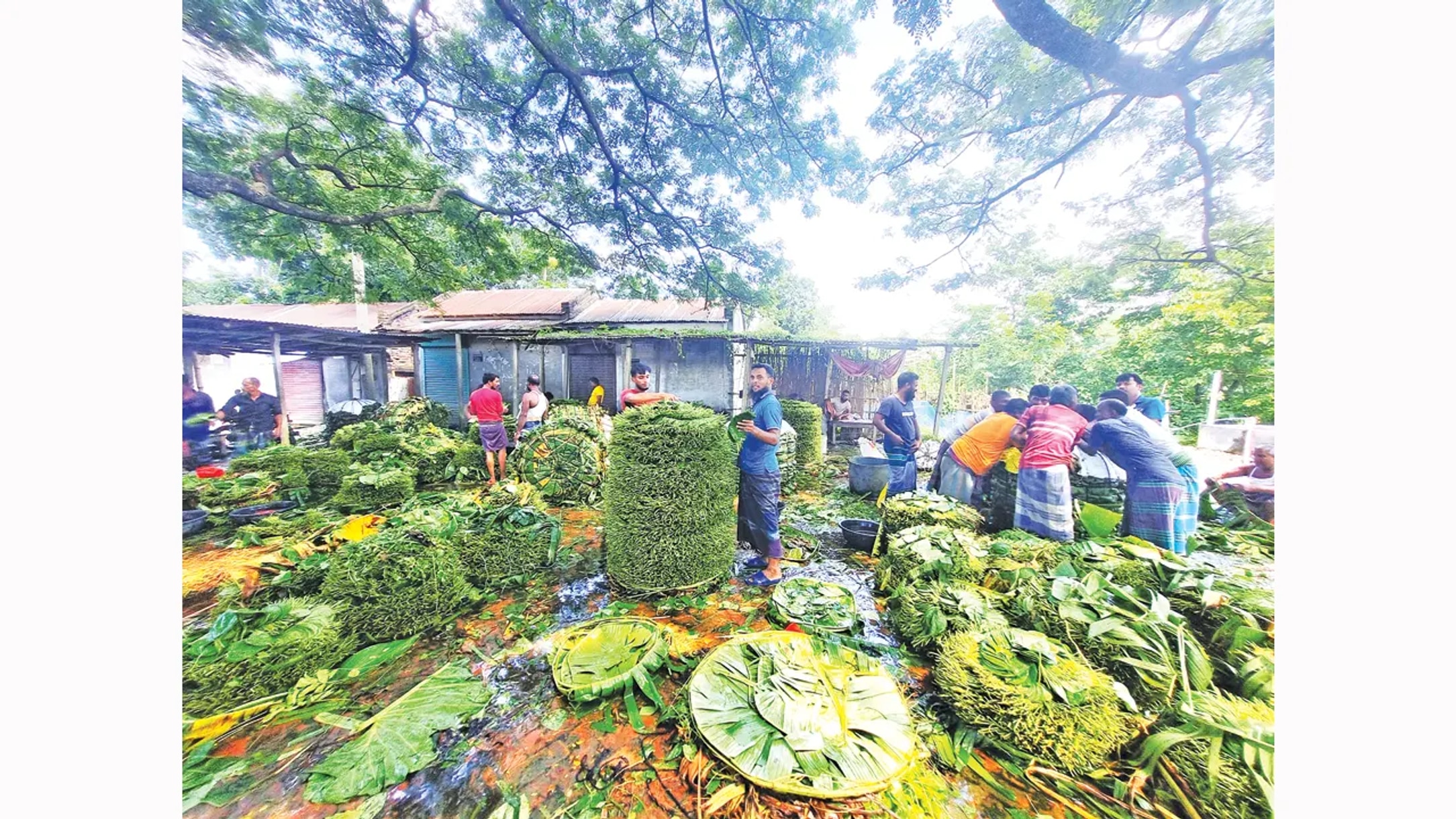
BHAIRAMARA, Kushtia — Betel leaf farmers in Bhairamara are despondent as prices have collapsed. Falling prices and soaring costs are driving smallholders away from betel cultivation, with many tearing down their groves.
According to the upazila agriculture extension office, betel is grown on about 645 hectares of land in three unions of Bhairamara upazila, producing 7,000 metric tons a year. The region has been known for betel cultivation since the British colonial period.
The hardship of smallholders is visible across the three unions of Juniadaha, Dharampur and Bahadurpur. Setting up a new betel grove costs 300,000 to 400,000 taka per bigha, but sales now bring in less than 100,000 taka. The price of materials for the groves has tripled. Labor costs that were once 400 to 500 taka per day have risen to 800 to 1,000 taka. As a result, many farmers have stopped maintaining their groves, while others, in despair over low prices, are not even harvesting the leaves. Some, weighed down by loans, are tearing down their groves to plant other crops. Others have left their villages because they could not repay loans taken against the groves.
At Jagaswar, the largest betel market in the upazila, bundles of leaves that once sold for 50 to 200 taka now go for 5 to 30 taka. Top-quality leaves fetch 60 taka a bundle. Md. Rafi, a farmer selling his crop, said he sold each bundle for 7 taka, against 90 to 100 taka last year. “The cost of picking and transporting is not even recovered. This business is no longer viable,” he said. (One bundle equals 80 leaves.)
Jamela Khatun, a 70-year-old farmer from Bahadurpur, said through tears: “My grove is 40 years old. I can neither tear it down nor keep it. When I take the leaves to market, I don’t even recover what I spent.”
Moin Uddin, general secretary of the Jagaswar betel market, said prices are far lower this year than in previous years because of high production and weak exports, while labor and material costs are two to three times higher than before. “Without any government subsidy, smallholder betel growers are in distress,” he said.
Bhairamara upazila acting agriculture extension officer Ashfaqur Rahman told Kalbela that the office was aware of farmers’ plight. “Earlier, betel was exported to the Middle East and several other countries, but that has now nearly stopped. For the moment, there is no government incentive in place for betel farmers,” he said.
বাংলায় মূল প্রতিবেদন পড়ুন · Read the original Bengali report