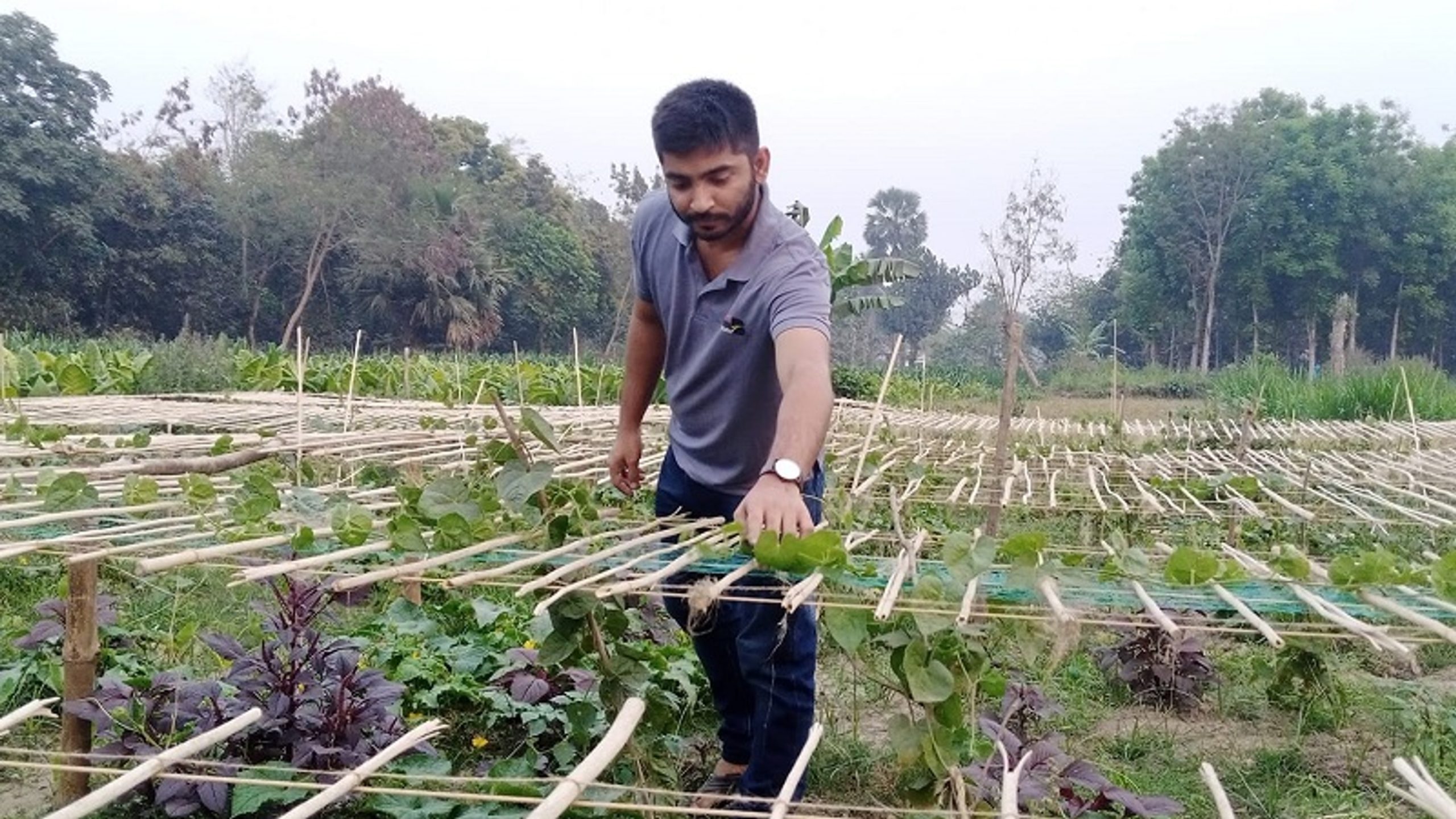
KUSHTIA — In Amla village in the Mirpur upazila of Kushtia district, an agricultural library and organization called Krishaker Batighar is working to encourage farmers to confront climate change and adopt sustainable agriculture, while developing young students of the area as skilled human resources.
Volunteers go to villages and to farmers in the fields and read books to them, the organization’s activities show. They discuss modern farming methods, ways to improve livelihoods, how to cope with climate change, literature, travel and other subjects. Similar programs are run for rural women, helping illiterate farmers and ordinary villagers improve their lives.
Severe heat waves, droughts and unusual rainfall have increased hardships in agriculture, while separate irrigation has added extra costs, the organization said. Farmers fear they may not recover their losses even after planting crops. Seeing those climate changes, the group is providing advice and services on climate change for farmers’ development. Members of Krishaker Batighar visit crop fields, inform farmers about climate change and offer advice.
Chamidul Islam, a farmer in Charpara village of Mirpur upazila who took part in the program, said members of Krishaker Batighar told him and others about climate change and agricultural weather. “They read aloud from books on how to produce better crops,” he said. “It is a great help for us farmers. We have now reduced chemical fertilizers and increased the use of organic fertilizers. With perching practices and planting various trees on the bunds of our fields, the crop fields now look more beautiful as well.”
Through these activities, the organization is also building skilled human resources, particularly by encouraging students to read, training them in leadership and offering computer training to volunteers and members. Such skilled human resources are needed to increase agricultural productivity and build sustainable farming systems, those involved said.
Sadia Khatun, a member of the organization, said: “Before reading books aloud to farmers, we read those books carefully ourselves; otherwise we could not explain them. Our own development has been much greater because of this. We learn about many subjects outside the curriculum. And the biggest thing is that we do not just read these books — we absorb them, because we have to explain them again to farmers. Often after reading a book once we forget, but with this practice we do not forget easily. By learning many subjects well, we are becoming more skilled than others. The organization also gives us computer training and other training.”
Md. Shoeb Mallik, a volunteer with Krishaker Batighar, said he could not previously operate a computer. “After taking my SSC exams, I joined Krishaker Batighar,” he said. “From here I received six months of computer training. I am now skilled at computers. I have bought a computer myself and help the organization with its work, and I help others learn computers too.”
The organization’s training programs include computer training, English-language training, leadership training, entrepreneurship training and employment-oriented skills training. Students who have received the training have found employment in agriculture, business and other fields.
Md. Jamshed Ali, the social services officer for Mirpur upazila, said: “Krishaker Batighar is working in our upazila to encourage adaptation to climate change and sustainable agriculture and to build skilled human resources. The initiative is highly praiseworthy. Adapting to climate change and developing sustainable farming systems is very important at this time. Krishaker Batighar is playing an important role in achieving this goal. Through various training programs, the organization is making young students aware of climate change and sustainable agriculture. I hope this initiative will have a wide impact in our upazila.”
Hosain Mohammad Sagar, founder of Krishaker Batighar, said the organization’s activities are very useful for farmers. “It plays an important role in raising farmers’ crop productivity and in building sustainable farming systems,” he said. “It provides technology support to farmers. At the same time, it works to develop young students living in the village as skilled human resources. Through various training programs, the organization helps build students’ technical skills, leadership and employment-oriented skills. Our objective is to build a bright future for young people living in rural areas of Bangladesh. We believe that the development of rural areas of Bangladesh is possible only through skilled human resources.”
বাংলায় মূল প্রতিবেদন পড়ুন · Read the original Bengali report