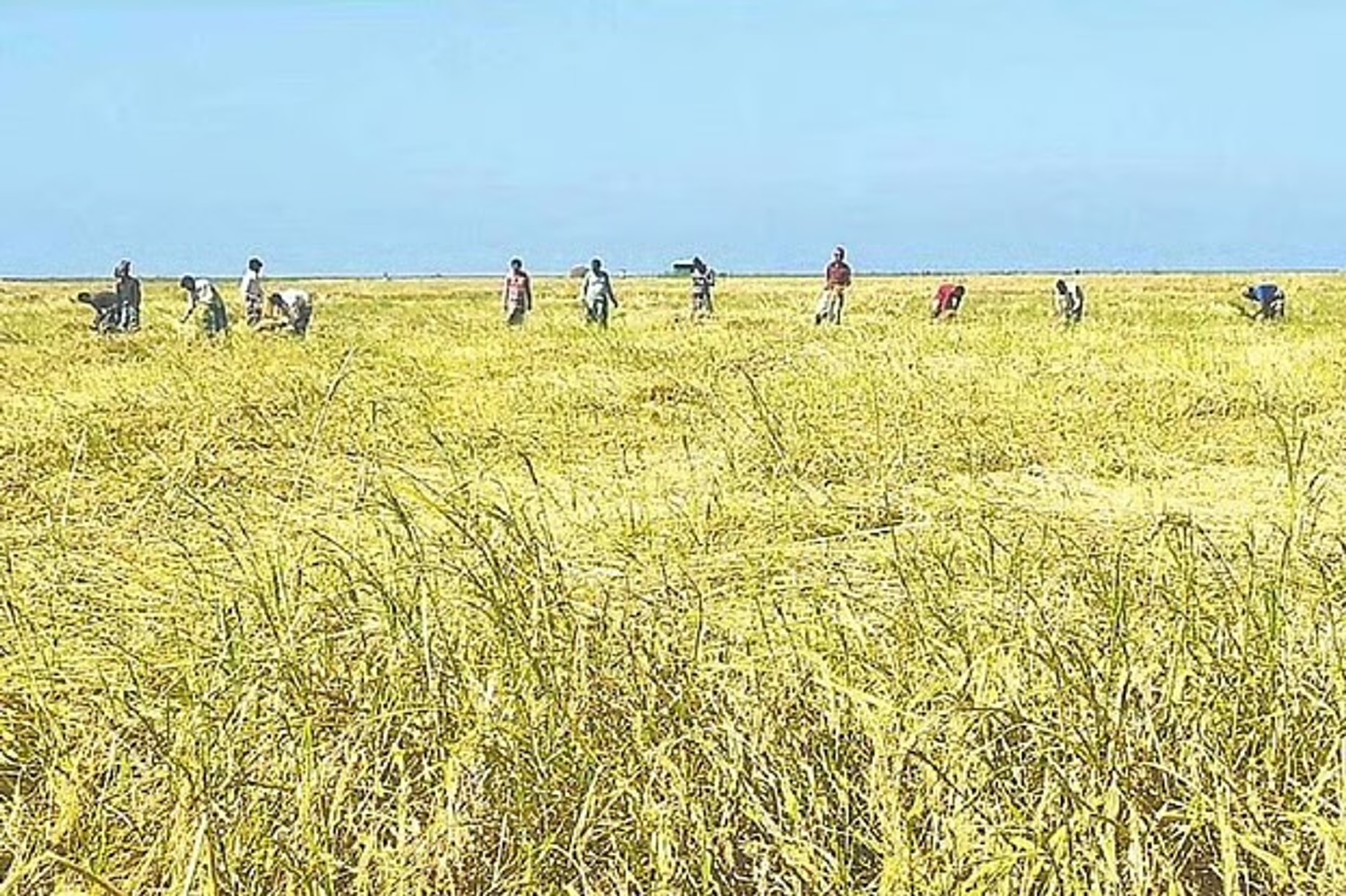
CHATTOGRAM — Dubochar, a 10-kilometer-long and 3-kilometer-wide new tidal flat off the northwestern coast of Sandwip in Chattogram, is yielding a record harvest of golden aman paddy this season.
Locals call the flat Dobachar or Dubaga. Dubaga means a flat that is submerged at high tide. Farmers there had previously cultivated rice mainly to support fish farming. This year, for the first time, paddy yields have exceeded their expectations, and farmers say they expect strong income from both fish and rice.
A visit to Dubochar showed paddy plants bent under the weight of ripe, golden grain. Farmers were busy harvesting, while others gathered cut paddy into stacks or loaded it onto tractors. Farmers said this year’s harvest from about 500 kani of cultivated land — 1 kani equals 160 decimals — would reach at least 30,000 maunds, or 1,200 tonnes, a yield they describe as a bumper crop.
Farmers said this was the first year cultivation had been carried out on such a large scale at Dubochar. Strong returns from a trial crop last season prompted a sharp expansion this year, and they expect cultivation to grow further in coming seasons. Despite the bumper aman crop, farmers complained that no field officer from the agriculture department had visited the area.
Sandwip agriculture officer Md. Maruf Hossain told Prothom Alo that he had not visited Dubochar but was aware of the strong aman yields there.
Rice farming expands
Farmers said they tested paddy yields last season. Because the land floods with saline tidewater, they planted the century-old aman variety Rajashail, which thrived. Following that success, cultivation expanded to at least 500 kani this year — 10 times the previous season. Md. Nurul Islam, 55, who was harvesting paddy in the middle of the flat, told Prothom Alo that cultivation here would surpass 1,000 kani in the future.
Md. Nur Uddin, 50, was stacking sheaves of cut paddy left to dry in the field. Nur Uddin cultivated 12 kani this year and is hoping for a strong profit. He plans to plant 20 kani of aman in the future. Most farmers, like Nur Uddin and Nurul Islam, hope to expand aman cultivation further.
Success in both rice and fish
At Dubochar, farmers’ activity is not limited to rice. They also farm fish in the same paddy fields, and many farmers planted rice as a way to support fish farming. Both have paid off.
Talim Hossain returned to his ancestors’ land and began farming. He cultivated rice on 12 kani and stocked fish in the same fields. He sold about 2.2 million taka worth of fish this year and plans to expand cultivation, with hopes of stronger fish sales as well.
Higher yields on the tidal flat
Sediment is deposited at Dubochar each year by the tides, making the land fertile. Neighboring Sabujchar and Swarnadwip no longer receive fresh silt, farmers said. As long as sediment continues to accumulate, fertility will remain, supporting higher rice yields and abundant fish. Talim Hossain, who returned to farming after completing his bachelor’s degree and now earns several lakh taka, said the bumper aman harvest is driven by the fresh silt. As the flat rises, tidal flooding will stop, and both fish stocks and rice yields will eventually decline, he said.
বাংলায় মূল প্রতিবেদন পড়ুন · Read the original Bengali report