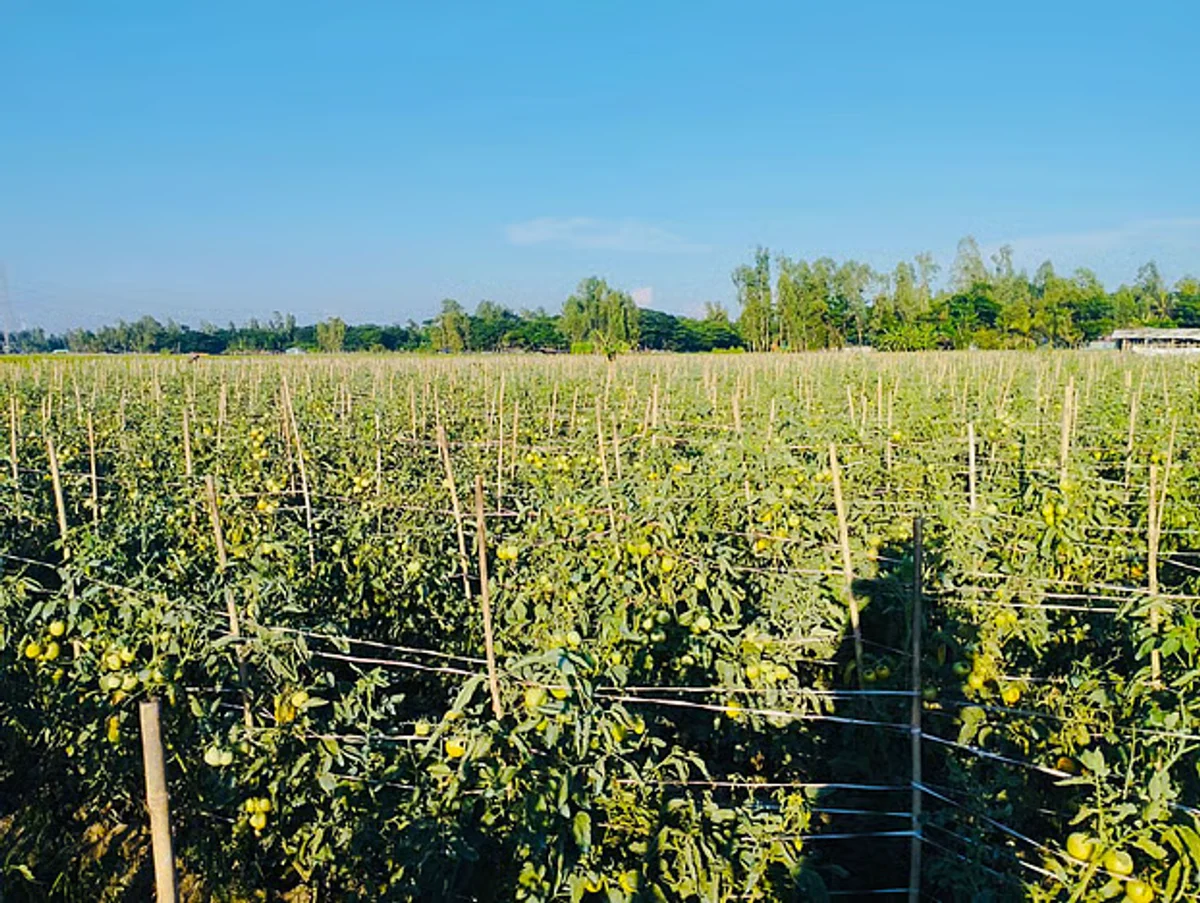
CHATTOGRAM — Farmers in the coastal Banshkhali upazila of Chattogram have turned a profit by planting tomatoes two months earlier than usual, betting that special drainage systems would protect their crops from monsoon rains, agriculture officials and growers said.
Some farmers were spraying disinfectants on their fields, while others were busy tending to plants. Elsewhere, ripe and unripe tomatoes were being picked. Growers were sorting the harvest and piling it beside the fields in what looked like a festival atmosphere across villages in the Gandamara and Saral unions of Banshkhali.
Tomato cultivation in the area usually begins in October, when rainfall typically stops. This year, however, growers planted in August. To prevent damage from rainwater, they dug irrigation channels across their fields so water would not accumulate around the plants. That step, they said, was the key to their success.
The upazila agriculture office said tomatoes have been cultivated this year on 415 hectares of land across the Gandamara, Saral, Baharchhara, Bailchari, Khankhanabad, Kathariya, Shilkup, Chambal and Puichari unions. Of that, 350 hectares are in the Gandamara and Saral unions alone. Farmers are growing high-yielding varieties including “Profit Early,” “Durjoy” and “Bahubali.” Higher yields and better market prices have raised expectations.
The area where the early planting was done is known as a coastal zone. Farmers said they began planting in early August using a special method, before the rainy season ended fully. Heavy rains followed, but growers drained the water from their fields. Standing water harms tomato yields. Four months later, they are now reaping the harvest. While cultivation in past years was on a small scale, this year it has gone commercial.
Rows of plants are now laden with ripe and unripe tomatoes. Each field has irrigation channels that drain water in the monsoon and supply water to the roots in the dry season. Some farmers have already finished their harvest and are preparing fields for another planting.
Abdur Rashid, a farmer in the Gandamara union’s KG School area, said he cultivated tomatoes on five kanis of land. One kani equals 40 percent of an acre. “The yield was good, so I made at least 400,000 taka in profit,” Rashid said. “I used to grow rice on this land, but there wasn’t much profit. Tomato cultivation in this area will only grow in the future.”
Another farmer in the same area, Azgar Ali, cultivated tomatoes on eight kanis. “I sold them at 50 to 80 taka per kilogram,” Ali told Prothom Alo. “These tomatoes were planted four months ago. The land here is salty. I couldn’t have imagined this much yield.”
Sifatul Islam, a 10th-grade student in the upazila’s Charpara area, helped his father plant tomatoes. “We cultivated tomatoes on one kani of land,” he said. “It cost 40,000 to 50,000 taka. We earned 160,000 taka by selling the crop.”
Shyamal Chandra Sarkar, the Banshkhali upazila agriculture officer, said farmers have brought about a revolution in tomato cultivation along the coast. “Village after village is growing tomatoes commercially,” Sarkar said. “Cultivation is expanding every year. We are in regular contact with farmers and providing various advisories.”
বাংলায় মূল প্রতিবেদন পড়ুন · Read the original Bengali report