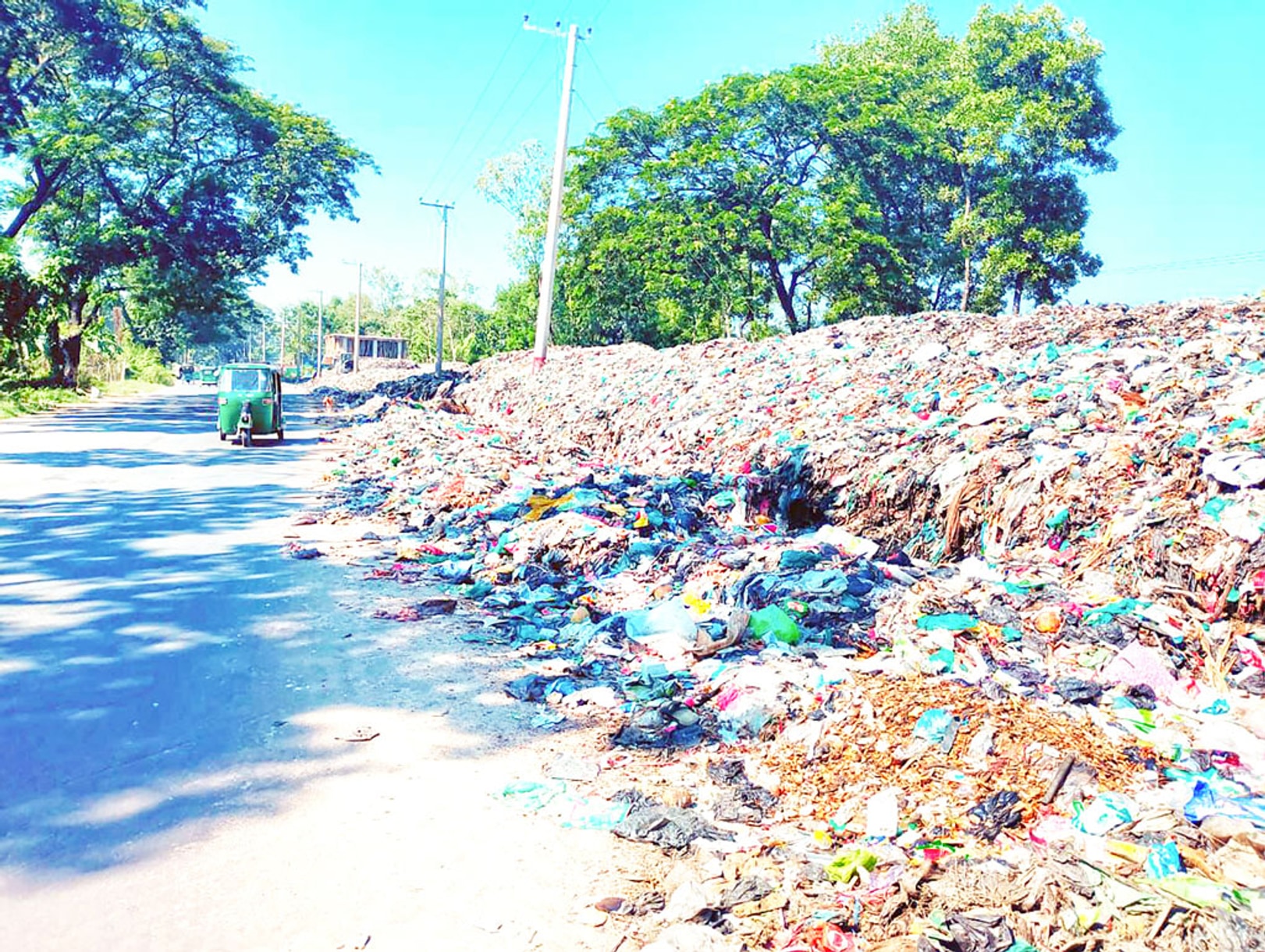
CHATTOGRAM — A 35-year-old municipality in Bangladesh still has no dumping station, leaving thousands of tons of waste piled along a major highway and exposing residents to severe health and environmental risks, officials said.
For decades, garbage from Patiya municipality has been dumped along the Chattogram-Cox’s Bazar highway, creating what locals call a “wall of trash.”
Patiya, one of the oldest municipalities in Chattogram, was established on April 9, 1990. It received first-class municipality status just a year after its founding, but in 35 years no permanent waste management facility or dumping station has been built. As a result, more than 100,000 residents in the 4-square-mile area face daily challenges disposing of household and other waste.
Thousands of tons of waste have accumulated for years at an open site in the Bahuli area along the Chattogram-Cox’s Bazar highway. Several hundred tons of garbage are brought there daily from the municipality’s nine wards. The stench in the area is so strong that it becomes difficult to stand near it. Mosquitoes and flies swarm the site, accelerating the spread of disease.
Local residents said the situation worsens during the rainy season. Rainwater washes garbage from the pile onto the highway, causing severe inconvenience to pedestrians and bus and train passengers. The toxic smoke from burning garbage in the open also poses a serious threat to the surrounding environment and biodiversity.
Arjit Kumar Das, an inspector in charge of waste management at the Patiya municipality, said 14 women and 32 men work full-time to clear waste. “But the absence of modern waste management infrastructure creates constant problems,” he said.
Nezamul Haque, the municipality’s administrative officer, said a site has been identified in the Indrapul area of Patiya Sadar for a dumping station. “Work has been held up due to legal complications,” he said.
Farhanur Rahman, the upazila executive officer and acting Patiya municipal administrator, said a dumping station has long been demanded by residents. “It is essential for the environment and public health,” Rahman said. “We hope to start work soon.”
বাংলায় মূল প্রতিবেদন পড়ুন · Read the original Bengali report