DHAKA — The interim government plans to transform the Maheshkhali-Matarbari area in Cox’s Bazar into a modern port-centered township modeled on Singapore and Shanghai, officials said.
A separate body, the Maheshkhali Integrated Development Authority (MIDA), has been formed for the project. MIDA is preparing a master plan for the integrated development of Maheshkhali and Matarbari.
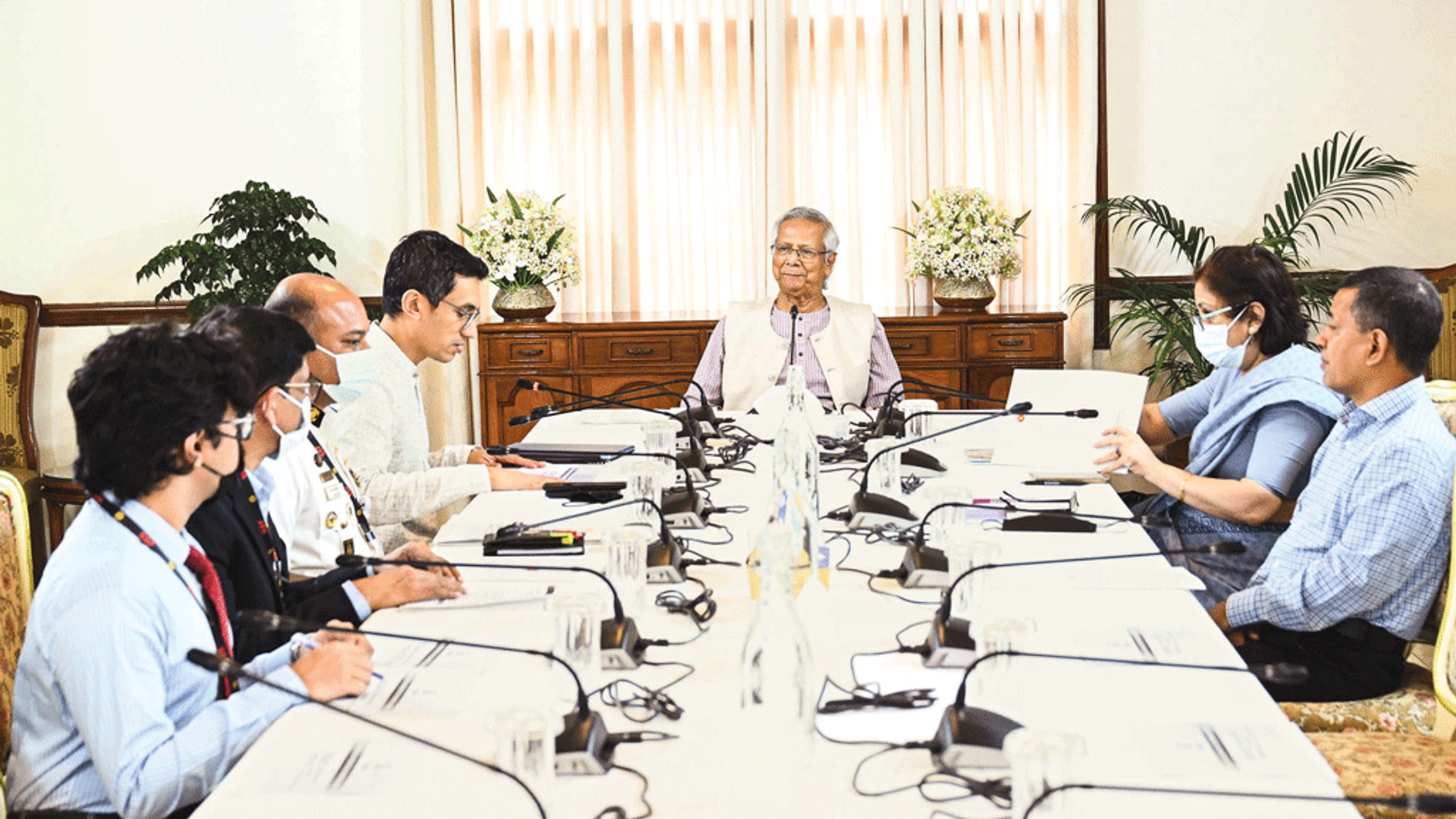
Chowdhury Ashik Mahmud Bin Harun, executive chairman of the Bangladesh Investment Development Authority (BIDA), is serving as chairman of MIDA. He recently met Chief Adviser Muhammad Yunus and presented an overview of the Maheshkhali-Matarbari project. The meeting at the chief adviser’s official residence, Jamuna, was also attended by MIDA members Commodore Tanzeem Faruk and Md. Sarwar Alam, the chief adviser’s chief coordinator for SDG affairs Lamiya Morshed and the chief adviser’s office secretary Md. Saiful Panna.
Ashik Chowdhury presented MIDA’s four-month work plan. He said the project would be completed in three phases — the first from 2025 to 2030, the second from 2030 to 2045 and the third from 2045 to 2055. If implemented, the project would create about 2.5 million direct and indirect jobs and add $150 billion to gross domestic product, he said.
Yunus said: “It will not just be a deep-sea port. We must work with a vision of building a blue economy. The area will not just be a facilitating zone — a new city will be born there. From there, we will build connectivity to the world. The sea will be our highway to the global market.”
The chief adviser placed special emphasis on deep-sea research. He also stressed building an international-standard training facility in the Maheshkhali area. He advised seeking cooperation from world experts in the field where needed.
“We have never entered the world of the sea. We have not even thought about it. There is no research, no findings,” Yunus said. “We must find out what research exists, look at other countries’ research papers that align with our context, and conduct our own research. For this we need institutions. Academia must be built up, and we should organize international conferences on the ocean economy.”
The chief adviser also stressed environmental protection. The meeting discussed creating an eco-tourism park. “What condition are the forests there in now, and what condition do we want to see those forests in in the future? We must plan for that,” Yunus said.
Ashik Chowdhury recently outlined MIDA’s plan for Matarbari and Maheshkhali at a news conference at the Foreign Service Academy on Beily Road in the capital.
“We want to see this as a township,” he said. “The world’s most successful deep-sea port and township is Singapore. Another port that often comes up is Shanghai. Think of it this way: we want to build a Singapore for Bangladesh, or a Shanghai port within Bangladesh.”
“After 30 years, we want to see this Maheshkhali-Matarbari area like Singapore or Shanghai,” he said. “It will not be a city of nine-to-five. It will not be a satellite city. It will be a suburb, another extended city like Chattogram, reformed and of a new kind.”
Ashik Chowdhury said the project plan is being built on four pillars: a deep-sea port and supply-chain management; a facilitation center; power and energy; and a marine fisheries hub. The project will be carried out in three phases through 2055, he said.
“In three periods, we can deliver this project by 2055,” he said. “The first five years we call the development period — foundation work and road connectivity will happen. The next period is environmental development, when we will complete port development work. Some industries will be set up alongside. We expect this to run through 2043-44. In the final phase, in the last 10 years, we can think about tourism.”
He said the Matarbari-Maheshkhali area was chosen for the multi-dimensional project because of several competitive advantages, including the required draft for building a deep-sea port; power, energy, manufacturing and heavy industry; and nearby land suitable for an integrated environment of marine and fisheries industries.
If successfully implemented, the plan will have a major impact on Bangladesh’s economy, Ashik Chowdhury said. A JICA survey has projected the project could attract $60 billion to $65 billion in investment over the next 20 to 30 years, according to the daily Ajker Patrika.
বাংলায় মূল প্রতিবেদন পড়ুন · Read the original Bengali report