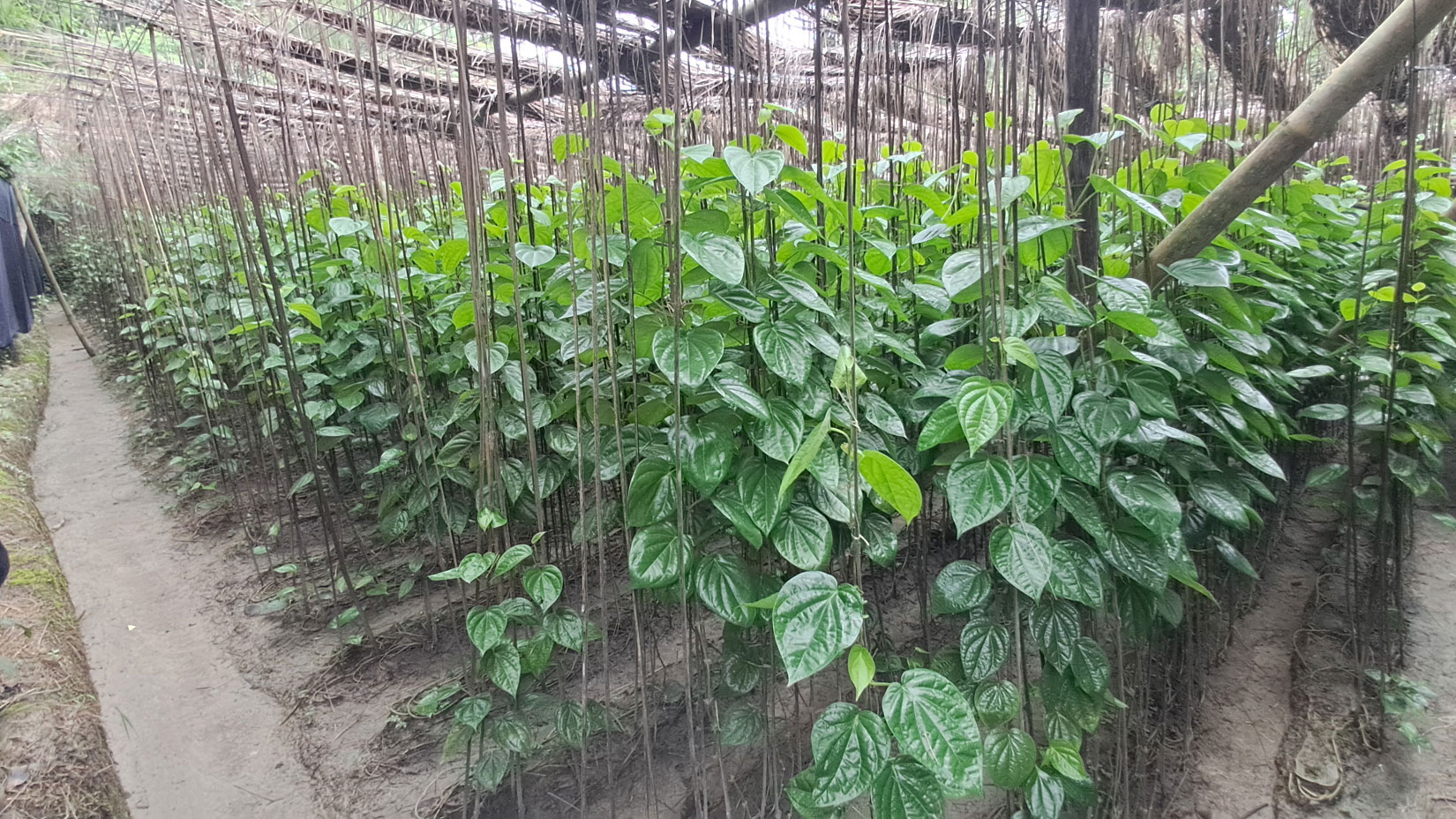
HAIMCHAR — Betel leaf is one of the most important cash crops in Chandpur’s coastal Haimchar upazila, where annual sales total about 50 crore to 52 crore taka (about $4.2 million to $4.4 million). After meeting local demand, the leaves are supplied to neighboring upazilas and district markets. But despite repeated losses from natural disasters and disease, betel growers say they have never received any incentive or government support, affected farmers said.
Haimchar’s residents are geographically split by the Meghna river, with people on the eastern bank mainly engaged in farming and those on the western chars depending on fishing and farming. For generations, thousands of people in the region have raised families by cultivating Mahanali, Chalta Kotha, Nal Dog and Sachi varieties of betel leaf. Many are involved in the cultivation through family tradition.
Touring the upazila and speaking with farmers, it was learned that betel collection and sales go on daily throughout the year except in the winter season. The market for betel was once outside the district town, but a betel wholesale market has now sprung up near the Haimchar upazila headquarters, where wholesale trading takes place daily.
Farukul Islam Gazi, a grower in Mahjampur village of North Algi union, cultivates betel on 1.5 acres of land. Three to four laborers work in his barj, or betel garden, every day. He said: “Natural disasters sometimes cause major losses. But when prices are good, the losses are somewhat offset. But I have never received any government assistance in any disaster.”
Several laborers in the barjes said they learned to cultivate betel at a young age and that the work supports their families.
Mohammad Harun, another farmer from the same village, said: “Our fathers left us this barj. Now we are the ones cultivating it. When disease strikes the betel, production drops, the roots rot and have to be replanted. We receive no training; we learn the work by watching our predecessors.”
Md. Rasel, a betel trader from Haimchar, has been in the business for two decades. He said: “I buy betel from Haimchar’s barjes and sell it wholesale and retail in local markets. More than 100 traders are involved in this profession at Baburhat, Mahamaya, Chandra Bazar and other nearby markets.”
Cherag Ali of Kamta village in Chandpur’s Faridganj upazila has been in the betel business for 30 years. He said: “Every Friday and Tuesday I sell betel in different markets. I buy half a lakh taka worth of betel from Haimchar each time. My family depends on this business.”
Haimchar Upazila agriculture officer Md. Shakil Khondaker said: “This year, betel has been cultivated on 235 hectares of land in Haimchar. There are 1,072 small and large barjes. Betel worth about 50 to 52 crore taka is sold every year. When disasters or diseases strike, we stand by the farmers and provide advice. If incentives are needed, we inform higher authorities. But so far no support has been received for betel cultivation.”
বাংলায় মূল প্রতিবেদন পড়ুন · Read the original Bengali report