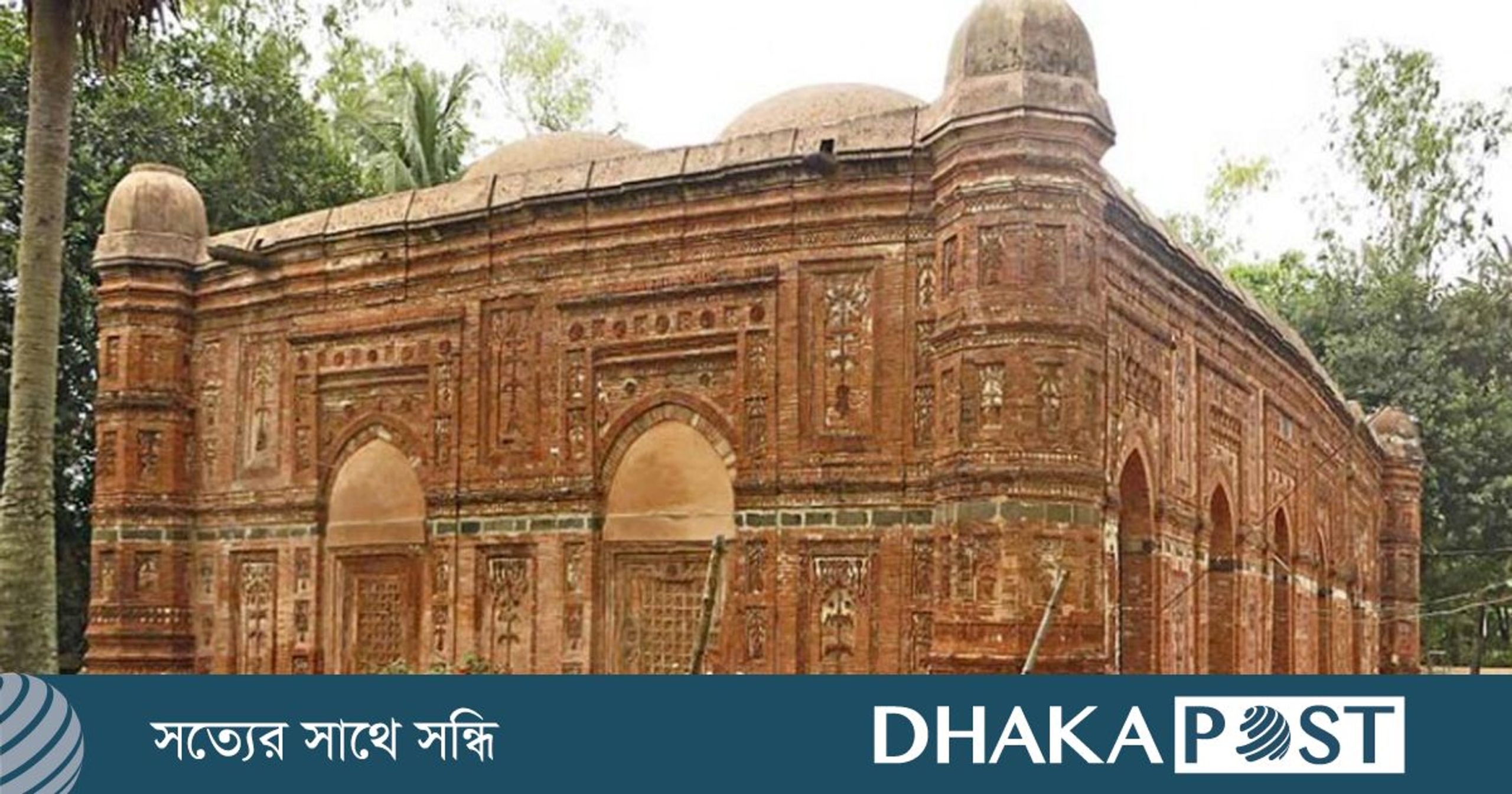
RAJSHAHI — Built in 1523-24, the Bagha Shahi Mosque in Rajshahi has stood as an architectural emblem of Bengal for more than five centuries. The ancient structure appears on Bangladesh’s 50-taka banknote and on a commemorative 10-taka postage stamp.
The 10-domed mosque is decorated throughout with intricate carvings and terracotta motifs, and has five doorways. A Persian inscription above the central door draws visitors from the main gate into a remarkable interior. Four octagonal towers stand at the corners, with six pillars inside. The mosque has four exquisitely carved mihrabs whose designs feature mangoes, roses and other motifs from Rajshahi’s heritage.
The mosque was built between 1523 and 1524 by Sultan Nusrat Shah, who ruled an independent Bengal at the time. He also commissioned a large pond in front of it on about 256 bighas of land. The complex includes shrines of saints, the main Dargah Sharif and a museum.
Drawn by its architectural beauty, tourists from across Bangladesh and abroad continue to visit. The mosque stands on a platform 8 to 10 feet above the ground. Although the courtyard is enclosed by a boundary wall, there are two entrances to the north and south, each flanked by two gates. The southern gate is intact; the northern gate is no longer in its original state.
According to relevant sources, the mosque is 75 feet long, 42 feet wide and 24 feet 6 inches high. The walls are 8 feet thick. The domes are 24 feet in diameter and 12 feet high. Terracotta motifs cover every surface. The Department of Archaeology restored similar motifs in 2007. The work was carried out by Madan Pal, a terracotta artisan from Sirajganj. Visitors still travel from far away to see the 501-year-old mosque, including historians researching its past. Many are spellbound by this ancient marvel.
Sekadul Islam, a visitor to the Bagha Shahi Mosque, told Dhaka Post that the mosque is depicted on the country’s 50-taka note and a commemorative 10-taka stamp. “This ancient architectural specimen is very beautiful. You cannot describe how beautiful it is until you see it. The kind of terracotta motifs around the mosque cannot be seen in modern buildings. Even without today’s technology, the craftsmanship deserves praise,” he said.
Salma Khatun offered a chicken at the mosque, praying to Allah for her daughter’s recovery from illness. She is not alone; many others bring chickens. Some come to view the mosque and to pray for various wishes, cooking meals beside the pond on the east side and feeding others.
Vehicles of visitors from afar are parked on the south side of the mosque. Around the mosque are saints’ shrines, the Dargah Sharif and a museum. To the north are the shrines of Hazrat Shah Doula and his five companions. To the south-west of these shrines are the graves of family members of Hazrat Shah. Outside the mosque complex to the south-west are the graves of two Baghdadi dervishes. Other saints, including Jahar Khaki Pir, are also buried in the area. Beside it is the women’s mosque. Visitors tour the surrounding shrines as well, and many spend time sitting beside the large pond.
Shafiqul Islam, the mosque’s muezzin for about 10 years, told Dhaka Post that visitors come in large numbers at this time of year. Many also come to offer Friday prayers at this old mosque from far away.
Md. Enayet Hossain, attached modeler at the Rajshahi regional office of the Department of Archaeology and head of the Bagha museum, told Dhaka Post the mosque is 501 years old and includes a museum. Tourists from home and abroad come throughout the year, but visitor numbers peak from January to April, he said.
Md. Shafiqul Alam, a professor of geology and mining at Rajshahi University, said the mosque is under the Department of Archaeology, which maintains it. “It is one of the oldest mosques and over 500 years old. It appears on Bangladesh’s 50-taka note and a commemorative 10-taka stamp as a specimen of ancient architecture,” he said.
Tariqul Islam, president of the Bagha Shahi Mosque management committee and Bagha upazila nirbahi officer, told Dhaka Post the mosque is 501 years old. Ablution facilities and other improvement work have been carried out, and more is under way. Money collected from the mosque is spent on its upkeep, he said.
How to get there
The mosque is accessible from anywhere in the country. Visitors from the Rajshahi division districts of Chapainawabganj, Naogaon and Joypurhat can take a bus to Rajshahi city’s bus stand and proceed to Bagha upazila sadar. Those coming through Natore district can travel via Puthia’s Baneshwar market and then south on the Charghat road, with Bagha being the next upazila beyond Charghat.
From Puthia upazila sadar, the mosque can also be reached by any vehicle by road. Train travelers may also visit; they should board a train that stops at Arani station. From the station, take a van, autorickshaw or CNG to Bagha upazila sadar. The mosque is very close from there.
বাংলায় মূল প্রতিবেদন পড়ুন · Read the original Bengali report