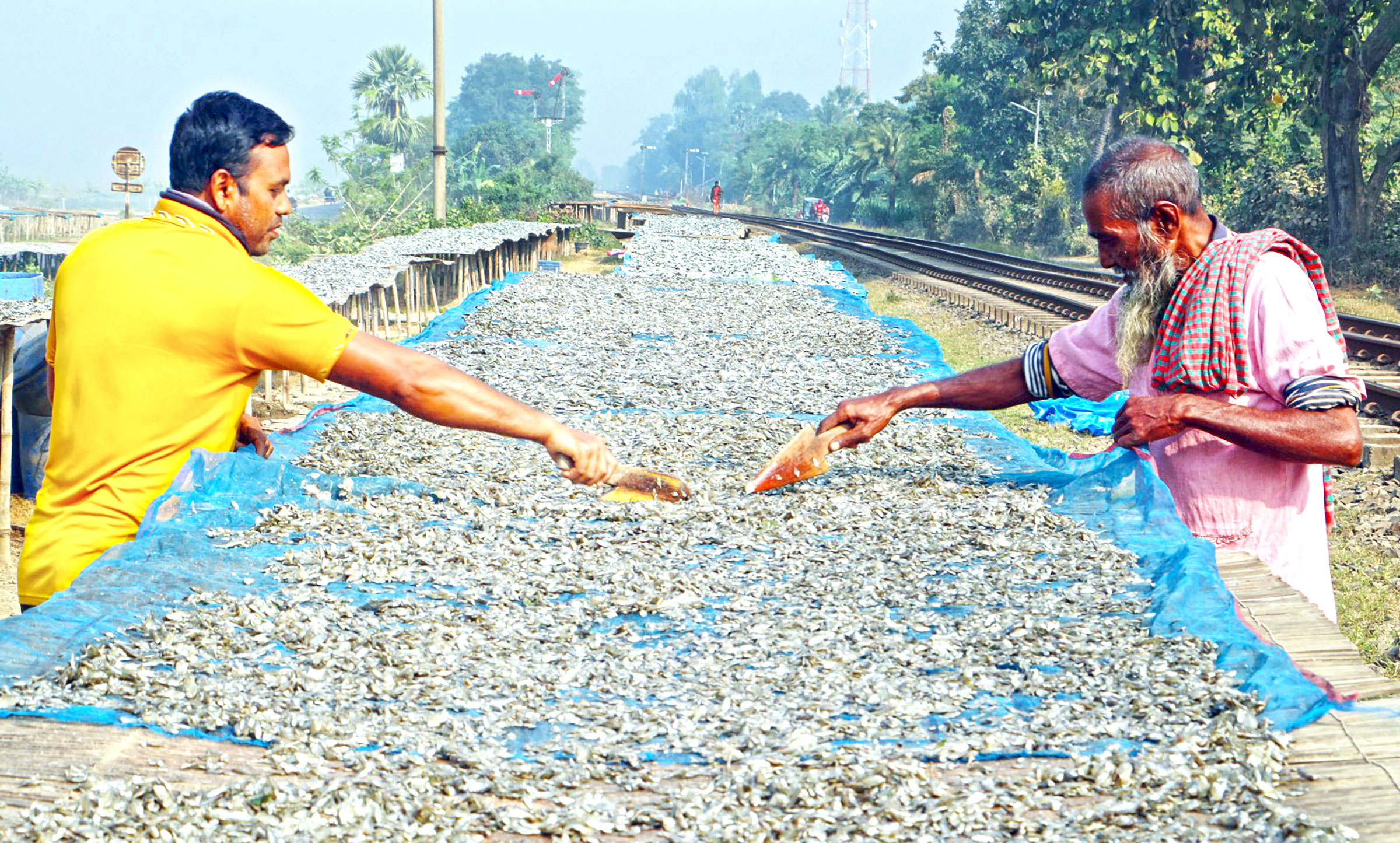
NAOGAON — Dried-fish production in Bhor Tetulia village of Naogaon’s Atrai upazila, long known as the country’s dried-fish village, has dropped sharply this season due to a shortage of native fish, traders said.
The naturally prepared dried fish from the area is in demand across Bangladesh and is also exported to India. But although it is now peak season, output has fallen because of the fish shortage, and what little fish is available is selling at higher prices, traders said.
The Atrai upazila fisheries office said about 250 tonnes of dried fish, worth around Tk 5 crore, had been targeted for production this season. The main markets for the village’s dried fish are Rangpur, Nilphamari, Lalmonirhat and Dhaka, and it is also exported to India. Once about 40 traders in the upazila were involved in dried-fish production; now only 15 to 18 remain.
Drying yards line both sides of the Atrai railway station. Men and women cut, wash and salt the fish before laying it out to dry. Some flip the morning-dried fish over throughout the day. Many drying yards are now sitting empty for lack of fish.
Local traders said Atrai upazila is dotted with wetlands. The Atrai river runs through it, alongside the smaller Jamuna and more than 100 canals and beels. When the water recedes, native fish such as tyangra, puti, khalshe, taki, shol and chanda would arrive at markets. But the indiscriminate use of fine-mesh dewatering, suti, current and bhadai nets has wiped out most of the catch this year. With fish scarce, most drying yards stayed shut through October and November, and producers cannot meet demand. Workers tied to the trade have been left jobless.
Rampada Sheel, a trader from Bhor Tetulia, said: “There is a severe fish shortage this year. Whatever little fish we get in the market, we have to buy at high prices. We are paying 100 to 220 taka per kilogram depending on quality. Daily demand is 20 to 25 maunds, but local markets and fish landings together yield no more than 7 to 10 maunds. We just cannot produce enough dried fish to meet demand.”
Trader Jillur Rahman said: “A few years ago this dried-fish hamlet would have been bustling at this time. But now, with suti, dewatering and current nets used from the start of the monsoon, no fish reach the markets. When fish were plentiful, the business ran for two to two-and-a-half months. Many drying yards are closed now. As a result, the men and women working on them are also unemployed.”
Female worker Anjuman Begum said: “With no fish, the work has dried up. The money I earn at the drying yard runs the household. Without work, many of us just sit idle.”
Atrai upazila senior fisheries officer Maksudur Rahman said: “We are providing training to those engaged in the trade on safe and quality dried-fish production. Operations against the unlawful catching of fish are continuing.”
বাংলায় মূল প্রতিবেদন পড়ুন · Read the original Bengali report