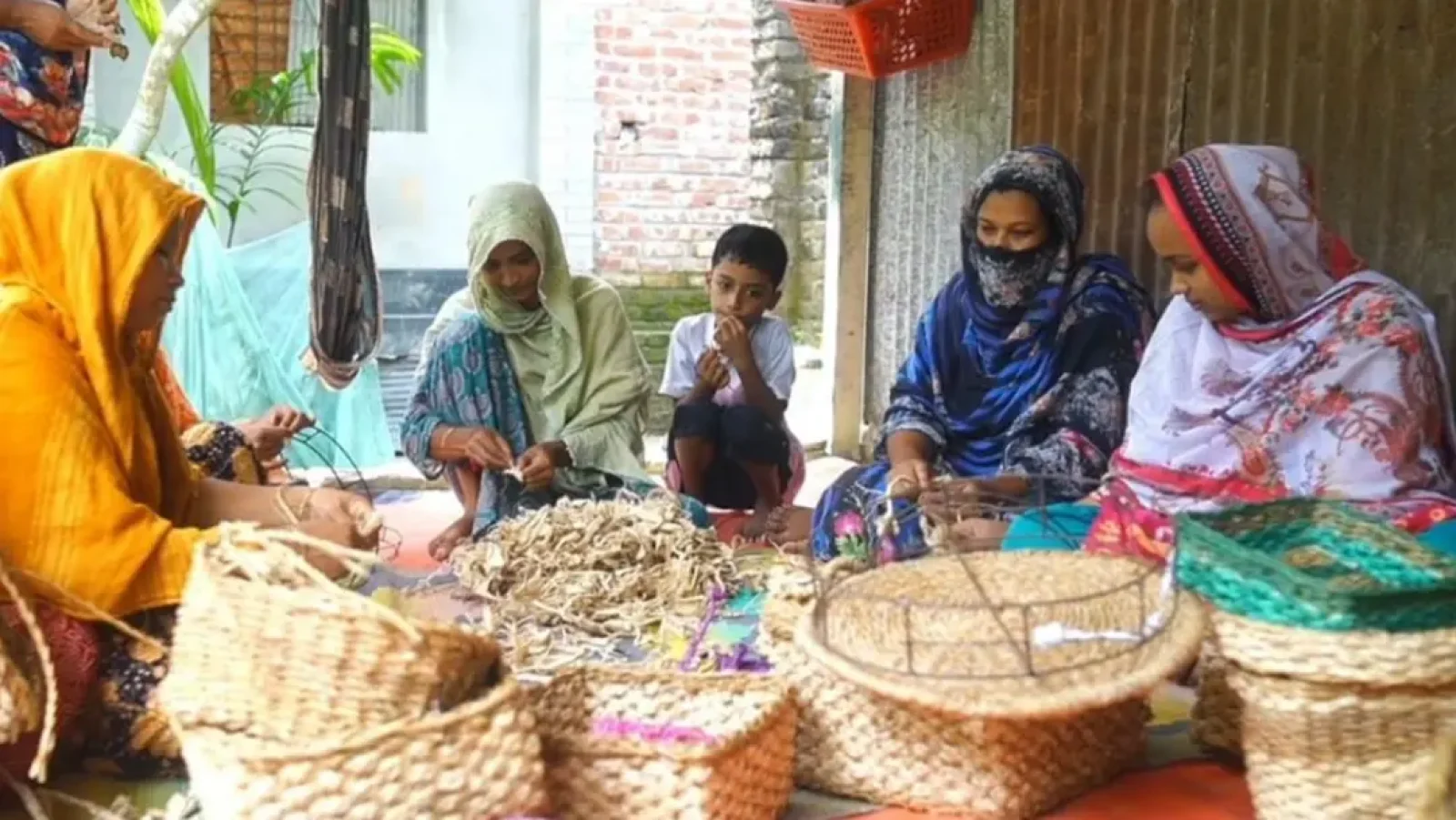
Corn husks that farmers once discarded or burned as fuel have become a new source of income in Mithapukur upazila of Rangpur, where rural women are weaving them into more than 200 varieties of eco-friendly handicrafts including flower vases, bags, baskets, trays and table mats.
Working in their spare time between household chores, women in Baldhipukur and nearby areas of Mithapukur are using the craft to support their families, pay for their children’s education and become financially independent, while farmers are earning extra income by selling the husks.
Local artisans are producing more than 200 items from corn husks, including flower vases, handbags, laundry baskets, trays, kitchen baskets, pen holders, table mats, tissue boxes and jewellery boxes. Entrepreneurs say stronger public and private support could expand the craft across Rangpur and open new export opportunities.
Employment and self-reliance for marginal women
Women from across Mithapukur, including many Santal women, have joined the initiative. Aduri Rishi, whose husband is a day labourer, said learning the craft allowed her to make items in her free time and bring financial relief to her family.
Another artisan, Hawa Begum, said she and her daughter took training in making corn-husk crafts and now cover their household expenses from their sales.
Rina Minji of Dakshin Mominpur said she works on the crafts at night after finishing her household duties during the day and uses the earnings to pay for her children’s schooling and family needs. Bulli Toppo, a student at Pairaband Degree College from the same area, said the income allows her to fund her own studies without relying on her family.
Extra income for farmers from discarded husks
With electric and gas stoves reducing the use of corn husks as fuel, growers are now selling husks for about Tk 1,200 per bigha. Farmers Rana and Mozammel Haque said the proceeds help cover cultivation and harvesting labour costs, while farmer Abu Bakar said his family now stores husks in sacks to sell year-round.
Entrepreneurs’ plans and administrative support
Nur Islam Nayeem of the enterprise Nutricycle Biosolution said they plan to expand the project across northern Bangladesh, noting that NGOs and multinational companies are already buying the products to reduce plastic use.
Rakibul Hasan Rakib, Rangpur district president of the National Association of Small and Cottage Industries of Bangladesh (NASCIB), called the initiative a model for eco-friendly production and rural women’s empowerment. Rangpur Deputy Commissioner Israt Jahan praised the initiative and assured entrepreneurs of full administrative support.
বাংলায় মূল প্রতিবেদন পড়ুন · Read the original Bengali report