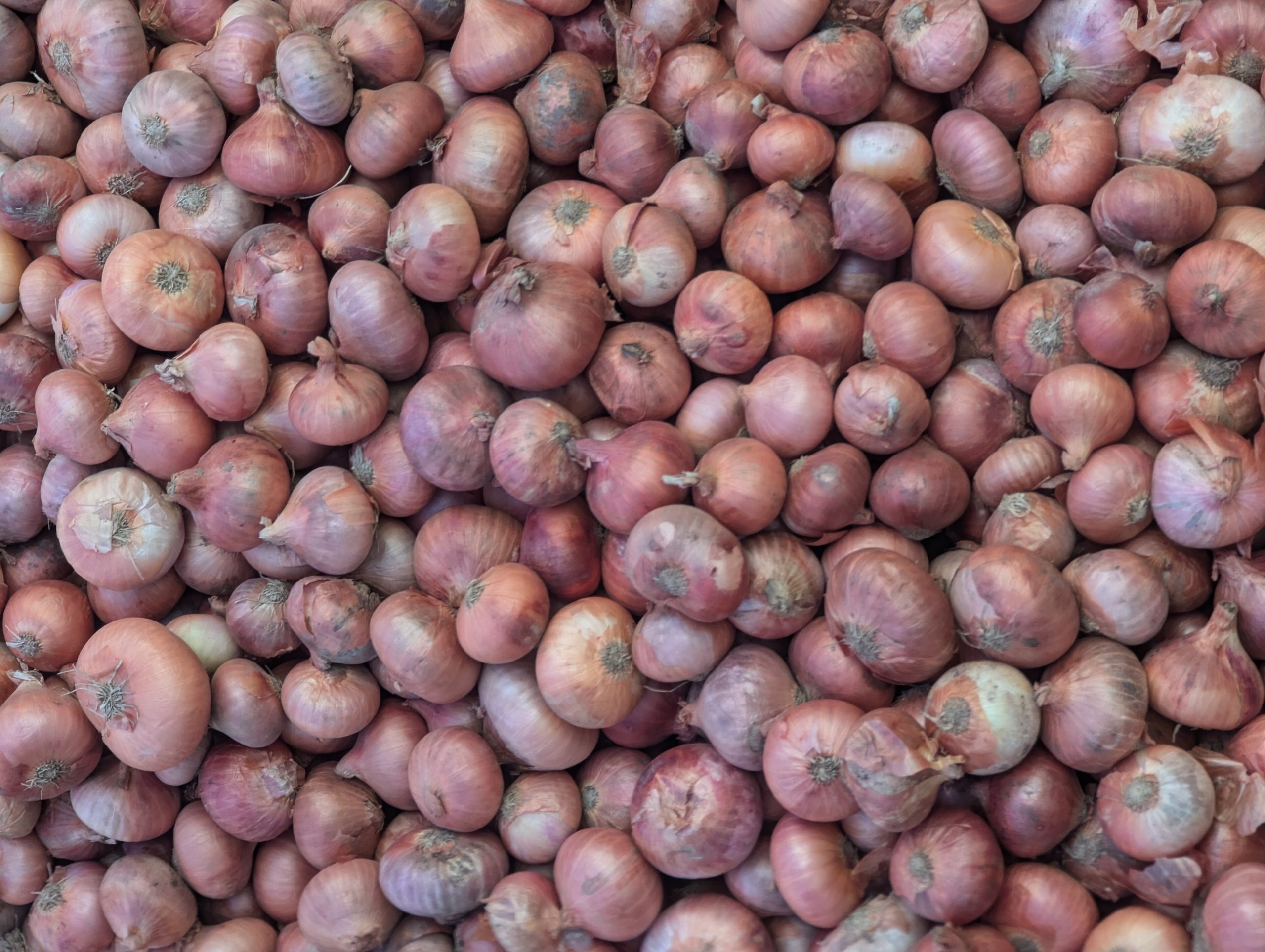
Onion prices have fallen to unprecedented levels in Pabna, one of the country’s main onion-growing districts. At a time of year when prices would normally rise, a glut of old onions has turned the market upside down. Onions that sold for Tk 5,000 to 6,000 a maund last year are now fetching just Tk 800 to 1,200. Farmers and stockists fear heavy losses because they cannot recover what they spent on growing and storing the crop.
The picture emerged from visits to Sujanagar, the district’s main onion market, on Sunday, 15 November, and to Hajirhat in Sadar upazila on Tuesday, and from talking to farmers there.
Farmer Zakir Hossain brought four maunds of onions to the market from Bangram in Santhia. He said he sold them at Tk 1,050 a maund, although storing them had cost him Tk 8,000. With no other choice, he is having to sell at a loss.
Ainal Mondal, a farmer from Durgapur village in Sujanagar, said onions are now selling at between Tk 800 and 1,100 a maund, depriving farmers of a fair price for their work.
Farmers say they borrowed at high interest to store onions for the lean season, hoping for a good price. On top of production costs, nearly six months of storage and the weight lost as the onions dry out have pushed up the cost of each maund sharply. Yet at the point of sale they cannot recover even a small part of that cost.
Farmer Siddiqur Rahman said the new murikata onion crop will reach the market in just one to one and a half months, yet stocks of old onions have not run out. Current stocks can meet another three to four months of demand. When the new crop arrives, prices could fall further to Tk 600 to 700 a maund, and farmers would lose their capital and face disaster.
According to the agriculture department, about 1 million tonnes of onions were produced on 54,000 hectares in Pabna this season, about 400,000 tonnes more than the district’s own demand. At the start of September about 100,000 tonnes were in storage, in farmers’ homes and in the 300 storehouses of the Department of Agricultural Marketing.
Agriculture officials say overproduction relative to demand and the huge stocks of old onions are among the main causes of the price crash. To avoid such a situation in future, they say, the focus must be on export-oriented production and marketing of onions.
Jahangir Alam Pramanik, deputy director of the Department of Agricultural Extension, said a specific, long-term plan for onion exports is needed to deal with such crises in future. New export markets abroad must also be found quickly to protect farmers from heavy financial losses, he said.
In all, despite a successful harvest, Pabna’s onion farmers face a serious financial crisis this year because of limits on storage, market management and exports. Those involved fear the situation could get much worse once the new crop reaches the market unless effective steps are taken in time.
বাংলায় মূল প্রতিবেদন পড়ুন · Read the original Bengali report