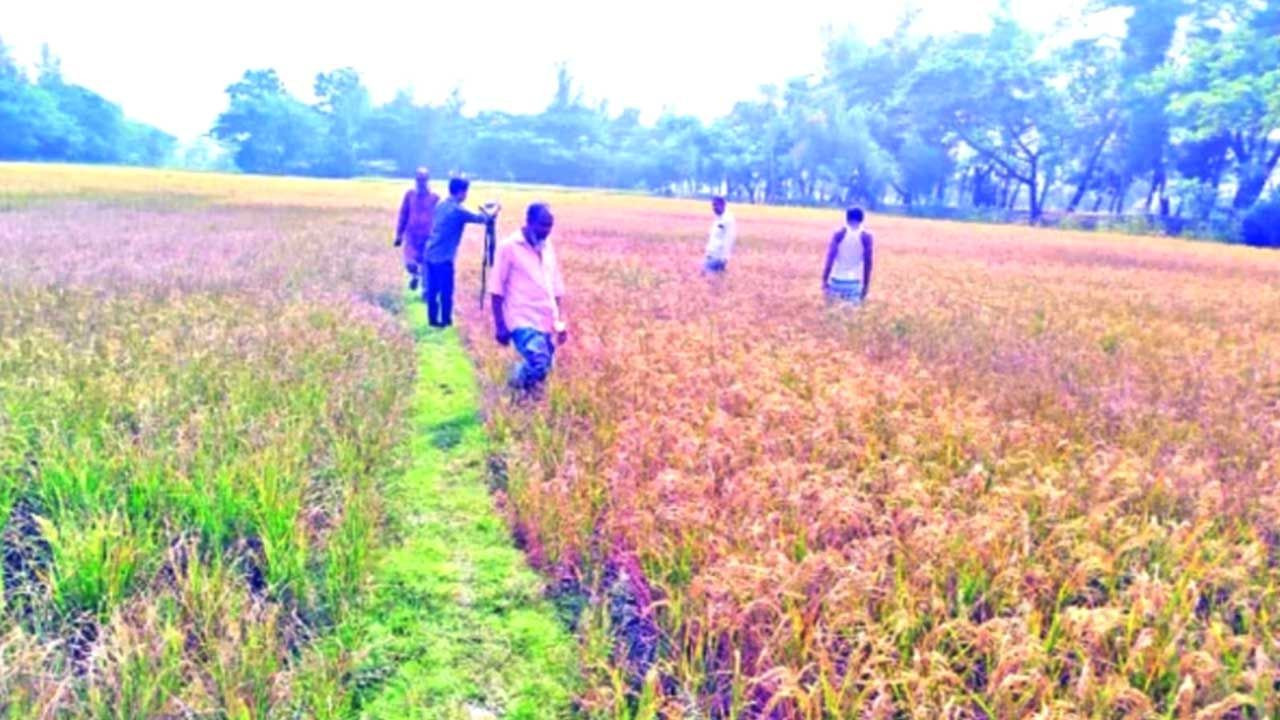
Lack of rainfall and rising salinity during the peak season have scorched transplanted Aman paddy across coastal areas of several upazilas in Noakhali, raising fears of a drop in production this season. Affected farmers said prolonged dry weather, increased soil salinity and fertiliser shortages have damaged paddy across thousands of hectares.
A field visit on Wednesday (November 18) showed Aman paddy stalks in coastal char areas dried out as if burned by fire, with cracked soil visible across fields. Similar scenes were observed in Noakhali and Dharmapur unions of Sadar upazila, and Char Wapda, Char Jabbar, Char Bata and Aman Ullah unions of Subarnachar upazila, as well as in Companiganj, Kabirhat and Hatiya upazilas.
Several farmers in Char Wapda village of Subarnachar upazila said they had cultivated transplanted Aman on five to seven acres each this year, but more than two months without rain caused severe water shortages. Combined with salinity and fertiliser scarcity, this caused widespread crop damage, and even surviving plots are unlikely to produce expected yields, they said.
Farmers said heavy rainfall in July delayed planting, and rainfall then stopped just as panicles began to form, leaving fields parched and cracked. Even where stalks appear healthy, yields are falling short of expectations.
Some farmers managed to save part of their crops through irrigation, but many fields could not be rescued due to insufficient water, with nearby canals and ponds also lacking water for irrigation.
Noakhali Department of Agricultural Extension Deputy Director Ashish Kumar Kar said transplanted Aman was cultivated on 170,622 hectares in the district this year, with a production target of 467,950 tonnes. He said drought could affect output, though the exact area of damaged crops has yet to be determined.
Ashish Kumar Kar added that initiatives are being taken to expand natural water sources and encourage farmers to cultivate salt-tolerant paddy varieties to protect against future water shortages.
Noakhali Regional On-Farm Research Division Chief Scientific Officer A H M Amir Faisal said improving drainage systems, adapting cultivation practices, and selecting short-duration, salt-tolerant rice varieties have become essential to sustain agricultural output in the coastal belt.
বাংলায় মূল প্রতিবেদন পড়ুন · Read the original Bengali report