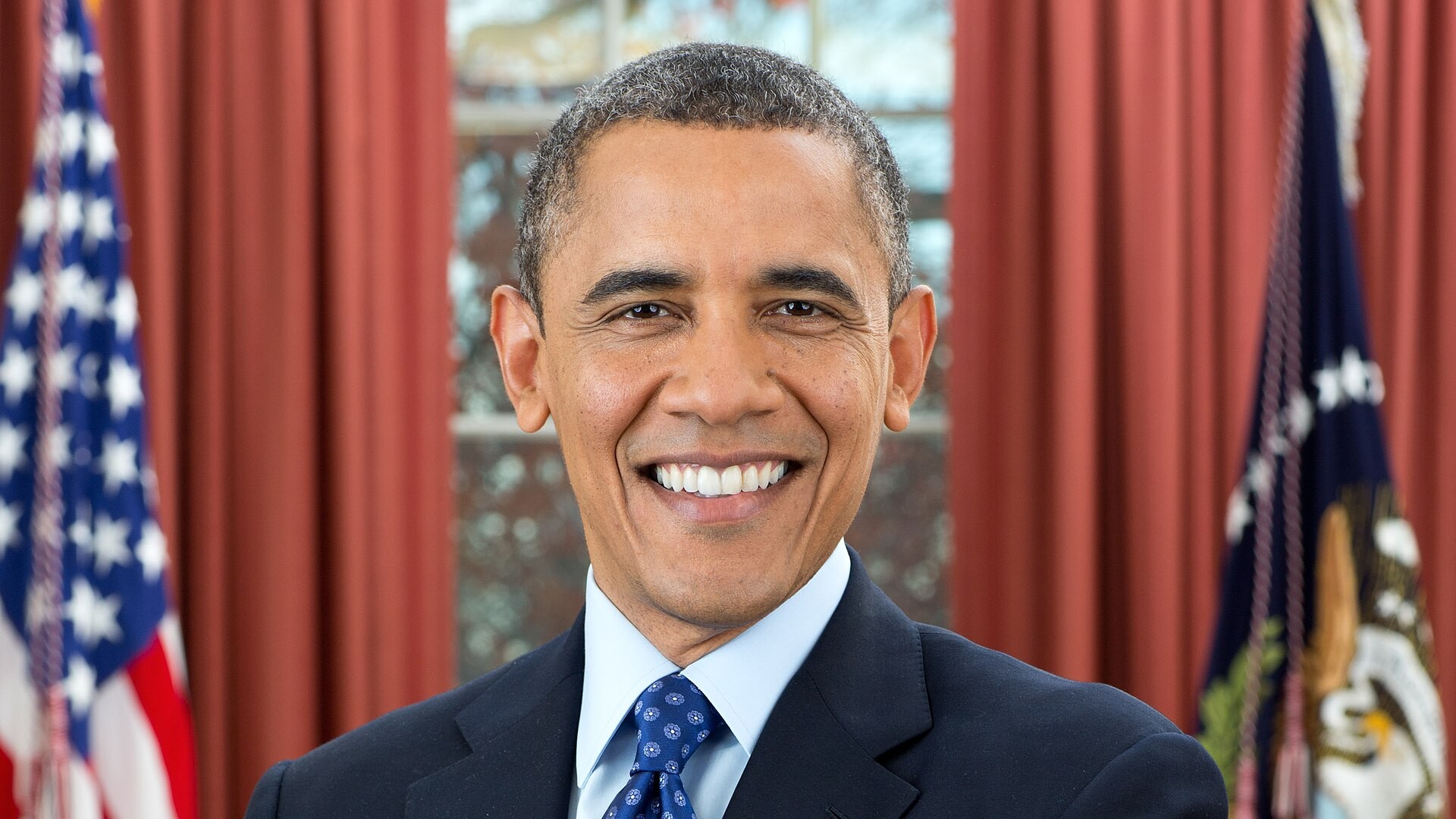
Barack Obama’s grandmother, Madelyn Dunham, died on 2 November 2008. Obama was devastated: it was she who had raised him. Yet in that time of grief came the greatest news of his life. Two days later, on 4 November, Obama made history by being elected the first Black president of the United States.
In that election the Democratic candidate won 365 electoral votes to 173 for his Republican rival, John McCain. On 20 January the following year Obama was sworn in as the 44th president of the United States. For people in the US and around the world it was a moment of great excitement and inspiration.
Obama, then 47, won over American voters with a promise of change. He arrived on the national stage at a time when the US was battered by a financial crisis, and frustration and anger over the Iraq war and the administration of Republican President George W Bush ran through American society.
In that climate, every speech by the eloquent Obama filled Americans with fresh hope. His main campaign slogan was “Change we can believe in”, and phrases such as “Yes we can”, “Hope” and “Change we need” were heard again and again in his speeches.
Just before the 18th anniversary of that historic victory, Obama has again been busy on the campaign trail. This time it is not for himself: the former president has been campaigning for Democratic candidates in the midterm elections.
From Hawaii to Chicago
Obama was born on 4 August 1961 in Honolulu, Hawaii. His mother, Ann Dunham, was a white American; his father, Barack Obama Sr, was Kenyan. His parents separated when he was two.
After his mother’s second marriage, Obama spent several years of his childhood in Indonesia. He later returned to Hawaii and was raised by his grandparents. The experience of growing up Black in a white family later found its way into his book Dreams from My Father, published in 1995.
Obama graduated in political science from Columbia University in 1983. In 1985 he went to Chicago as a community organiser, working on the problems of low-income residents. He then studied law at Harvard, and in 1990 became the first Black president of the Harvard Law Review.
While working as a summer associate at a Chicago law firm he met Michelle Robinson, who was assigned to supervise his work. They married in 1992, and built their family before he reached the national stage.
A long struggle for one victory
To understand the significance of Obama’s victory, one has to go back a century and a half. Slavery was abolished in 1865 by the 13th Amendment to the US Constitution, but the fight for equal rights for Black Americans went on for a long time after.
Even in the 20th century, American politics was deeply divided by race, and Black Americans faced many obstacles to registering to vote. In 1964, under pressure from the movement led by Martin Luther King Jr and other activists, the Civil Rights Act was passed. The following year the Voting Rights Act strengthened federal protection against barriers to voting on the basis of race.
These two laws opened the way for a Black American to become president, but it took another 43 years before one was elected to the country’s highest office. The moment came in 2008, when Obama won by a wide margin. A Pew Research Center survey after the election found that 75 per cent of Black voters expected his victory to improve race relations in the US.
Those hopes did not erase inequality. In Obama’s second term, protests grew over the deaths of Black Americans at the hands of police, and the Black Lives Matter movement came to the fore. Pew’s research in 2016 also showed a deep racial divide.
Obama was also the target of false claims. Donald Trump claimed that Obama had not been born in the United States; his birth certificate disproved this, and in 2016 Trump too acknowledged that Obama was born in the US.
The White House eight years after a defeat
Obama’s political rise was not an unbroken run of victories. He was elected to the Illinois state Senate in 1996, but in 2000 he lost heavily when he sought his party’s nomination for a seat in the US House of Representatives. The winner was Bobby Rush.
In 2004 Obama caught the nation’s attention with the keynote speech at the Democratic National Convention, and the same year he was elected to the US Senate. In 2007 he announced his run for president, and he beat Hillary Clinton for the party’s nomination.
The economic crisis of 2007-08 became one of the most important issues of Obama’s campaign. Starting in the housing sector and spreading to banks and financial institutions, the recession battered the US economy and unemployment kept rising. A Pew Research Center survey in October 2008 found voters thought Obama better able than McCain to deal with the economic crisis.
Obama also won the support of a large share of young people. According to a Pew Research Center analysis, 66 per cent of voters under 30 voted for him, though the youth vote alone did not decide his victory.
Fighting for reform in a crisis
After taking office in 2009, Obama announced a stimulus package to revive the economy. He carried forward the financial sector rescue programme begun under the Bush administration and gave government support to keep the struggling car industry alive. Before the end of his presidency, US unemployment fell below 5 per cent.
According to political scientist Michael Nelson of the Miller Center, one of Obama’s biggest impacts was preventing a possible second Great Depression. But achievements that rested on executive power were at risk of being reversed by his successors.
Despite the pressure, Obama paid close attention to his family. In his memoir A Promised Land he writes that after dinner he would go for walks with Michelle, their two daughters and their dog, Bo, and that at those times he felt normal and whole.
On election night Obama had promised his daughters a puppy, and he kept that promise in his first term in the White House.
One of his biggest commitments as president, however, was health reform. In 2010 he signed the Affordable Care Act, which became known as Obamacare. According to the health policy research organisation KFF (formerly the Kaiser Family Foundation), about 20 million more people had health insurance in 2016 than before the law was passed.
This achievement was also contested. Obama had promised that anyone who wanted to could keep their existing health plan, but many people’s plans were cancelled because they did not meet the new law’s requirements. In 2013 the US fact-checking outlet PolitiFact named that promise its “Lie of the Year”.
In May 2011, after a worldwide search of nearly 10 years, Obama announced that al-Qaeda leader Osama bin Laden, who planned the 11 September attacks, had been killed in a US operation in Pakistan. Obama watched the raid live with his administration’s top officials.
Re-elected for a second term
In the 2012 election Obama defeated the Republican candidate Mitt Romney to win a second term, with 332 electoral votes to Romney’s 206.
In his second term Obama announced major gun control reforms. After the Sandy Hook school shooting in 2012, in which 20 children and six adults were killed, his administration sought to widen background checks on gun buyers. But in April 2013 a proposal to do so fell short of the 60 votes it needed in the Senate, with 54 votes for and 46 against. In January 2016 Obama wept as he spoke about the children killed at Sandy Hook.
On social rights, however, his second term brought success. In 2012 Obama publicly backed same-sex marriage. Three years later, in June 2015, the US Supreme Court ruled that same-sex couples have a constitutional right to marry nationwide, and Obama welcomed the ruling.
His role on immigration cut both ways. In 2012 he launched the DACA (Deferred Action for Childhood Arrivals) programme to give temporary protection from deportation to some young immigrants brought to the US as children.
According to the Pew Research Center, his administration formally deported about 2.8 million immigrants from fiscal years 2009 to 2015, a figure that includes people apprehended at the border.
A Nobel laureate’s wars and diplomacy
Barack Obama received the Nobel Peace Prize in 2009, in recognition of his efforts to strengthen international diplomacy and cooperation. He had not yet completed eight months as president.
On Obama’s orders, US forces killed al-Qaeda leader Osama bin Laden in a raid in Pakistan in 2011. At the end of the same year all US troops were withdrawn from Iraq. In Afghanistan, however, Obama first increased troop numbers, announcing in December 2009 that 30,000 more troops would be sent, before they were reduced in stages.
After the rise of the Islamic State (IS), Obama sent US troops back to Iraq in 2014. That August the US began air strikes on IS positions in Iraq, and in September strikes against IS began in Syria too.
These operations were part of the wider “war on terror” begun in 2001 by then-President George W Bush. US military operations against IS in Iraq and Syria continued after Obama’s two terms ended.
Drone strikes abroad were among the most controversial military actions of the Obama years. According to a 2017 count by Micah Zenko of the Council on Foreign Relations, Obama authorised 542 drone strikes in Pakistan, Yemen and Somalia, which killed an estimated 324 civilians.
Obama promised to close the Guantanamo prison but could not, in the face of opposition in Congress.
In 2013 Edward Snowden leaked classified documents from the US National Security Agency (NSA) revealing its vast surveillance programmes. The Obama administration defended the programmes in the name of national security, raising questions about citizens’ privacy and the limits of state surveillance.
Obama later admitted there had not been enough planning to manage the situation in Libya after the 2011 military intervention there. In 2016 he called this the worst mistake of his presidency, though he still defended the decision to intervene.
On the other hand, a nuclear deal with Iran was reached in 2015, diplomatic relations with Cuba were restored, and his administration helped shape the Paris climate agreement. These were the main diplomatic achievements of his second term.
Bangladesh: an honour and GSP
One notable event in Obama’s relations with Bangladesh came on 12 August 2009, when he awarded Bangladesh’s Nobel laureate Professor Muhammad Yunus the Presidential Medal of Freedom, the highest civilian honour in the US, in recognition of his work to reduce poverty through microcredit.
Another concerned Bangladesh’s trade benefits and labour rights. On 27 June 2013 the Obama administration announced the suspension of the Generalized System of Preferences (GSP) benefits given to Bangladesh, on the grounds that Bangladesh had not taken adequate steps to ensure internationally recognised workers’ rights.
The decision came two months after the Rana Plaza collapse. US documents said, however, that a review of labour rights and factory safety had been under way before that, and cited the Tazreen Fashions fire as well as the Rana Plaza collapse.
A new life for the family
Obama left office on 20 January 2017. Since then he has been busy writing books, producing films and programmes, and working on his foundation. With Michelle he founded the production company Higher Ground, which makes films, television programmes and podcasts.
Michelle is now active in writing and podcasting. With her older brother, Craig Robinson, she hosts IMO, where they talk about family, relationships and everyday life.
Their elder daughter, Malia, works in film-making and uses the name Malia Ann professionally. Her short film The Heart, which she wrote and directed, was screened at the 2024 Sundance Film Festival.
Their younger daughter, Sasha, graduated in sociology from the University of Southern California in 2023. No reliable information is available about her current work.
In the introduction to A Promised Land, Obama writes that in the first months after leaving office they slept late, took their time over meals and went on long walks, and had the chance to focus on their relationships again.
Obama also has his own way of writing. For first drafts he prefers a pen and a yellow legal pad; in his view, a computer can make half-formed thoughts look too polished.
Back on the campaign stage
On 18 June the whole family was seen at the opening of the Obama Presidential Center in Chicago. His foundation also runs programmes to develop new leaders.
But much of the time of Obama, now 65, is taken up with the midterm elections. On 24 October he campaigned for Democrats in Ohio and Michigan, and on 28 October he joined a rally in Georgia for Senator Jon Ossoff and gubernatorial candidate Keisha Lance Bottoms.
This time Obama’s own name is not on the ballot; he is asking for votes for his party’s candidates. Ahead of the anniversary of that 2008 victory, Obama is once again urging people to go out and vote.
At a rally for Democratic candidate Keisha Lance Bottoms in Georgia on 31 October, Obama sharply criticised what he called President Trump’s authoritarian attitude, and mocked the failures of his foreign policy in the Middle East.
“This election is our last and best chance to at least rein him in, to stop some of this administration’s foolishness,” Obama said. “It is the system’s circuit breaker. And to make it work, we have to change the majority in Congress.”
Sources: Catalini, M. (29 October 2026). Trump and Obama in final midterm push in key states. News4JAX. Nelson, M. (undated). Barack Obama: impact and legacy. Miller Center, University of Virginia. Obama, B. (27 June 2013). Message to Congress on suspending Bangladesh’s Generalized System of Preferences (GSP) benefits. The American Presidency Project. Obama, B. (2020). A Promised Land. Crown. Pew Research Center (27 June 2016). On views of race and inequality, Blacks and whites are worlds apart. Zenko, M. (20 January 2017). Obama’s final drone strike data. Council on Foreign Relations.
বাংলায় মূল প্রতিবেদন পড়ুন · Read the original Bengali report