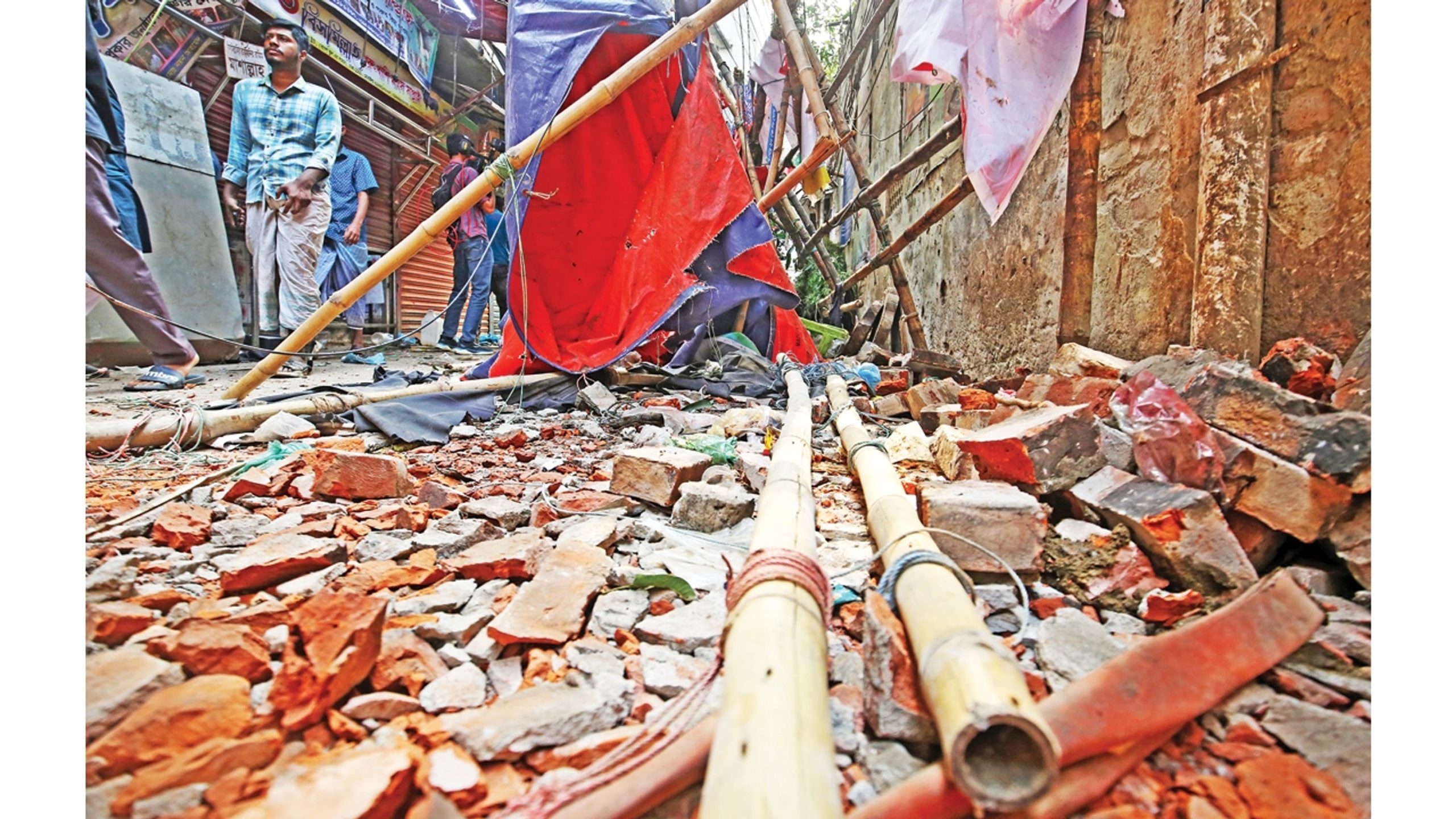
DHAKA — Friday morning’s magnitude-5.7 earthquake offered a glimpse of what a major quake could do to Dhaka, geologists and seismologists said, urging immediate preparations and treating the tremor as a foreshock of a potentially devastating event.
Bangladesh has not experienced a major earthquake in a century, but the historical record shows the region remains seismically active, experts said. A few additional seconds of shaking could have triggered a humanitarian catastrophe, they warned, calling for stepped-up drills and public awareness to reduce casualties.
City authorities have identified about 2.146 million buildings across the capital as at risk. Most were constructed without complying with building codes, using outdated designs or weak foundations. A major earthquake could bring devastating consequences to the capital, urban planners said. Friday’s quake, occurring close to Dhaka and at a higher magnitude than the region has seen in decades, was felt by most residents and triggered widespread panic, experts said.
Syeda Rizwana Hasan, adviser to the Ministry of Environment, Forest and Climate Change, said Dhaka and Old Dhaka face the highest earthquake risk. “Even though current buildings follow the code, Rajuk statistics show that a large number of structures, 90 percent of which have no approval, have already been built. What will happen to them if quakes like this keep repeating?” she said.
A joint survey by the Comprehensive Disaster Management Programme and the Japan International Cooperation Agency (JICA) found that a magnitude-7 or stronger earthquake in Dhaka would collapse 72,000 buildings and damage another 135,000, generating 70 million tonnes of concrete debris.
Experts said Bangladesh sits on the Indian Plate, which is moving northeast. To the north of Sylhet lies the south-moving Eurasian Plate, and the two are pressing against each other. The country is also subducting under the Myanmar subplate to its east, with the Dauki Fault to the north and Myanmar’s Sagaing Fault and the Madhupur Fault to the east, leaving Bangladesh geologically prone to earthquakes.
Md. Mominul Islam, director of the Bangladesh Meteorological Department, said the epicenter this time was very close to Dhaka, which is why the shaking was felt so strongly. “Even a magnitude-7 quake in Rangamati or Khagrachhari would not have shaken Dhaka this much. But if this earthquake had lasted 5 to 7 seconds longer, many buildings in Dhaka would have collapsed. Dhaka and surrounding areas have never faced an earthquake like this before,” he said.
“It may seem that a magnitude-6 earthquake is only one point stronger than a magnitude-5 one, but that is not the case. A magnitude-6 quake has 10 times the shaking intensity of a magnitude-5. Every fractional unit means many times the intensity. The shaking from this earthquake had an intensity radius of at least 100 km,” Islam said.
Earthquakes have been centered in and around Dhaka before but at lower magnitudes. A magnitude-4.5 quake occurred on March 18, 2012, a magnitude-4.8 on July 26, 2008, and a magnitude-4.5 on December 19, 2001. Those events caused no major casualties. A magnitude-6.2 earthquake struck Chattogram on November 26, 2011.
The region has historically witnessed major quakes. The 1897 Great Indian Earthquake (magnitude 8.0) killed more than 1,500 people in then-undivided Bengal. The 1918 Srimangal earthquake (magnitude 7.6) caused widespread damage.
A 2024 study by the Rajdhani Unnayan Kartripakkha (Rajuk) found that a magnitude-6.9 earthquake on the Madhupur Fault in Tangail would collapse between 40.28 percent and 64.83 percent of Dhaka’s buildings. Depending on the time of day, the death toll could range from 210,000 to 310,000 in the morning, 270,000 to 400,000 in the afternoon, and 320,000 to 500,000 at night, the study said. A magnitude-7.1 quake along the Sylhet lineament (Dauki Fault Line) could damage between 40,935 and 314,000 of Dhaka’s buildings, or 1.91 percent to 14.66 percent.
Infrastructure damage from a magnitude-6.9 Madhupur Fault earthquake would also be severe. Some 49.6 percent of main roads and 59.4 percent of inner-city roads could collapse, with 96.22 percent of major bridges and 96.79 percent of city bridges at risk of destruction. Financial losses could exceed $1 billion in the transport sector, $887 million in water and sewage systems and $27.1 million in electricity infrastructure, the study estimated.
Rajuk’s jurisdiction contains more than 2.15 million buildings, of which 514,000 are concrete structures. Of 3,252 buildings inspected in the survey, 42 were classified as extremely vulnerable and recommended for immediate demolition.
A magnitude-7.5 quake would collapse 72,000 buildings and severely damage another 150,000, according to the Comprehensive Disaster Management Programme. Buildings on weak soil and structures taller than six stories that were built without complying with the building code would be the worst affected, experts said.
Experts identified several factors driving Dhaka’s risk. The unplanned high-rises, slums and narrow lanes of one of the world’s most densely populated cities are major obstacles. Many buildings were not built to seismic safety standards, turning them into death traps. Bangladesh’s weak soil composition is another factor. Much of the country sits on loose, waterlogged alluvial soil that can liquefy under strong shaking and cause buildings to collapse.
Earthquake-prone regions such as Japan and California have extensive public awareness, emergency drills and effective disaster-response systems. Bangladesh lacks all of them, experts warned.
Mehedi Ahmed Ansary, a civil engineering professor at the Bangladesh University of Engineering and Technology (BUET), said all 2.1 million of Dhaka’s buildings need to be inspected immediately. “The government will not have to spend money on this. Rajuk should inform the public, check all the buildings and issue certificates confirming they meet the building code,” he said.
“Friday’s earthquake can be called a foreshock — the smaller quakes that precede a major one. Major earthquakes tend to recur every 150 years or so. From that perspective, the time for a magnitude-7 quake is approaching. There has been no major earthquake here since 1930, but research shows the risk is significant,” Ansary said.
“This earthquake damaged many buildings in Dhaka, settled foundations and caused cracks. The damage from a magnitude-5.7 quake is one thing, but a magnitude-7 quake would multiply it, collapsing buildings and causing casualties. A quake of that strength within 100 km of Dhaka would kill or injure 200,000 to 300,000 people and put 35 percent of the city’s buildings at risk of collapse — about one-third of them,” Ansary said.
Humayun Akhter, an earthquake specialist, said larger quakes are likely ahead. “Friday’s earthquake is the warning. The plate that was locked is unlocking. Larger earthquakes will come to this region in the future. We have told the government repeatedly that there is no alternative to drills for earthquake response. The government keeps huge budgets for post-quake rescue work — money that can be siphoned through corruption — but no proper steps are taken,” he said.
Adil Muhammad Khan, an urban-planning professor, said Dhaka lacks open shelter space to handle a disaster of this scale. “When people panic and rush out looking for a safe open space, in most neighborhoods there is none to be found. Dhaka has been built and expanded such that most areas have no open spaces. The ones that existed have gradually been converted. That means there is no space where people can stand during an earthquake or a major disaster in most areas,” he said.
“Hundreds of open spaces needed to be created in Dhaka, but with no state initiative, private players will never do it. That neglect could prove disastrous for Dhaka residents during a calamity. Playgrounds should be used not only for sports but as shelter during disasters,” Khan said.
Rubaiyat Kabir, head of the Bangladesh Meteorological Department’s Earthquake Observation and Research Centre, said Bangladesh sits in a seismically active region. “There are historical records of major earthquakes here. Since digital monitoring began in 2007, this magnitude-5.7 is the strongest quake recorded around Dhaka. Aftershocks typically follow a major earthquake, although none of significance have occurred so far,” he said.
বাংলায় মূল প্রতিবেদন পড়ুন · Read the original Bengali report