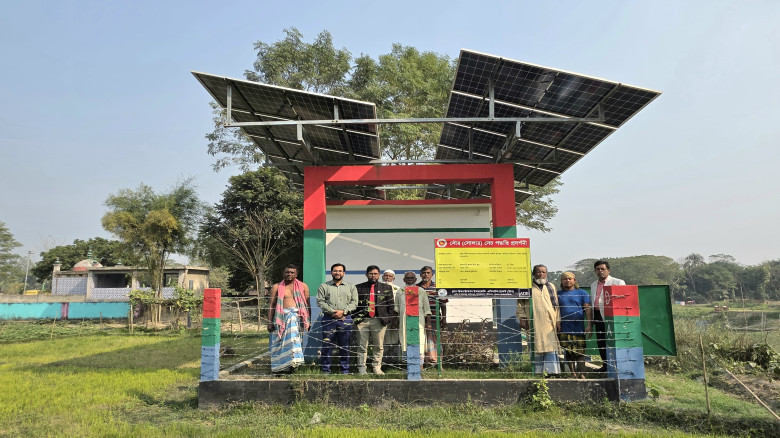
In Brahmanbaria’s Nabinagar, a new possibility of aush rice cultivation has emerged this season on land that had long lain fallow. With modern solar irrigation, planned initiatives by the agriculture department and farmers’ spontaneous participation, aush rice has been grown for the first time on about 150 bighas of land in Dolabari, Satmora and Ratanpur in Nabinagar municipality and various areas of Salimganj union in the upazila this season.
Through a solar irrigation system installed with FRIP project funding along the banks of the Titas river, renewable solar power is being used to supply irrigation water continuously to farmland via high-quality underground buried pipelines. Under various agriculture-department projects and incentive programmes, farmers have also been given high-quality seed, fertiliser and other inputs free of charge. As a result, land that once lay fallow is now filled with green, and golden ears of ripe aush rice are swaying across the fields. Aush rice of the BRI dhan-98 and BRI dhan-48 varieties has been grown on about 75 bighas there for the first time.
Abdul Mannan, a farmer from Dolabari village in Nabinagar municipality, said: “Thanks to the government’s solar irrigation scheme, we are getting irrigation at low cost. With the agriculture department’s help, I have grown aush on such a large scale for the first time. The crop is in very good condition; I’m hoping for a bumper yield.”
Mannan Mia, a farmer from Chuoria village, said: “I used seed I had preserved because of last year’s good yield. Several other farmers collected seed from me and grew aush. With enough rainfall, the yield prospects are very good this time.”
Safurullah, sub-assistant agriculture officer for Satmora union, said that after a successful demonstration of BINA dhan-19 on farmer Mannan Mia’s field last season, he had preserved the seed. This season, under the demonstration and incentive programme of the Bangladesh Institute of Nuclear Agriculture, seed, fertiliser and other inputs had been supplied to farmers free of charge, expanding aush cultivation by about 25 bighas in Chuoria village.
Aktaruzzaman, sub-assistant agriculture officer for the municipality block, said that under the overall direction of the upazila agriculture officer, a plan for fresh aush cultivation had been taken up in the Dolabari block. Farmers had been given regular field-level advice, training and necessary inputs. Thanks to modern solar irrigation technology, more fallow land could be brought under aush cultivation in future, he said.
Nabinagar upazila agriculture officer Md Jahangir Alam Liton said that, using renewable energy, 75 bighas of land in Dolabari had been brought under aush cultivation together for the first time under the solar irrigation scheme. Supplying irrigation water through high-quality buried pipelines had reduced water wastage and significantly cut farmers’ irrigation costs, he said.
He added that about 150 bighas of fallow land in Nabinagar upazila had been brought under fresh aush cultivation this season. “Our aim is to increase food production, raise farmers’ incomes and build a sustainable farming system by bringing flood-free fallow land under short-duration aush rice after the boro season,” he said.
Nabinagar’s initiative has shown that when the right planning, modern technology, renewable energy and farmers’ tireless effort come together, even fallow land can fill with golden crops. The aush ears swaying across the fields are today a symbol not just of a successful season but of a bright example of achieving sustainable agriculture and food security.
বাংলায় মূল প্রতিবেদন পড়ুন · Read the original Bengali report