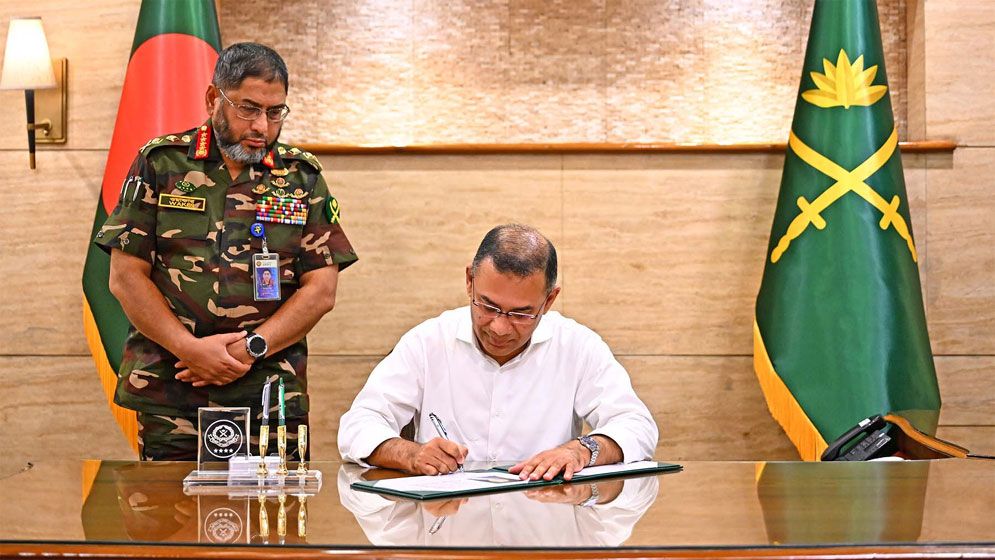
Prime Minister Tarique Rahman has said the government is determined to build a modern, technology-based army suited to the demands of the time. He said that if certain specific policies are followed in promotion and posting, the “army headquarters selection board” can play a transformative role in establishing professionalism. Merit and ability should be the main yardstick by which an army officer earns promotion, he said.
An officer’s physical fitness and physical appearance should be among the main considerations for promotion, he said.
The prime minister made the remarks in his address as chief guest at the inaugural session of the “Army Headquarters Selection Board 2026” at army headquarters in Dhaka Cantonment on Sunday, 26 July.
The prime minister said Bangladesh currently faces multidimensional and complex security challenges, including maritime security, border security, inter-state and cross-border threats, cyber and information-based security, disaster management and humanitarian assistance operations. It is therefore the demand of the times, he said, to follow a realistic and sustainable model of defence modernisation that takes account of Bangladesh’s geographical position, economic capacity, national security requirements and the expectations and resilience of the people.
Tarique Rahman said: “As head of government and at the same time defence minister, my belief is that the main strength of Bangladesh’s defence system lies not only in the capability of the armed forces but in the unity, preparedness and resilience of the whole nation.”
He said: “To that end a modern policy will be framed in the light of the ideas of the martyred president Ziaur Rahman, under which the armed forces, law enforcement agencies, the civil administration, industry, technology, educational institutions and the general public will work as part of an integrated national security structure. The aim of this policy is not to encourage war but to build armed forces that are always prepared, stable and self-reliant in facing any possible crisis, aggression or disaster, so that the country’s sovereignty, independence and national interests are fully protected.”
Addressing the generals present, the prime minister said the nature of war has changed in the present day. Security no longer means only protecting geographical borders. Cyberspace, information warfare, drone technology, artificial intelligence and regional geostrategic competition have been added to it. The government therefore wants to build a stronger defence system by increasing capability in drone technology, satellite surveillance, and cyber and electronic warfare.
He said that in this continuity the government is working on framing an outline for the modernisation and development of the armed forces. Our aim is the future development of the forces, he said — one in which capability rather than numbers, effectiveness alongside expansion, technological innovation rather than an increase in platforms, and jointness rather than single-service development will be given importance.
He added that the government’s main themes in developing the armed forces are building disciplined, modern and strong armed forces; strengthening integrated defence planning; framing defence policies and strategies fit for the times; developing the domestic defence industry; and consolidating democratic civil-military relations.
The prime minister said: “It is through this selection board, formed to select and recognise the deserving by the proper rules on an assessment of merit, ability, skill and integrity, that discipline will be re-established in posting and promotion. At the same time I believe a firm foundation will be laid for visionary and professional leadership in the army in the days ahead.”
He said: “I feel a kind of pride in any success of the army. And I feel unease at any negative news about the army.”
The prime minister said: “The cantonment is a place of deep feeling and memory for me. As you know, my adolescence and youth were spent in an army environment, at home and outside. So naturally I am fairly well acquainted with the army’s rules, discipline and regulations. For these reasons I become somewhat nostalgic when I have to say something about the army.”
He said: “I grew up with my parents and my only younger brother within the discipline and orderly conduct followed in an army environment. I have always regarded the army as part of my wider family.”
Tarique Rahman added: “At today’s event I remember with respect the proclaimer of independence, valiant freedom fighter and martyred president Ziaur Rahman. As an army officer, by declaring independence, the then Major Zia made the army an inseparable part of the history of Bangladesh’s independence and liberation war. This is undoubtedly a glorious chapter for the country’s army.”
The prime minister said that although the army played a glorious role in the liberation war, a kind of attempt to damage the army’s image and create instability within it was noticeable immediately after independence. Even in that unstable time, he said, a new era of discipline and professionalism began in the army through the firm and far-sighted leadership of the former army chief, the martyred Lieutenant General Ziaur Rahman.
He said: “From the very beginning of independence, members of the army have worked tirelessly to protect the security and stability of the Chittagong Hill Tracts. The continuing ‘border road’ project, about 1,036 kilometres long in the hill and border regions, is not only ensuring border security but has opened the door to new possibilities in the livelihoods and economic activity of people in remote areas.”
Noting that work is also under way through the army to clear 1,200 square metres of the hill areas of mines and explosives, the prime minister said: “I express deep condolences and gratitude to the families of the 217 valiant army members who were martyred while deployed on peacekeeping and counter-terrorism duty in the Chittagong Hill Tracts.”
He said: “The reputation of the Bangladesh Army in the international arena is well established today. By discharging its duties with skill, professionalism and dedication in United Nations peacekeeping missions, Bangladesh has earned special pride and prestige on the world stage in recent years as the largest contributor of peacekeepers.”
Tarique Rahman said members of the Bangladesh Army have recently upheld the country’s honour in the international arena by carrying out their duties with great skill and professionalism in the Central African Republic, South Sudan and Mali. But behind this glorious achievement, he said, lies a history of sacrifice.
He said six Bangladesh Army peacekeepers were martyred in a drone attack in South Sudan on 13 December 2025. “I pray for the peace of the souls of the martyrs and express deep condolences to their grieving families,” he said.
Tarique Rahman said he believes the democratically minded public will judge positively the responsible role played by the army in the historic student-people uprising of 2024 and in the critical moments after 5 August. At the same time, he said, the army played a commendable role throughout the period of the interim government in maintaining law and order, ensuring the security of industrial areas and keeping the wheels of a stalled economy turning.
He said: “The army’s unstinting support in completing the free and impartial election held on 12 February last was essentially a unique expression of deep institutional faith in democratic rules. Beyond that, the army played an extremely important role in keeping the situation normal by discharging its duties at fuel storage depots with skill and prudence even amid the global fuel oil crisis.”
The prime minister described the Bangladesh Army’s role in protecting the country’s sovereignty, countering terrorism in the Chittagong Hill Tracts and in United Nations peacekeeping missions as highly commendable.
He said the army has always played a leading role in the country’s infrastructural development, in post-disaster rescue operations and in any national crisis, including the July uprising and the flood situation.
He added that every institution in the country lost its professionalism during fascist rule. The army too had to face an unwanted and adverse situation. In the present democratic environment, he said, the army must once again keep the confidence of the people through its ability, skill and professionalism.
Turning to physical fitness and regular physical exercise, the prime minister said he found a remark by the late US general Norman Schwarzkopf quite relevant.
He said General H Norman Schwarzkopf had said: “The more you sweat in peace, the less you bleed in war.” There is therefore no scope for compromise at any level on discipline and fitness in the army, he said.
The prime minister said the officers selected through this selection board will further consolidate the continuity of the Bangladesh Army’s success, pride and professionalism in future. The present government’s philosophy, he said, is “Bangladesh first” in protecting the country’s interests and “Bangladesh for all” in protecting the interests of the people.
বাংলায় মূল প্রতিবেদন পড়ুন · Read the original Bengali report