After Sheikh Hasina’s government fell, a recorded call between her and Sheikh Fazle Noor Taposh, former mayor of Dhaka South City Corporation, spread on social media. Taposh made the call; Sheikh Hasina was on the other end. Greeting her, Taposh said: “I want to go to Singapore for a bit; I was hoping to. Can I go?” Sheikh Hasina replied: “Yes, go. Why wouldn’t you?” They spoke further.
Taposh made the call at 8:16am on 3 August 2024. From the conversation, it appears Taposh had gone to the airport to leave for Singapore but was stopped by immigration authorities, and contacted Sheikh Hasina for help.
Until the day before Taposh hurriedly left the country, hundreds of people were confirmed killed in the student-people’s movement. Dhaka and the whole country were in turmoil. The previous day, an anti-government protest called the “Drohojatra” drew crowds of university teachers and students, cultural workers, artists, lawyers, development workers, rights activists and people of various professions.
3 August 2024 is remembered as one of the most important turning points in the history of the July uprising. That afternoon, at a rally attended by hundreds of thousands at the capital’s Central Shaheed Minar, anti-discrimination student movement coordinator Nahid Islam announced a one-point demand for the government’s fall, turning the quota-reform movement decisively into an anti-government mass movement. The same morning, at an army headquarters gathering, views emerged from the army against the use of force on ordinary people.
Seeing the government’s shaky position, Taposh — a son of Sheikh Hasina’s cousin — quietly left the country. Before and after Sheikh Hasina’s fall, almost all her close relatives fled abroad. All the important members of the Sheikh family managed to avoid arrest — even though, during her more than 15 years in power, they had been at the top of the exercise of power. Nearly two dozen members of the family or Sheikh Hasina’s relatives had been beneficiaries of the government as ministers, MPs or key party office-holders.
Of them, only Moin Uddin Abdullah, son of Sheikh Hasina’s cousin Abul Hasanat Abdullah, was arrested in Dhaka in October 2024. But he was not politically prominent; he was in business and, according to those close to him, had not gone into hiding. The rest of the family or relatives left the country before and after the government’s fall, and most are now in India, according to relevant sources, with many said to be living in expensive residential buildings in Kolkata — as photos and videos posted on social media have shown.
When Sheikh Hasina resigned and left the country on 5 August 2024, her younger sister Sheikh Rehana went with her. Rehana was not seen during the student-people’s movement; Awami League-linked sources say she came to Dhaka from the UK two days before the government’s fall. She is a permanent UK resident. Since going to India with Sheikh Hasina, Rehana has been staying in London and India, Awami League leaders say, but has not appeared in public. Also with them on 5 August 2024 was the former prime minister’s defence adviser Tarique Ahmed Siddiqui, who is Rehana’s brother-in-law.
Sheikh Hasina’s son Sajeeb Wazed Joy had long lived in the United States and was there before the government’s fall; there is talk that he later went to India to see his mother. During Sheikh Hasina’s rule, Joy regularly came home and took part in official and private programmes, and was also her ICT adviser. Her daughter Saima Wazed (Putul) was elected WHO regional director for South-East Asia in November 2023; the regional office is in New Delhi, where she was at the time of the government’s fall. After the fall, the WHO sent Saima Wazed on indefinite leave last July, though she draws a salary; she stays sometimes in Delhi and sometimes in Dubai, several sources say.
Rehana’s son Radwan Mujib Siddiq (Bobby) oversaw the Awami League’s research body, the Centre for Research and Information (CRI). During Sheikh Hasina’s rule he lived at home and abroad; at the time of the fall he was in Thailand, sources say. His wife is a Finnish citizen. He became involved in politics in Bangladesh ahead of the 2014 election, having earlier worked on the Prime Minister’s Office’s Access to Information (a2i) project. Rehana’s daughter Tulip Siddiq is a British citizen and a member of that country’s parliament. Tulip’s sister Azmina Siddiq Rupanti is a UK citizen who rarely came to Bangladesh and was not seen to be involved in politics.
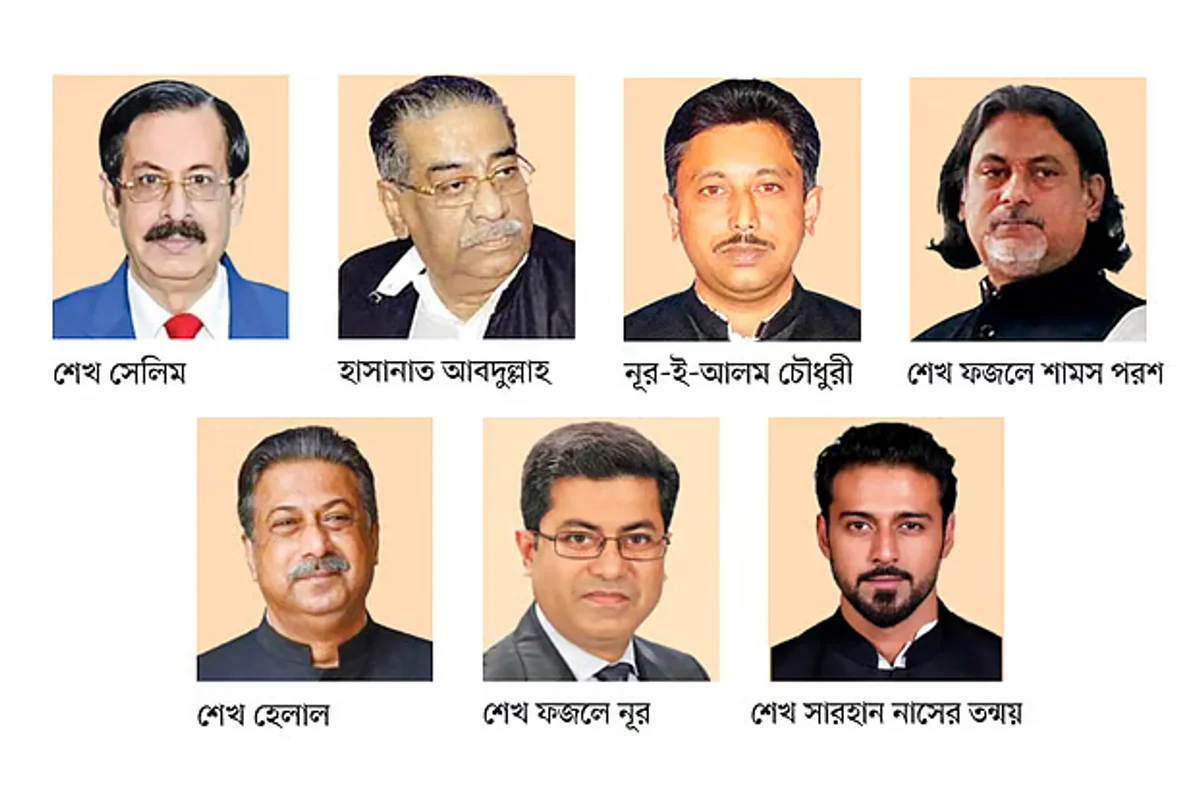
In the controversial 2024 election, Sheikh Hasina and eight of her relatives became MPs. Among her relatives were her cousins Sheikh Fazlul Karim Selim and Abul Hasanat Abdullah, cousins Sheikh Helal Uddin and Sheikh Salahuddin Jewel, Helal’s son Sheikh Tanmoy, and cousins’ sons Nur-e-Alam Chowdhury and Mujibur Rahman Chowdhury (Nixon Chowdhury). Another cousin, Abul Khair Abdullah, was mayor of Barishal City Corporation. Sheikh Fazle Shams Parosh, son of a cousin, was Jubo League chairman. Other relatives held key posts in the Awami League and its bodies.
Awami League presidium member and MP Sheikh Fazlul Karim Selim was in the country during the movement and in hiding after the fall; according to sources, he went to India in September 2024 and is now in Kolkata. His son and Jubo League joint general secretary Sheikh Fazle Naeem has also gone to Kolkata, keeping regular contact with Jubo League activists at home, several leaders say. Another son, Sheikh Fazle Fahim, a former FBCCI president, left the country before Sheikh Hasina’s fall, Awami League leaders say.
Jubo League chairman Sheikh Fazle Shams Parosh, eldest son of the late Sheikh Fazlul Haque Moni, had come home from Canada the week before the fall and spoke at various programmes to resist the uprising. He was in Dhaka on the day of the fall; a source said Parosh later went to Canada via India and has since returned to India. Sheikh Fazlur Rahman Maruf, another cousin, was not so prominent in politics and is now said to be in Singapore.
Abul Hasanat Abdullah, a cousin, was quite influential and went to India before the government’s fall, sources say. He often visited the Ajmer Sharif shrine in Rajasthan, where one of his daughters lives; she has married an Indian citizen. He is reported to have a restaurant and other assets in India, and his son Ashiq Abdullah went to India with him. His eldest son Sadik Abdullah, former mayor of Barishal City Corporation — the father was Barishal district Awami League president and the son the city unit’s general secretary, and together they controlled the region’s politics — was active in Barishal in suppressing the movement; he is thought to have left for the United States via India, sources say, and holds US citizenship. After the fall, an angry crowd set fire to Sadik Abdullah’s house in Barishal.
Sheikh Hasina’s two influential cousins Sheikh Helal Uddin and Sheikh Salahuddin Jewel were in the country during the movement and later went to India, with reports that they are living in an expensive residential complex in Kolkata’s New Town. Helal’s son Sheikh Tanmoy is also in India. With Sheikh Salahuddin Jewel is his wife Shahana Yasmin Shampa, who Awami League leaders say was often seen beside Sheikh Hasina at Ganabhaban. Helal’s brother Sheikh Sohel, a former cricket board director who controlled development tenders in Khulna, is in hiding, though Awami League leaders could not confirm where. Nur-e-Alam Chowdhury (Liton Chowdhury), son of a cousin, was chief whip of parliament; his brother Nixon Chowdhury was a Jubo League leader and independent MP. Both went into hiding after the fall and are reported to be in India.
Awami League sources say many of Sheikh Hasina’s relatives crossed into India through the Satkhira border, and some through the Sylhet and Mymensingh borders, managing to leave through political influence, administrative contacts and large sums of money, the sources claim. While her relatives left the country safely, large numbers of party leaders and activists could not — a source of resentment among many ordinary party workers.
After the fall of Sheikh Hasina’s government on 5 August 2024, large numbers of Awami League former ministers, state ministers, deputy ministers, MPs and central leaders were arrested across the country — about three dozen former ministers and state ministers and more than 50 former MPs. Of them, Engineer Mosharraf Hossain and Dabirul Islam died after being freed on bail; former water resources minister Ramesh Chandra Sen died in Dinajpur district jail and former industries minister Nurul Majid Mahmud Humayun while under treatment at Dhaka Medical College Hospital. Awami League presidium member Matia Chowdhury also died after the government’s fall.
Central leaders currently in jail include Kazi Zafarullah, Md Abdur Razzaq, Faruk Khan, Shajahan Khan, Kamrul Islam, Dipu Moni, Ahmad Hossain and Abdus Sobhan Golap. Sheikh Hasina’s adviser Salman F Rahman, former law minister Anisul Huq and former state minister Junaid Ahmed Palak are also in jail.
Political writer and researcher Mohiuddin Ahmed said Sheikh Hasina’s two favourite things were power and favouring her kin: she made the utmost effort to cling to power and, having failed, helped her kin flee to safety. The Awami League’s more than 15 years of rule had become family rule, he said, in which relatives, some businesspeople and office-holders enjoyed the greatest benefits, while ordinary workers and supporters were used as cannon fodder — and this could be repeated in future.
বাংলায় মূল প্রতিবেদন পড়ুন · Read the original Bengali report