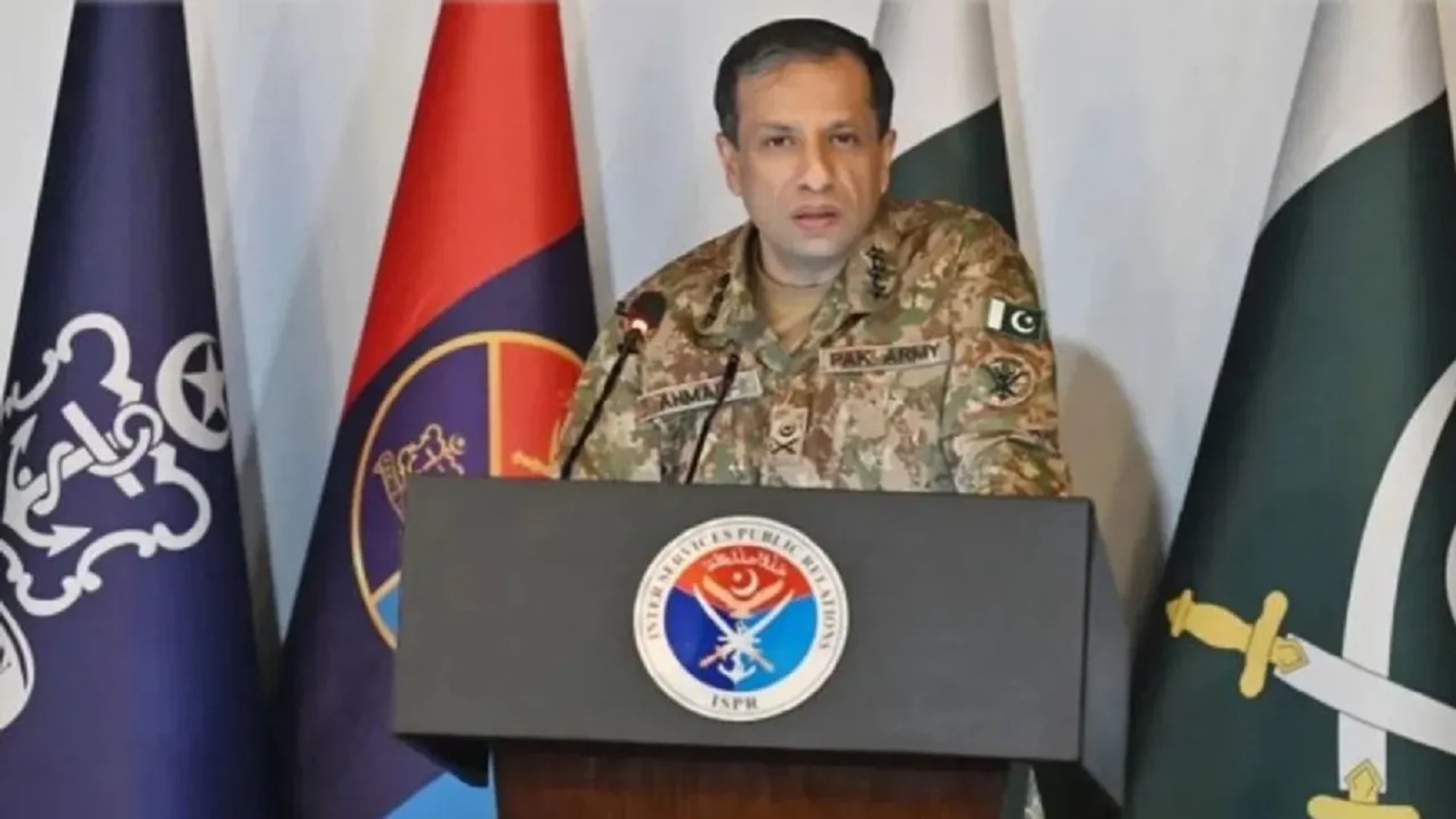
ISLAMABAD — The director general of the Pakistan army’s media wing, Lt. Gen. Ahmed Sharif Chaudhry, called India the “biggest terrorist” and said no one believed New Delhi’s claims, according to a report by the newspaper Dawn on Thursday.
“You are the biggest terrorists,” Chaudhry said of India. “No one listens to you, no one believes you.”
Chaudhry, who heads the Inter-Services Public Relations directorate, known as ISPR, made the comments at a news conference marking the one-year anniversary of what Pakistan calls “Marka-e-Haq,” or the “Battle of Truth,” Dawn reported Thursday, May 7. He was joined by Pakistan navy’s Deputy Chief of Naval Staff (Operations) Rear Adm. Shafaat Ali and the air force’s Deputy Chief of Air Staff (Projects) Air Vice Marshal Tariq Ghazi.
Pakistan refers to the period of military tensions with India that began with the Pahalgam attack on April 22 last year, its own “Operation Bunyan um Marsoos,” and the May 10 ceasefire as “Marka-e-Haq.”
Chaudhry opened the news conference by congratulating Pakistanis on the anniversary. He said Pakistan’s armed forces had met the people’s expectations and defeated the enemy through a multidimensional military operation.
“Today we will not talk much about what happened,” Chaudhry said. “Instead, we will talk more about the period from May 2025 to May 2026.”
He said the “strategic consequences” of the conflict would be laid out.
Chaudhry said “Marka-e-Haq” had produced 10 strategic consequences. The first, he said, was that the Indian narrative presenting Pakistan as a source of terrorism had been “buried.” Pakistan had been linked to terrorism in India without any evidence, he said, and even a year after the Pahalgam incident, the questions raised by Pakistan had not been answered.
“Where is the evidence” of Pakistan’s involvement in the Pahalgam attack, Chaudhry asked. “No one believes this. You are the biggest terrorists. No one listens to them, no one believes them.”
The second strategic consequence, he said, was Pakistan’s establishment as the “main force of security stability” in the region. “The biggest security envoy in this region is Pakistan and Pakistan’s current leadership,” he said.
On the third strategic consequence, Chaudhry criticized India’s military and political leadership, accusing it of “the politicization of Indian military leadership and the militarization of political leadership.” India’s military had previously been professional, he said, but had now unfortunately been politicized.
The ISPR chief said the statements of Indian politicians suggested they were “warmongers.” The politicization of the military and the militarization of politics were “dangerous,” he said.
Chaudhry said India’s internal problems included the repression of minorities and Kashmiris, which he said came from “a kind of misguided sense of superiority and arrogance.” India did not want to resolve its own internal problems, he said, and instead accused Pakistan of involvement in terrorism in India.
On Kashmir, Chaudhry said: “Kashmir is an internationally recognized disputed region. It is not India’s internal matter that the demographic picture there can be changed.” He repeated the accusation that India was supporting terrorism in Pakistan and said terrorist acts inside India were also blamed on others.
After “Marka-e-Haq,” he said, the world had come to understand India’s hypocritical conduct. As a fifth strategic consequence, he said, “the true face of the Indian media and the failure of their information warfare” had been exposed.
Chaudhry also presented statistics on counterterrorism operations. Terrorist attacks in Pakistan had increased after “Marka-e-Haq,” he said, and in October Pakistan struck terrorist infrastructure in neighboring Afghanistan. The number of incidents had since fallen, he said.
India had a role in terrorism in Pakistan and was using Afghanistan as a base, Chaudhry said. “After being taught a lesson in Marka-e-Haq, did you see who India called? The so-called foreign minister of the Afghan Taliban government.”
বাংলায় মূল প্রতিবেদন পড়ুন · Read the original Bengali report